
Earth’s orbit is getting crowded, and now, satellite and spacecraft operators have a new tool to track small debris. Researchers at the University of Michigan have made a breakthrough. They can spot space debris as small as a millimeter in diameter, which is about the size of a pencil lead.
This is key because our orbit is filling up with a lot of small pieces. These pieces break into even smaller, hard-to-spot parts. Tracking these tiny objects is crucial for satellites and spacecraft to avoid dangerous collisions.
At speeds of 22,000 miles per hour, even a small piece of debris can cause big damage. As more debris fills Earth’s orbit, the risk to satellites grows. It’s important for the space industry and scientists to find ways to deal with this problem.
Key Takeaways
- New detection method can identify space debris smaller than 1 millimeter in diameter.
- Earth’s orbit is increasingly cluttered with over 170 million pieces of space junk.
- Even tiny debris can cause catastrophic collisions at orbital speeds up to 22,000 mph.
- Continuous growth in orbital clutter poses serious risks to satellite infrastructure.
- Innovative approaches are needed to track and mitigate the space debris crisis.
Introduction to Space Debris
Space debris, often called « space junk, » is a big worry for space activities. It includes old satellites, broken spacecraft, and other trash floating in space, especially in the low Earth orbit (LEO). This trash is making space more dangerous for working satellites and spacecraft.
Definition and Sources of Space Debris
Space debris is a mix of big rocket parts and tiny paint flecks. It comes from things like launching satellites, working on spacecraft, and when objects break apart. A plan was made for 1996-1998 to study space debris, model its environment, and find ways to reduce it.
Hazards and Risks Posed by Orbital Clutter
Space debris is a big risk to working satellites and spacecraft. Even a tiny piece can hit another object at 22,000 miles per hour, causing a lot of damage. Small pieces can also be a danger to astronauts and spacecraft, making managing space debris very important.
| Statistic | Value |
|---|---|
| Currently Tracked Space Debris Objects | Approximately 25,000 |
| Estimated Total Number of Space Debris Objects | Millions |
| First Satellite Breakup Incident | June 29, 1961 (over 200 cataloged fragments) |
| Increase in Debris-Related Events (late 2000s) | Chinese FY-1C ASAT test (2007 – over 3,500 trackable pieces) |
| Iridium 33 and Cosmos 2251 Collision | 2009 (over 2,300 pieces of debris) |
The Inter-Agency Space Debris Coordination Committee (IADC), started in 1993, leads the world in fighting space debris. It brings together top space agencies to tackle this big problem.
« Even a small piece of debris, the size of a plum, can collide with an object at a staggering speed of 22,000 miles per hour, potentially causing extensive damage or disabling the target. »
Current Methods for Detecting Space Debris
Space debris is a big problem in Earth’s orbit. It’s made up of old or broken man-made objects. These objects can harm operational satellites and spacecraft. To deal with this, scientists have come up with ways to find and track these objects.
Mostly, they use radar and optical tracking for this job. These methods help us spot and follow these dangerous items.
Limitations of Radar and Optical Tracking
Radar and optical tracking are key in fighting space debris, but they have limits. It’s hard to find small pieces of debris with these methods. Only objects bigger than a softball can be tracked, which is a tiny part of the millions of pieces out there.
This means most small, dangerous objects can’t be seen. They still risk damaging satellites and spacecraft.
Also, space debris moves really fast, about 22,000 miles per hour. Even small pieces can hit hard and cause big damage.
| Space Debris Detection Method | Limitations |
|---|---|
| Radar Tracking | Can’t find objects smaller than 10-30 cm in Low Earth Orbit and 1 m in Geostationary Orbit |
| Optical Tracking | Can only see objects bigger than 15 cm in the Geostationary Orbit |
We need new ways to find and watch space debris because the old methods aren’t enough. Scientists are looking into new ideas, like electric field analysis and satellite star trackers. These could help us better understand and deal with space debris risks.
Innovative Approach: Electric Field Analysis
Researchers at the University of Michigan are tackling the issue of space debris with a new method: electric field analysis. This method uses the energy from lightning-like bursts when debris collides and breaks apart.
Lightning-Like Energy Bursts from Colliding Debris
When small objects in space crash, they often break into tiny pieces. Some of these pieces vaporize into a charged gas, creating brief energy bursts. These bursts are like the static sparks we feel on Earth. They can help us detect and track debris and the tiny pieces it creates.
Detecting Charged Gas Clouds and Debris Fragments
Charged debris also sends out electric field signals, making more lightning-like bursts. By watching these signals, scientists can learn about the debris’s size, where it is, and how it moves. This new way of tracking could change how we deal with space debris, making it easier to manage.
| Key Statistic | Value |
|---|---|
| Current Estimates of Debris Objects in Orbit | Millions |
| Typical Debris Object Velocity | Over 28,000 km/h |
| Threat to Operational Spacecraft | Catastrophic Damage upon Impact |
| Kessler Syndrome Impact | Increased Mission Costs, Restricted Satellite Deployment |
« This innovative approach could revolutionize our ability to track the ever-increasing challenge of orbital clutter, ultimately enhancing space situational awareness and enabling more effective debris mitigation strategies. »
Space Debris Field Analysis
Understanding the space debris field is key to managing risks and finding solutions. Researchers use simulations, experiments, and data to study space debris. They look at what it’s made of, how it moves, and how it behaves. This includes looking at debris clouds and the difference between hard and soft objects.
Recently, the number of accidental ‘fragmentation’ events in space has gone up. On average, there are 12 such events each year over the past 20 years. Also, not many objects follow rules about disposing of debris after use. Only 5% to 20% of objects launched into low-Earth orbit follow these rules in the last decade.
More small satellites and constellations are being launched, making space busier. This makes it more important to follow rules about debris. It’s thought that about 170 million pieces of debris are in Earth’s orbit. Most of these are too small to track well.
| Debris Mitigation Measure | Compliance Rate |
|---|---|
| Rockets aiming to clear low-Earth orbit | Over 80% in the last decade, up from just 20% at the beginning of the millennium |
| Rockets adhering to debris mitigation measures in terms of mass | Between 60% and 80% in the last decade |
| Satellites in geostationary orbit attempting to comply at the end of their operational life | Between 85% and 100% this decade |
| Small payloads naturally adhering to debris mitigation measures due to low altitude | Around 88% in the last 10 years |
The challenges in space debris field analysis show we need to keep working on orbital clutter modeling. We also need good strategies to use space safely for a long time.
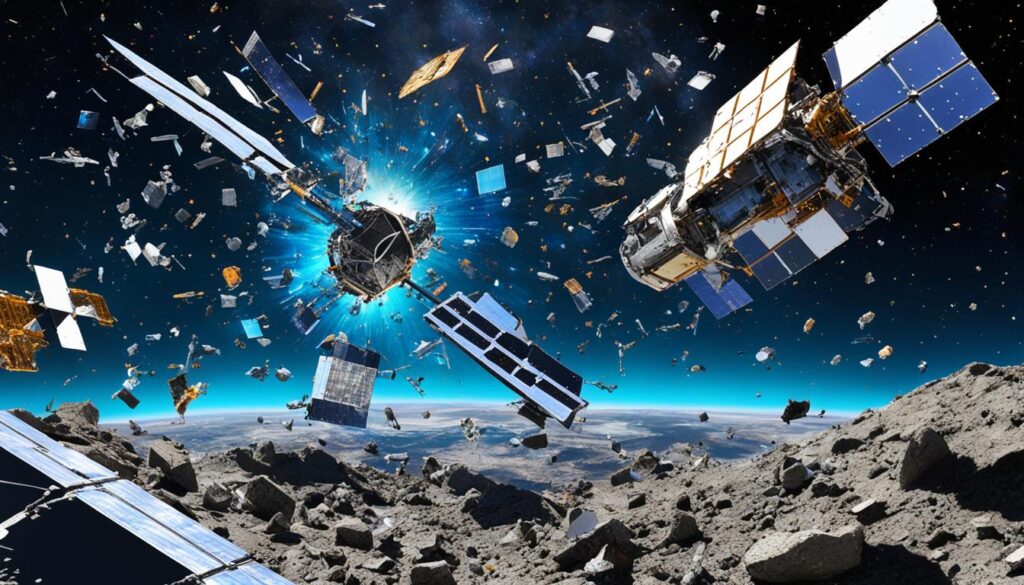
Hypervelocity Experiments and Simulations
Researchers are doing hypervelocity experiments at places like the Naval Research Laboratory and NASA’s Ames Research Center. They launch different types of debris collision simulations at targets moving at orbital speeds. This helps them measure the electric emissions during impacts.
They use these experiments and computer simulations to learn about the electrical signals from debris collisions. This info is key for making better detection and tracking methods. These are important for dealing with the growing problem of space clutter.
Space debris can hit at speeds up to 15 km/s, and meteoroids can go as fast as 72 km/s. In these hypervelocity impacts, the speed often breaks the sound barrier in the target. This can cause the projectile to break apart and melt if it goes faster than 4 km/s.
« Hypervelocity collisions research focuses on understanding fragmentation, size distribution, delta-V, and changes in directionality as a result of the collision geometry and energy. »
These experiments and simulations help us understand debris collisions better. They also guide the creation of new ways to protect spacecraft. Researchers are looking into things like Whipple shields with aluminum and Nextel–Kevlar layers to make space assets more resilient.
The team’s work in combining new experimental data with advanced simulations is making big strides in space debris research. By studying hypervelocity impacts, they’re finding better ways to protect the space environment. This helps ensure the success of space exploration and use.
Assessing Debris Composition and Characteristics
Understanding space debris is key to predicting its path and impact on spacecraft. Researchers aim to know if debris is « hard » or « soft » to understand its orbit and danger level. Hypervelocity experiments and electric field analysis help reveal what the debris is made of and how it behaves.
Distinguishing Hard and Soft Debris Objects
Space debris falls into two main types: hard and soft. Hard debris includes rocket stages, inactive satellites, and big pieces from collisions. These are usually metal and can cause a lot of damage. Soft debris, like insulation and paint flakes, is less harmful but there’s a lot of it.
- The number of trackable space debris has grown by more than half in 25 years.
- By February 2020, there were about 34,000 big debris pieces in orbit, and nearly a million smaller ones.
- Only about 10% of dangerous debris is being tracked.
Knowing the difference between hard and soft debris helps in assessing risks and finding ways to deal with them. This knowledge helps space agencies and satellite operators tackle the issue of space debris composition and hard and soft debris objects better.
« A sustainable risk level of less than 10^(-3) is achievable with high compliance of over 98% to the 25-year postmission deorbitingGuideline. »
Implications for Space Traffic Management
Tracking space debris is key for managing space traffic. New tech helps spot and track debris, helping satellites avoid collisions. This is especially important in low Earth orbit where risks are high.
With more satellites launching, keeping track of them is crucial. In 2019, a European satellite had to move to avoid another one because of a missed warning. Last year, a test by Russia created over 1,500 pieces of debris, making the problem worse.
The US has made a big move to improve space traffic management. In 2022, they promised not to test anti-satellite weapons that could create debris. They want to use their tech to help set global standards for space safety, working with other countries.
| Metric | Value |
|---|---|
| Active satellites currently orbiting Earth | Over 4,800 |
| Projected satellites by 2030 | Nearly 25,000 |
| Probability of collision for a satellite at GEO | About 1 in 20,000 per year |
| Probability of collision for a satellite at 75° East longitude | About 1 in 2,000 per year |
The number of satellites is growing fast, which means we need a strong system to manage space traffic. Groups like the Inter-Agency Space Debris Coordination Committee are working on rules to reduce debris. But, we need more international cooperation and government support to make it work.
As space tech gets better, we’ll need new ways to manage space traffic. By improving how we detect and track debris, satellite operators can avoid collisions. This helps protect their satellites and the space around us.
Challenges and Future Developments
The global space industry is growing fast. This means we need to find better ways to detect and track space debris. The electric field analysis method is a new solution, but it faces big challenges.
Signal Frequency Variations
One big challenge is the changing frequency of electrical signals from colliding debris. These signals change with the speed of the collision and the debris type. This makes it hard to detect them, as we need smart algorithms to recognize and understand the signals.
Atmospheric Interference
Also, the signals must be strong enough to be picked up by ground stations and get through Earth’s atmosphere without getting lost. The team is tackling this by doing more simulations, experiments, and analyzing data. They aim to improve detection methods and beat the atmospheric effects that make space debris detection challenges harder.
As we learn more about signal frequency and atmospheric effects, we’re getting closer to better ways to watch and manage space debris.
| Challenge | Potential Solution |
|---|---|
| Varying signal frequency | Develop robust algorithms to interpret fluctuating signals |
| Atmospheric interference | Refine detection methods to overcome atmospheric effects |
« The research team is working to address these issues through further simulations, experiments, and data analysis to refine the detection methods. »
Collaboration and Data Sharing
Dealing with space debris needs a team effort from space agencies, research centers, and private firms. The University of Michigan is part of a big project funded by the Intelligence Advanced Research Projects Activity. This project includes partners like Blue Halo and the University of Alaska Fairbanks. Sharing data and working together is key to improving how we track and deal with space debris.
The problem of space debris is a worldwide concern. As of January 2021, the US Space Surveillance Network tracked about 28,200 objects bigger than ten centimeters in space. There are also millions of smaller objects, from tiny pieces to objects the size of a basketball.
More satellites are going into Low-Earth Orbit (LEO), thanks to microsatellites. In 2020, there was almost three times more traffic to LEO than before. This growth means more space debris, which can harm satellites and communication systems we rely on every day.
| Metric | Value |
|---|---|
| Estimated objects larger than 10cm in Earth’s orbit | 28,200 |
| Estimated objects between 1-10cm in Earth’s orbit | 900,000 |
| Estimated objects between 1mm-1cm in Earth’s orbit | 128 million |
| Estimated objects smaller than 1mm in Earth’s orbit | Countless |
| Increase in payload traffic to LEO in 2020 | Nearly triple compared to previous years |
There’s no strong Space Traffic Management (STM) system in LEO, which raises the risk of collisions. To fix this, we need to reduce debris by following rules for space missions. New technologies are also being developed to remove debris from space.
Working together is crucial for solving the space debris problem. By sharing data and expertise, the space community can find better ways to track and remove debris. This will help keep our space safe for future use.
Orbital Debris Mitigation Strategies
The space industry is growing fast, with launch rates 10 times higher than before. This means we need strong space debris mitigation strategies more than ever. Even though we’re not following old rules well, new ideas are coming to help us.
Sustainable Satellite Operations
One way to fight debris is through sustainable satellite operations. We’re making satellites that can easily come back to Earth at the end of their life. The European Space Agency (ESA) has made a big change, cutting the time satellites stay in low-Earth orbits from 25 years to 5 years. This shows how important it is to quickly remove satellites from space.
Active Debris Removal Techniques
We’re also looking at active debris removal techniques to take out big pieces of debris. Ideas like robotic systems could help clean up space. With more alerts about potential collisions, these methods are key to keeping space safe for the future.
Groups are working together, like the Zero Debris Charter with over 40 space sector players. These efforts aim to share knowledge and work together to solve the space debris problem.
| Strategy | Description | Impact |
|---|---|---|
| Sustainable Satellite Operations | Designing satellites for easy deorbiting and implementing robust end-of-life procedures | Reduces the amount of debris left in orbit, contributing to the long-term sustainability of the space environment |
| Active Debris Removal | Innovative solutions, such as robotic capture systems, to actively remove larger pieces of debris from orbit | Helps to address the growing threat posed by the increasing amount of space clutter, mitigating the risk of collisions and further debris generation |
| Collaborative Efforts | Initiatives like the Zero Debris Charter involving multiple space sector actors | Promotes a shared understanding and coordinated approach to the space debris challenge, fostering international cooperation and collective action |
By using space debris mitigation strategies like sustainable satellites, active removal, and teamwork, we can make space safe for the future. These efforts help keep the space environment clean and safe for everyone.
International Cooperation and Regulations
The problem of international space debris regulations is a big deal worldwide. It impacts every country that goes to space and the space around us. Right now, there are no strict rules for satellites in space, causing confusion and no one to answer for actions. We need strong international rules and plans to manage space debris for a sustainable future of space governance.
Working together, countries, space agencies, and companies must create good rules and guidelines. NASA has found over 250 times when satellites broke apart in space, often because of things like battery failures or engine issues. This shows we really need to work together.
In 2021, 18 countries that control space found a Chinese satellite hit a piece of debris from a Russian launch. This was the fifth time two known objects in space collided. It shows that countries have different ways of looking at risks and making decisions, making it hard to create a global system to handle space collisions.
Working together to stop satellites from hitting each other is hard because sharing data and planning is slow. The European Union has a system to help avoid collisions that anyone can use, showing we can work together. But, we need to do more to agree on safety rules and how to look at risks.
« The lack of alignment between China and the United States on assessing collision risks between their satellites highlights disparities in risk tolerances and analytical methodologies, and underlines that global agreement on safety standards in space is not always achieved. »
The International Standards Organization (ISO) is trying to make safety rules for space, especially about space debris. But, we need more strict rules to make sure space is safe for everyone.
Impact on Space Exploration and Utilization
The growing problem of space debris is a big challenge for space exploration and use. More satellites and space infrastructure mean more risks of collisions with debris. Losing these assets can disrupt services like GPS, weather monitoring, and global communications we all depend on.
Space debris also slows down new space projects, like commercial space stations and trips to other planets. Navigating through debris requires constant checks and avoiding obstacles, making space missions more complex and expensive. This slows down space exploration and limits new discoveries.
To keep space operations going long-term, we must tackle the space debris issue. Using methods like removing debris and designing satellites to be safely disposed of can protect the space around us. This will help us fully explore and use space.
| Metric | Value |
|---|---|
| Tracked space debris objects | Approximately 30,000 |
| Predicted additional satellites by 2031 | 25,000 |
| Starlink satellites maneuvered to avoid collisions | Over 1,000 times |
| Largest contributors to space debris | Russia, the U.S., and China |
Space debris greatly affects space exploration and use. By finding new solutions and working together, we can keep space safe for the future. This will let us fully explore and use space for the good of all humans.
Future of Space Situational Awareness
With more satellites and spacecraft in orbit, keeping track of them all is key for safe space use. New ways to spot and track space debris, like electric field analysis, are crucial. They help us understand space better and the dangers of space junk.
Recently, a Chinese spacecraft was spotted in orbit by LeoLabs, showing how important it is to watch the skies. Current tracking methods work well but have limits. They can only see up to 2,000 km away and are affected by weather and resolution issues.
To overcome these issues, space agencies and companies are investing in better tracking systems. For example, Japan’s JAXA is creating a new radar that can see smaller objects below 650 km. This will help avoid collisions and make decisions easier for space users.
The need for good tracking data is growing with more satellites and missions. Private companies are playing a big role by offering new services and making things more accessible. The market for space tracking is expected to grow a lot, from $82 million in 2022 to about $1.4 billion in ten years.
The future of tracking space will depend on using new technologies, sharing data, and working together. By understanding space better and the dangers it poses, we can keep space safe and open for exploration and use.
| Metric | Value |
|---|---|
| Objects Orbiting Earth (CSpOC catalog) | Almost 20,000 |
| Low Orbit Debris (below 2,000 km) | 70% of observable space debris |
| JAXA’s Current Radar Observation Capability | Objects at least 1.6 meters in diameter at 650 km altitude |
| JAXA’s New Radar Observation Capability | Softball-size objects (10-cm diameter) at altitudes below 650 km |
| JAXA’s Radar Range | Up to 1,350 kilometers for objects at least 5.5 meters in diameter |
| JAXA’s Current Radar Coverage | Observes about 5% of the softball size (10-cm diameter class) objects in the CSpOC catalog |
The space industry is changing, making space situational awareness, space debris tracking, and safe space operations more important. New detection tech, data sharing, and teamwork will keep space safe and open for the future.
Conclusion
The issue of space debris is complex and needs a global effort. It threatens the future of space use. New methods like the electric field analysis from the University of Michigan could help. These methods can spot small pieces of debris that are hard to see now.
With more objects in space, we need better ways to know what’s up there and how to remove debris. Working together, sharing data, and international cooperation are key. They will help us handle this big problem and make space use safe and sustainable.
The space industry is at a critical point with the growing space debris challenges. Solving these problems is crucial for the future of space. It will help us use space to its full potential and keep exploring the universe.