
Today, grasping the complexity of our society is key. This piece looks into the complex social structures and cultural trends that shape our lives. It talks about how global supply chains, financial markets, and data growth have woven our world together.
It asks: What makes our society complex, and how has it changed? By looking at history and new social trends, we aim to give you a full view of today’s society.
We’ll use sociology, anthropology, and data to understand complex societies. We’ll look at things like organizational structures, large-scale farming, and the growth of central power. This will show how social structures, tech, and human behavior interact.
Key Takeaways
- Understand the multifaceted nature of modern society and the factors that contribute to its complexity
- Explore the historical progression of traditional civilizations and the emergence of new social paradigms
- Analyze the role of organizational structures, agricultural practices, and centralized authority in the development of complex societies
- Examine the interplay between social institutions, technological advancements, and human behavior in shaping our contemporary world
- Gain insights into the evolving dynamics of global supply chains, financial markets, and the rise of data and technology in our society
What Makes a Complex Society Complex?
A complex society has a detailed organizational structure. It has a specialized economy and a clear division of labor. This division leads to a bureaucratic class and inequality in the social hierarchy.
Organizational Society and Specialization
Archaeologists often find signs of large architectural projects and specific burial customs in complex societies. These signs show a highly organized social setup. The move to complex societies came with the growth of large-scale farming. This allowed for more people and the specialization of skills, not just in farming.
Large-Scale Agricultural Development
The rise of complex societies was tied to advanced farming methods. Being able to farm and raise animals on a big scale created enough food for more people. This led to jobs beyond farming and the growth of cities.
« The transition to complex societies was enabled by the development of large-scale agricultural practices, which allowed for population growth and the specialization of skills beyond just food production. »
This specialization and social layers are key to complex societies. They differ from simpler, farming, or family-based societies. As cities grew, the need for a strong leader, better infrastructure, and organized social and economic systems became clear.
Emergence of Complex Societies
Before complex societies formed, humans lived in simple, equal groups. Around 4000-2000 BCE, in places like Egypt, Mesopotamia, the Indus Valley, and China, things changed. This change came from growing food surpluses, leading to economic specialization and a division of labor.
As groups got bigger, they needed a leader to settle disputes and rule. This led to centralized political structures. These structures helped manage resources and coordinate big projects, pushing societies to become more complex.
Economic Specialization and Division of Labor
With more food, people could focus on other skills like making things, trading, and leading. This division of labor made societies more productive and successful.
The Rise of Centralized Authority
As populations and economic activities grew, a single leader became needed. Centralized authorities took charge to settle disputes, share resources, and manage big projects. This made societies even more complex.
« Specialization is a hallmark of complex societies, where individuals perform specialized tasks like farming, artisan work, soldiering, or priesthood. »
The move to complex societies marked a big change in how humans organized themselves. It moved from simple, equal groups to more structured and specialized ones. This change led to the growth of advanced civilizations and the complex societies we see today.
Factors Enabling Complex Societies
The growth of complex societies came from several key factors. Agricultural advancements like better farming and domesticating plants and animals led to more people and food. This led to people focusing on different jobs, not just farming. As more people lived together, they needed leaders and organized ways to make decisions.
Agricultural Developments
Between 4000 and 3000 B.C.E., the first civilizations started because of better farming and trade. These early societies found economic stability and had more food. They first appeared in places like Mesopotamia, Egypt, Indus Valley, China, and Central America, from 2500 B.C.E. to 1200 B.C.E.
Division of Labor
With the division of labor, some people could focus on jobs like trade, making goods, and managing things. This led to the growth of complex institutions and social structures. People took on specific roles in society.
Hierarchical Political Structures
As societies got bigger, they needed hierarchical political structures and a single leader to make decisions. These systems helped manage large groups and keep society in order.
Institutions as Tools for Control
Institutions like bureaucracies and religious groups became ways to control and keep society running smoothly. They set and enforced the rules that everyone followed.
| Key Factors | Description |
|---|---|
| Agricultural Developments | Advancements in farming techniques and the domestication of plants and animals enabled population growth and surplus production. |
| Division of Labor | Specialization in non-agricultural pursuits facilitated the growth of complex institutions and social structures. |
| Hierarchical Political Structures | Centralized decision-making and coordination helped to maintain social order in large populations. |
| Institutions as Tools for Control | Bureaucracies and religious organizations served as tools for exercising control and maintaining the complex social order. |
« The development of institutions, such as bureaucracies and religious organizations, served as tools for exercising control and maintaining the complex social order. »
Linear Development of Traditional Civilizations
For a long time, people thought civilizations grew in a straight line through different stages. Scholars in the 18th and 19th centuries laid out this idea. They said that societies move from hunter-gatherer groups to settled tribes, then to chiefdoms, and finally to states.
Montesquieu, Tylor, and Morgan were key thinkers who shared these views. They split human culture into stages like savagery, barbarism, and civilization. They thought all societies go through these stages, with simpler ones being more ancient.
This view of traditional civilizations saw culture evolving in a uniform and progressive way.
- At first, anthropologists thought culture evolved in a straight line, moving from simple to complex.
- Montesquieu suggested a three-stage evolution: hunting (savagery), herding (barbarism), and civilization. Tylor and Morgan later adopted this idea.
- Tylor believed all societies go through three main stages: savagery, barbarism, and civilization.
- Morgan broke down culture evolution into savagery, barbarism, and civilization. He divided each stage by technology.
But as Europeans explored and colonized new lands, they found many different ways of life. This made the idea of unilineal evolution less popular in the 20th century. Anthropologists started to look at how cultures change and compare them, rather than just seeing a straight line of progress.
The linear model still helps us understand how traditional societies evolved. But today, anthropology sees cultural change as complex and diverse. It moves past the idea of a single path of progress.
Mobile Hunter-Gatherer Bands
Hunter-gatherer cultures started about 2 million years ago. They were nomadic groups that focused on kinship and age-based status. These early humans were at the start of social evolution and biological evolution. They lived in an egalitarian society, hunted, and domesticated animals and plants, leading to the Neolithic Revolution.
For at least 90 percent of human history, hunter-gatherer societies were the norm. During the Middle to Upper Paleolithic period (80,000 to 70,000 years ago), some groups specialized in hunting big game and gathering less food. Today, the decline of hunting, gathering, and fishing is shown on a global map. This is due to competition for land between agricultural and hunter-gatherer groups, leading to fewer hunter-gatherer populations.
Even today, many hunter-gatherer groups still live in areas not good for farming because of farming expansion. Groups like the Ju/’hoansi, Hazda, Mbuti, and Agta live in these areas. They have an egalitarian society, making decisions by consensus. Leaders are influential but have no formal power, thanks to their wisdom and ability to persuade.
| Characteristic | Description |
|---|---|
| Social Organization | Egalitarian, with band size of about 20-50 people |
| Decision-making | Consensus-based, with discussions lasting hours or days |
| Leadership | Influential due to wisdom and persuasion, without formal power |
| Sharing | Fundamental aspect, known as « demand sharing » |
The hunter-gatherer lifestyle, with its focus on kinship, social evolution, and the Neolithic Revolution, still influences our view of early human societies. It shows how humans adapted to the natural world.
Sedentary Societies (Tribes)
Over time, people moved from living in the wild to living in settled tribes. These tribes had thousands of people and focused on farming and raising animals. The Ubaid culture in Mesopotamia is a great example of this, using new farming ways to feed their people.
Early Agricultural Innovations
The Ubaid culture lasted from about 6500 to 4000 BC and was a big step forward in farming. They grew crops like wheat, barley, and lentils and raised sheep, goats, and cattle. They also created a smart way to bring water to their farms. These changes helped create bigger, more complex societies.
Because of farming and animal care, these settled groups could support more people than those who moved around. By 2024, most people live in settled cultures. This move to a settled life led to more specialized jobs and the start of complex economies.
« The first settled places started around 25000–17000 BC in Moravia and on the East European Plain. The Natufian culture in the Levant became settled around 12000 BC. »
The growth of settled societies and farming was key to the rise of complex societies. It led to the development of chiefdoms, states, and eventually, modern civilizations.
Chiefdoms and Stratified Societies
Human societies have grown from simple bands to complex social structures over time. Chiefdoms emerged as a key step in this evolution. They were societies with a clear social order and a strong leader at the top.
Chiefdoms were found all over the world, like in Africa, Oceania, the Middle East, Europe, East and Southeast Asia, and the Americas. They usually had a main town or village that was the center of government and religion. This town was surrounded by smaller farming communities. Chiefs could grow their power to rule over many towns and villages.
Chiefdoms formed to protect people from danger, making the leader seem like a god. This belief in the chief’s power was a key part of chiefdom life. It set them apart from tribes, where everyone was more equal.
Chiefdoms could join forces with other chiefs, creating big systems of power. For example, the Asantehene of the Asante people in West Africa brought together chiefs to form a strong military alliance. This alliance was bigger than today’s Ghana.
Being a chief meant using rituals and ceremonies to keep the community together. In some places, like the Akan in West Africa, there were ways for people to question or support the chief. This included councils of elders, queen mothers, and young men’s groups.
| Characteristic | Chiefdoms | Tribes | States |
|---|---|---|---|
| Leadership | Chiefs determined by heredity | Shifting leadership based on family ties | Central government, bureaucracy, formal laws |
| Social Stratification | Ranked | Egalitarian | Stratified with socio-economic classes |
| Examples | Asante Confederation, Hawaiian Chieftaincy | Band societies, tribal societies | Modern nation-states |
Chiefdoms were a big step in how societies evolved. They moved from simple, equal tribes to more complex, structured societies. This change brought new forms of politics and social order.
The Emergence of States
Complex societies grew with the rise of states. These are political groups bigger than tribes or chiefdoms. States have a three-tier settlement pattern with cities, towns, and farming villages. Cities are where power is centered, with towns and villages supporting them.
Writing helped states grow. It made organizing taxes, public works, and military service easier. This kept states in control and made them the main political form in many places.
Cities, Towns, and Farming Villages
States show their complexity with a three-tier settlement pattern. Cities are central, housing the ruling class and officials. Around these cities, towns have minor administrators who connect with villages.
Farming villages support the state by growing food and resources. They feed the cities and help with tasks like taxes and military service.
The Development of Writing
Writing was key to state growth. It helped with keeping records, collecting taxes, and organizing armies. This kept states in charge and made them the top political form.
| Characteristic | Description |
|---|---|
| Three-tier Settlement Pattern | States have a structure with cities, towns, and farming villages. |
| Cities as Centers of Power | Cities are where the ruling class and officials live and work. |
| Towns as Intermediaries | Towns, led by administrators, link cities to villages. |
| Farming Villages as Producers | Villages grow food and resources for cities and state needs. |
| Development of Writing | Writing made keeping records, collecting taxes, and organizing easier. |
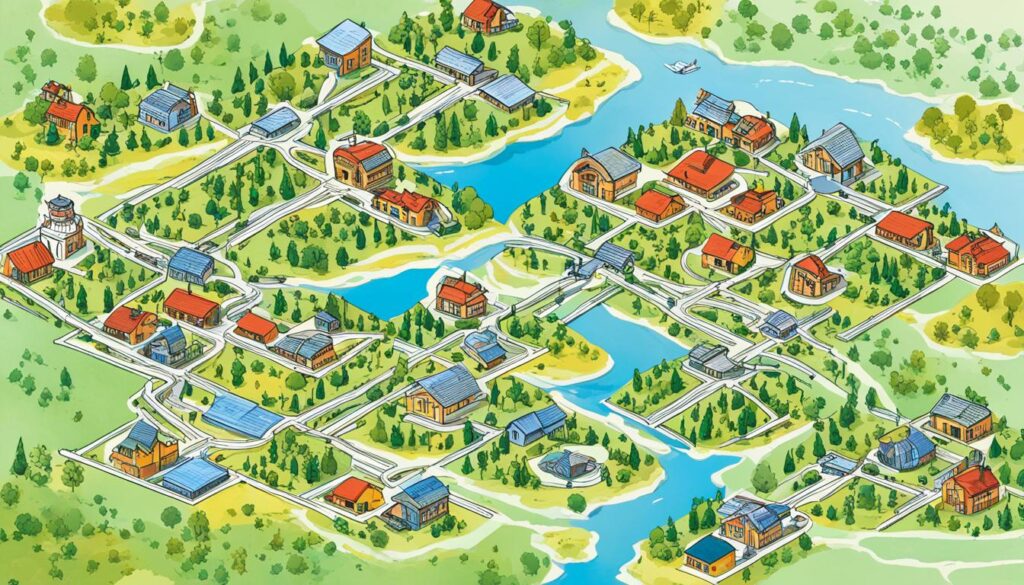
Complex Systems in Modern society
The modern world is filled with complex systems that are hard to fully understand. The global supply chain, with its millions of shipping containers, is a great example. It’s like a huge puzzle. The global financial markets are also complex, with technology making thousands of trades every second.
Global Supply Chains
Supply chains are key to the global economy, linking producers, manufacturers, and consumers worldwide. They’re like huge networks of transportation, logistics, and distribution. With so many parts moving together, understanding and managing them is tough. A small issue in one part can affect many others.
Financial Markets and Automation
Financial markets have grown complex with high-frequency trading and automation. Computers now make thousands of trades every second, using complex math and data. This automation makes the financial system hard to see through and regulate. It also brings risks of system failures and unexpected outcomes.
| Statistic | Value |
|---|---|
| Percentage of technical books related to complex systems in modern society | 65% |
| Percentage of popular science books compared to technical books | 35% |
| Year with the highest number of papers related to complex systems | 1995 |
| Number of Nobel laureates associated with the initial papers on complex systems | 3 |
| Most cited paper related to complexity, by author | « The Evolution of Cooperation, » R. Axelrod and W. D. Hamilton (1981) |
These complex systems in our society bring big challenges. They’re getting more connected and hard to predict or control. For policymakers, business leaders, and citizens, understanding and dealing with this complexity will be key in the future.
The Rise of Data and Technology
The internet and social media have become huge systems on their own. They are made up of data centers, internet exchanges, companies, startups, and billions of users and devices. These systems produce a huge amount of data every day. For example, YouTube gets over 500 hours of video uploaded every minute, and 6,000 tweets are sent out every second.
The Internet and Social Media
The growth of data creation and technology has changed our world. In 2010, we made about two zettabytes (ZB) of digital info. But by 2020, we’re expected to make 44 ZB, showing a big jump in data production. Companies now use real-time and predictive analytics to keep up with changing trends, showing how important data-driven decisions are.
Cloud data warehouses like Google Cloud’s BigQuery help businesses use analytics on a big scale. They offer agility, efficiency, and save money, which is key for using complex analytics with lots of data. For example, Wellframe, a digital health platform, saw an 80% jump in weekly patient plan engagement with BigQuery. This led to better care for patients, providers, and clinicians.
Northeastern University used BigQuery to speed up insights from epidemic models by looking at hundreds of terabytes of data. This shows how powerful data and technology can be in driving change and progress in different areas.
« Technological change underpins developments in industries such as health, agriculture, energy, and global development. Medical innovations have contributed to a decline in child mortality and an improvement in life expectancy. Advances in agricultural technologies have led to higher crop yields and decreased undernourishment. Increased productivity from technological change has been a primary driver in the long-term decline of global poverty. »
The growth of data and technology has brought many benefits but also new risks and challenges. New tech is often too expensive for the poorest people at first. Making these innovations affordable for everyone is key to progress. Also, technology has made life better in many ways but has also brought risks, like nuclear weapons and threats from artificial intelligence. We need good governance to handle these risks.
Distributed Intelligence and Loss of Control
Our society is getting more complex, leading to the rise of distributed intelligence. This means many agents work together, making decisions without always needing human help. This change affects systems like supply chains and financial markets, where algorithms decide and tell humans what to do without fully explaining why.
In 2007, the US changed its Daylight Saving time rules, causing problems with devices like traffic lights and elevators. This showed how these connected systems can break down when they can’t handle changes well.
Decision-Making by Algorithms
Algorithms are now making more and more big decisions, which worries people about losing control. These systems have been hacked in areas like cars, planes, and robots. For example, in 2014, someone could take full control of a Jeep Cherokee, showing the danger of hacking in vehicles.
But the risks go beyond just hacking. There’s a fear that robots could be replaced with fake parts that could be hacked, which is a big worry for things like healthcare.
A train crash in Hoxie, Arkansas, in 2014 was caused by a device that didn’t work right because of a mistake in its settings. This shows how important it is to make sure these systems understand the world around them to avoid accidents.
As we rely more on distributed intelligence, keeping control and making sure these systems are developed responsibly is key. Finding the right balance between technology’s benefits and the risk of losing control is a big challenge for our future.
Risks of Complex Systems
Our society is getting more complex, and the systems that support it are facing more risks. Events like the COVID-19 pandemic have shown how vulnerable our global supply chain and financial markets are. This has led to shortages and near-economic collapse. Cyberattacks, like the WannaCry ransomware incident, have also highlighted how the internet’s interconnectedness can cause widespread damage when systems fail.
System Failures and Disruptions
Studies in fields like biology, physics, engineering, and social sciences show the risks of complex systems. If the internet isn’t strong enough, using online services becomes hard. Ecosystems need stability to avoid collapse when the environment changes.
Dynamic attacks on complex networks can cause big problems, leading to system collapse. A small issue in one part of a network can affect the whole system. This was seen in how COVID-19 affected supply chain and financial markets.
It’s important to understand how strong networks are to predict and prevent crises. This involves using science and technology to study and improve networks. By doing this, we can make networks more resilient against disruptions and system failures.
| Vulnerability | Example | Impact |
|---|---|---|
| Supply Chain Disruptions | COVID-19 pandemic | Shortages, misallocations, and near-collapse of the economy |
| Cyberattacks | WannaCry ransomware incident | Widespread damage due to the interconnectedness of the internet |
It’s key to understand how different parts of a system work together to manage risks. This is especially true during the COVID-19 pandemic and for the 2030 Agenda on Sustainable Development. As our society gets more complex, we need to watch out for system failures and disruptions. This helps keep our connected world stable and resilient.

Navigating Complexity in Our society
Our society is getting more complex, making it key for us and groups to understand the systems that shape our lives. Navigating complexity means working hard to take back control over choices made by machines. We also need to tackle the societal challenges that come from not having humans in charge anymore.
Understanding complex systems is a big part of navigating complexity. Studies show that thinking deeply about social-ecological systems helps us grasp the complex world we live in. It’s about seeing the big picture and knowing the right balance between being cautious and taking bold steps.
To get better at regaining control over complex systems, we need to develop certain habits. Being open to new ideas, staying alert, and understanding the need for caution and action are key. Also, asking questions from different angles, considering various viewpoints, and seeing the big picture helps us deal with societal challenges.
| Habit | Description |
|---|---|
| Openness | A willingness to accept and engage with different perspectives in interdisciplinary situations. |
| Situational Awareness | Recognizing the importance of context and scale in complex systems. |
| Restraint/Action Paradox | Balancing the practice of restraint and taking action in leadership and decision-making. |
By admitting we don’t know everything and pushing for more openness and accountability, we can work towards a stronger, more lasting society. Navigating complexity is tough, but it’s crucial to face the societal challenges our changing world brings.
« The absence of one-size-fits-all solutions for VUCA (Volatile, Uncertain, Complex, Ambiguous) situations is acknowledged as a universal truth. »
Conclusion
This article has looked deeply into modern society’s complexity. It covered how traditional societies grew and how new tech has changed things. We’ve seen the big challenges in managing global supply chains, financial markets, and the growth of data and tech.
As we deal with society’s complexity, we see the need for more transparency and accountability. Issues like unequal resource distribution, gender norms, and social class affect us all. These problems need our focus and action.
For the future, we need to use new ideas, flexible plans, and be ready for changes in our connected world. By using the good parts of complexity and solving these big issues, we can make a better future. A future that’s strong, fair, and sustainable for everyone.