
Satellite orbit clearing technologies are key to tackling the space debris problem. They help keep space safe for future missions. These technologies aim to remove satellites and debris from Earth’s orbit. This way, they protect space assets, make space safer, and open doors for future missions.
Removing space debris is more urgent than ever. With more satellites in space, debris is increasing fast. This debris can harm spacecraft, space stations, and even Earth-based systems.
Technologies to clear satellite orbits are tackling this big problem. They use lasers to track debris and plan for safe disposal. These efforts help make space safer for future use and growth.
Key Takeaways
- Satellite orbit clearing technologies are crucial for addressing the growing threat of space debris
- These solutions protect critical space and ground assets, enable safer space operations, and support sustainable future missions
- Innovative systems and methods, including laser-based debris tracking and debris impact shielding, are being developed to mitigate risks
- Collaborative efforts from international space agencies and aerospace corporations are essential for minimizing and removing existing space debris
- Advancements in satellite orbit clearing technologies will help create a more secure and sustainable space environment for future exploration and commercialization
Introduction: The Need for Satellite Orbit Clearing
Space debris in Earth’s orbit is a big problem for space exploration and operations. There are about 900,000 pieces of debris bigger than 1 cm up there. This debris can cause big problems, like damaging satellites and spacecraft, which is known as the Kessler syndrome.
This could make space travel dangerous, disrupt important satellite services, and slow down space research. It’s a big issue for the future of space.
The Growing Threat of Space Debris
Since 1957, nearly 50,000 tonnes of space material have been sent into orbit. About 10,000 tonnes are still up there. Every week, one object falls back to Earth without control, adding to the debris problem.
Recently, more satellites have been launched than in all the past six decades. This means more objects in orbit, which raises the chance of collisions and more debris. It’s a cycle that’s hard to stop.
Impacts on Space Exploration and Operations
Space debris affects many parts of space exploration and operations. With a million 1 cm particles moving fast in orbit, the risk of hitting spacecraft or satellites is high. Such collisions can cause big damage, disrupt services, and put astronauts in danger.
There are more alerts and maneuvers needed to avoid collisions in low-Earth orbit. This shows we need better ways to avoid crashes and keep satellites safe.
The European Space Agency (ESA) has a plan called ‘Zero Debris’ to tackle this issue. By 2030, they want to reduce debris in Earth and Lunar orbits. They suggest new rules for debris, tools to check risks, and ways to protect the sky for astronomy.
« The growing presence of space debris in Earth’s orbit poses a significant threat to the future of space exploration and operations. »
Active Debris Removal Vehicle (ADRV)
NASA’s Johnson Space Center has created an Active Debris Removal Vehicle (ADRV). It’s made to clean up big pieces of space junk in low-Earth orbit (LEO). The ADRV can get close to a piece of debris, figure out what it is and how it moves, plan a capture path, match its spin, and safely send it back to Earth.
Key Technologies: Guidance, Navigation, and Control
The ADRV uses advanced tech for guidance, navigation, and control. It also has systems to study debris and catch and release it. These NASA technologies help not just with removing space junk but also with fixing satellites and making orbit adjustments.
| ADRV Capabilities | Specifications |
|---|---|
| Debris Mass Range | 1000 to 4000 kg |
| Debris Altitudes | 200 to 2000 km |
| Debris Inclination | 20 to 98 degrees |
| Tumbling Rates | Up to 25 degrees per second |
| Cluster Capacity | Up to 8 vehicles per launch |
The ADRV tech lets up to eight vehicles launch together, making it more efficient for cleaning up space junk. NASA wants to work with others to make the ADRV tech better and more useful for space solutions.
« The ADRV can handle debris targets with tumbling rates of up to 25 degrees per second, leveraging decades of spaceflight experience while reducing costs and enhancing mission success probability. »
Debris Object Characterization and Capture Systems
Effective satellite orbit clearing needs advanced tech for figuring out debris properties and movements. NASA uses computer vision and robotics to track and catch debris. These solutions are key for dealing with debris that moves unpredictably.
These systems use advanced methods like Perspective-n-Point challenges and regional Convolutional Neural Networks. They also combine data from different sensors. This makes robotic grappling more precise and effective. By improving how we understand and catch debris, these techs help in removing space debris.
| Technique | Description |
|---|---|
| Perspective-n-Point | A computer vision algorithm that estimates the 3D pose of an object from a set of 2D-3D correspondences. |
| Regional Convolutional Neural Networks | A deep learning approach that can accurately detect and classify objects in complex, cluttered environments. |
| Multi-sensor Data Integration | The fusion of data from various sensors, such as cameras, LiDAR, and radar, to improve the overall accuracy and reliability of object detection and tracking. |
« These advanced technologies are essential for unlocking the full potential of satellite orbit clearing and paving the way for a more sustainable future in space. »
By using the latest in debris characterization, debris capture, robotic grappling, and computer vision, the space industry is tackling the space debris problem. This ensures space exploration and operations can continue for a long time.
Benefits of Satellite Orbit Clearing Technologies
Satellite orbit clearing technologies are key for the long-term success of space missions. They remove big pieces of debris from crowded orbits. This protects important space and ground equipment from big crashes. It also lets space exploration continue safely, making sure future missions won’t be stopped by debris.
These technologies help us use space wisely and safely for the future. They keep the orbit clean, which is good for all space activities.
Protecting Space and Ground Assets
Space debris is a big problem and getting worse. NASA tracks over 26,000 pieces of debris moving at 40,000 km/h. Even tiny pieces can hurt satellites a lot, like an exploding grenade. So, getting rid of debris is crucial to protect our space and ground equipment.
Enabling Sustainable Space Exploration
More space missions mean more debris in orbit. We need to explore space in a way that doesn’t harm it. Satellite orbit clearing helps keep space safe for future missions. It stops big pieces from hitting the International Space Station or future trips to the Moon or Mars.
This makes exploring space safer and more reliable for everyone.
| Benefit | Impact |
|---|---|
| Protecting Space Assets | Mitigating the risk of catastrophic collisions with space debris, safeguarding operational satellites and critical space infrastructure. |
| Enabling Sustainable Space Exploration | Maintaining the long-term viability of space missions by reducing the threat of debris interference, ensuring the continued safe exploration of the final frontier. |
| Responsible Use of Orbital Environment | Promoting a more sustainable and accountable approach to the utilization of the Earth’s orbit, paving the way for future space activities. |
« Even the smallest 1cm fragments of debris traveling at 40,000km per hour could cause significant damage to active satellites, equating the impact to that of an exploding grenade. »
– European Space Agency’s Space Debris Office
The market for In-Orbit Services and Manufacturing is expected to hit $4.4 billion by 2030. This shows how important satellite orbit clearing is for keeping space safe and open for the future.
ClearSpace-1: A Pioneering Debris Removal Mission
The ClearSpace-1 mission is a big step towards cleaning up space. It’s led by the European Space Agency (ESA) and backed by eight countries. This project aims to use new tech to remove old satellites and other space junk from orbit. This will help make space safer for future missions.
Mission Overview and Objectives
ClearSpace-1 is key to managing space debris. It’s led by ClearSpace, a company from the Swiss EPFL Space Center. A team of 90 experts is working on it, focusing on grabbing and removing space junk.
The main goal is to catch and bring down a 112 kg object called Vespa. It’s like a small satellite. This will show that removing space junk can be done automatically. It also opens the door for fixing, refueling, and updating satellites in the future.
Collaboration with ESA and Member States
ESA and eight member states are supporting the ClearSpace-1 mission. In 2020, ESA gave ClearSpace SA an €86 million deal for the mission, set for 2025. This shows how important it is to clean up space to keep it safe for everyone.
ESA is bringing advanced tech to the table, like better navigation systems. ClearSpace is leading a team from across Europe. This shows how countries are working together on this big project.
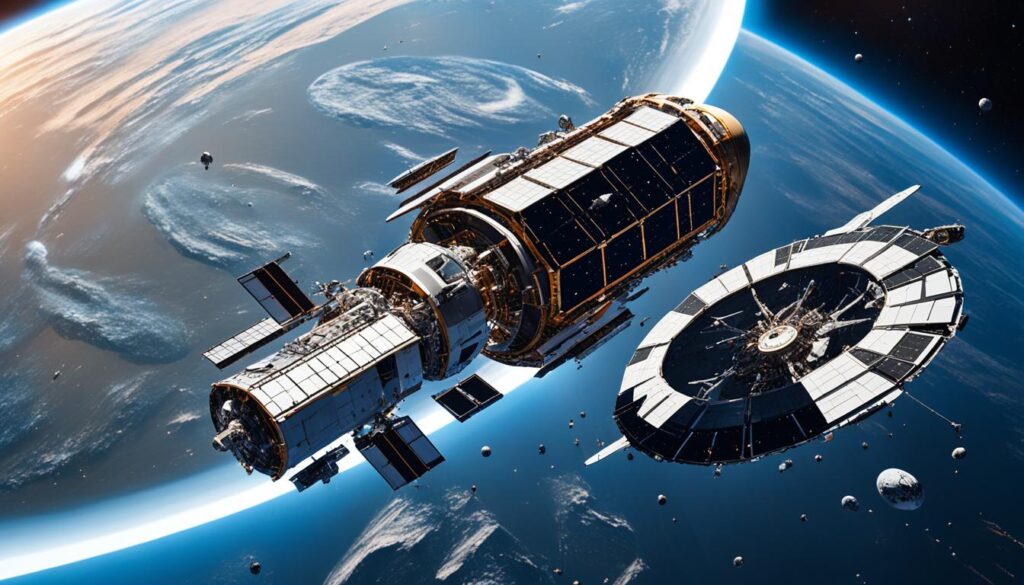
« Regular debris removals are essential as satellite numbers are set to grow rapidly, » stated the ESA Director General, highlighting the critical importance of the ClearSpace-1 mission and similar initiatives in maintaining a sustainable space environment.
satellite orbit clearing technologies
Satellite orbit clearing technologies have made big steps forward, but they still face many challenges. One big issue is the need for better guidance and control systems. These systems must track and catch a lot of debris objects precisely.
Understanding the size and path of these dangerous pieces in space is also key. This is why improving how we can tell what the debris looks like and where it’s going is vital.
As the space industry grows, we expect to see new improvements in how we clear orbits of debris. These will make things like removing debris more affordable and flexible. We’ll need ongoing research and new ideas to keep space safe for the future.
Addressing Scalability and Efficiency
With more satellites and debris in space, we need our debris removal methods to grow. We need new tech like self-capturing systems and better propulsion. These will make removing debris faster and cheaper.
Adapting to Emerging Space Missions
The space industry is always changing, so our debris removal tech must too. It needs to work with different kinds of debris and in various orbits. It should also work well with new systems for managing space traffic.
« The space industry in Washington state generates $4.6 billion in economic activity, and the ORBITS Act is aimed at establishing a demonstration program to reduce space junk in orbit. »
Dealing with these issues will take work from researchers, companies, and lawmakers. By supporting new ideas and working together, we can make space safer for the future. This will help us keep exploring and using space for new things.
Space Traffic Management (STM) Architecture
More satellites and spacecraft are going to space, making a strong Space Traffic Management (STM) system vital. STM helps keep space safe by tracking and checking who’s up there. It also keeps an eye on where everything is and makes sure data is correct.
This system uses standard APIs to bring together data from many sources. This helps avoid collisions and keeps space safe. It makes sure space operators act responsibly, helping space exploration last a long time.
Enabling Safe and Coordinated Operations
In June 2018, President Trump signed a directive for better space traffic management. It called for a system to improve how we share data in space. This is important as more spacecraft move closer together in orbit.
NASA Ames Research Center is working on a system to help manage space traffic. They use APIs to make sure spacecraft work together smoothly. This system is like ones used for drones on Earth, but for space.
- The system will bring together data providers, users, regulators, and operators through APIs. This makes things safer and more efficient.
- It will start with small satellites and then cover all sizes. It will also include tracking launch and reentry activities and more.
- The system focuses on U.S. traffic but could lead to a global system in the future.
The Space Traffic Management (STM) system uses APIs to keep space safe and organized. It helps with the growing number of space objects. This ensures space exploration and use can continue safely for a long time.
MMOD Impact Detection and Location
Understanding and managing the risks from Micrometeoroid and Orbital Debris (MMOD) is key. NASA has created a solution using strain sensors in optical fibers. These sensors are attached to structures or shields. They record the strain from MMOD impacts, helping to pinpoint where and when these events happen.
This MMOD impact detection tech helps protect space assets. It also provides data for better debris removal plans. The sensors can accurately locate where MMOD strikes happen. This info helps in dealing with the debris threat effectively.
This advanced system is a big step in keeping space safe and sustainable. By monitoring and mapping MMOD impacts, space agencies and companies can make smart choices. They can improve shields, change orbits, and use other methods to lessen space debris risks.
| Shielding Technology | Key Features | Effectiveness |
|---|---|---|
| Monolithic Shield | Basic slab of aluminum to absorb impact | Serves as a baseline for comparison |
| Whipple Shield | Sacrificial aluminum bumper to create debris cloud | Spreads force over a larger area on the spacecraft rearwall |
| Stuffed Whipple Shield | Layers of Nextel and Kevlar to further break down debris | Ensures remaining fragments are harmless to the rearwall |
| Multi-Shock Shield | Staggered layers of Nextel to repeatedly shock debris fragments | Effectively reduces fragments to a harmless size |
| Mesh Double Bumper Shield | Double-layer aluminum mesh bumper and rearwall | Provides added protection against MMOD impacts |
Using MMOD impact detection and location tech with optical fiber sensors is a big leap. It helps protect space assets and ensures space operations can continue safely into the future.
Computer Vision for Robotic Grappling
Robots have been key in space exploration for years, aiming to work with less human help. Now, advanced computer vision tech is making robotic grappling systems more precise and effective. This is especially true for tasks like fixing and building things in space.
NASA has led the way in using computer vision to solve the PnP challenge. This challenge is about figuring out how the camera and the robot arm match up. Thanks to algorithms and machine learning, like a regional Convolutional Neural Network (r-CNN), robots can now spot and grab objects on the International Space Station accurately.
This tech boost has made robots better at reaching and grabbing things, going from 0.5 meters to over 1.5 meters. It also cuts down on how long it takes to do these tasks. This could help with many jobs, like fixing satellites, recycling, and using space resources, both in space and on Earth.
Improving Precision and Operational Range
Computer vision has changed the game for robots in space. It helps them see and reach for objects better, even from far away. This makes space work safer and more efficient.
As we use more space services and resources, computer vision and robotics will be key. They’ll help us explore and use space in a smart way. This new way of using robots could open up new chances for fixing and building things in space, helping us take care of our space around Earth.
| Application | Impact of Computer Vision in Robotics |
|---|---|
| In-space Servicing, Assembly, and Manufacturing (ISAM) | Enhances precision and operational range for tasks like satellite servicing, refueling, and decommissioning |
| In-space Resource Utilization (ISRU) | Enables autonomous robotic systems to effectively utilize lunar resources for manufacturing and construction |
| Space Debris Removal | Improves 3D reconstruction and safe grappling of damaged or old objects to prevent further space debris |
« The integration of computer vision and robotics will play a crucial role in enabling sustainable space exploration and development. »
Multi-Stage Filtration Systems
In space exploration and satellite operations, keeping filters efficient and reliable is key. HEPA filters last a long time, but the pre-filters need regular cleaning or replacing. NASA’s Glenn Research Center has created a new multi-stage filtration system. It combines a pre-filter and a scroll filter to solve this problem.
This system cuts down on the need to replace HEPA filters. It makes the whole system last longer and reduces the need for a lot of maintenance, especially in harsh environments. The system uses an endless belt and a thin layer of safe grease to stick particles better, making it work better and last longer.
« This innovative multi-stage filtration system helps to extend the life of the more expensive HEPA filters while also reducing the maintenance burden, making it a game-changer in the world of satellite and space system operations. »
With multi-stage filtration, NASA’s tech boosts the life of important parts and lowers the need for expensive upkeep. This makes space systems more sustainable and reliable.

Emerging Startups and Innovative Solutions
The threat of space debris is pushing startups to create new solutions. These companies are at the forefront of removing debris, monitoring space, and managing orbits sustainably.
OrbitGuardians: Low-Cost Active Debris Removal
OrbitGuardians is a U.S. startup with a low-cost service for removing debris. They use advanced computer vision, AI, and IoT technology. This helps get rid of small, dangerous debris, keeping space safe.
ClearSpace: Space Debris Removal
ClearSpace comes from the Swiss EPFL Space Center. They’re working on tech to find, catch, and remove old satellites in space. They aim to start removing debris by 2025, making space safer for everyone.
Startups like OrbitGuardians and ClearSpace are changing the game in space. They’re making space safer and more sustainable for the future. Their work is key to solving the space debris problem.
« The space debris problem is a global challenge that requires collaborative efforts and innovative solutions. Startups like OrbitGuardians and ClearSpace are leading the way in addressing this critical issue, and their success will have far-reaching implications for the future of space exploration. »
Share My Space: Space Debris Monitoring
The space industry is growing fast, making space debris a big problem. French startup Share My Space has come up with new ways to deal with this issue. They offer solutions for tracking and warning about space debris.
One of their main products is the INDEMN service. It uses smart algorithms to predict the risk of collisions in space. This helps satellite owners know about potential dangers early and can protect their satellites.
- INDEMN: Predictive collision warning system
- CALM: Automated response to collision alerts
- DRYADE: Systematic on-orbit debris collection and tracking
The DRYADE system uses nature’s ideas and combines data from lasers on telescopes to track space debris better. This makes tracking and monitoring more accurate. Share My Space is helping make space safer and more sustainable with these tools.
| Solution | Key Features |
|---|---|
| INDEMN | Predictive collision warning system |
| CALM | Automated response to collision alerts |
| DRYADE | Systematic on-orbit debris collection and tracking |
Space debris is a big problem now, and satellites are more important than ever. Share My Space’s solutions are key to keeping space safe and sustainable. They help track and warn about space debris, making space technology more secure and reliable.
Astroscale: On-Orbit Servicing
Astroscale is a leading Japanese startup in the field of on-orbit servicing and active debris removal. They are working hard to solve the problem of space debris. They team up with space agencies, international groups, and satellite companies to make space safe for the future.
End of Life and Active Debris Removal Services
Astroscale provides services for the end of a satellite’s life and removing debris from space. They help satellites end their life safely and remove dangerous objects from orbit. Their team knows how to handle satellites from start to finish.
Astroscale has made a big impact, getting over $376 million in funding and growing to over 400 team members. They’ve had big wins, like the ELSA-d mission in 2021 and 2022. They also got picked for JAXA’s CRD2 program with the ADRAS-J spacecraft.
The ADRAS-J mission was a big step forward, getting close to a piece of space debris. This move is setting the stage for more work in cleaning up space. Astroscale Japan is now in Phase II of JAXA’s CRD2 program, aiming to remove space debris with their robots.
Astroscale is all about doing things right in space. They work with JAXA and others to make rules and rewards for cleaning up space. This helps make space travel safe for the future.
« Astroscale’s innovative solutions and pioneering efforts in on-orbit servicing and active debris removal are crucial in addressing the growing threat of orbital debris. Their work is not only transforming the space industry but also safeguarding the long-term viability of our space environment. »
Obruta: Tethered-Net Removal Technology
Obruta is a US startup leading the way in removing space debris with its tethered-net tech. The Puck device is a key part of this effort. It helps extend the life of satellites and work towards removing single-use satellites from orbit.
Obruta’s tech is vital for a sustainable future in space. By actively removing debris, the company is making space safer for exploration and operations. This is a big step towards a cleaner space environment.
| Key Facts | Statistics |
|---|---|
| Space Debris Monitoring and Removal Market Size | $866.4 million in 2021, projected to reach $1,527.7 million by 2029 (CAGR of 7.15%) |
| North America Market Share | 31% in 2021 |
| Operational Satellites in Earth’s Orbit | Approximately 3,373 |
| Obruta Partnerships | Signed MOU with Space Ventures Investors in 2019 for tethered-net technology |
Obruta is making a big impact in the fight against space debris. With its innovative tech and strong partnerships, it’s leading the charge for a sustainable space future. By tackling debris, Obruta is ensuring that space exploration can continue safely for generations to come.
Conclusion
Satellite orbit clearing technologies are key to solving the space debris problem. They help keep space safe for future use. NASA and companies like ClearSpace-1 are leading the way with new solutions.
These technologies are crucial as more services need space. They protect important space and ground assets. This makes space safer and sets the stage for a sustainable future.
Ground and space lasers, debris removal spacecraft, and recycling are making a big difference. These efforts will pay off in just a few decades, making space safer and more useful.
The space community is also working together to tackle space debris. With laws like the Orbital Sustainability Act and stopping harmful missile tests, we’re all working towards a clean space. This shows our commitment to keeping space safe for future missions.