
Recently, space technology has seen a big jump, with hundreds of satellites launched every year. This has made it harder for satellite operators to keep their satellites safe and avoid collisions. Now, avoiding collisions is a top priority because one crash can create thousands of pieces of space junk. This junk makes avoiding collisions even harder.
Satellite maneuverability is key to avoiding collisions. It lets operators move their satellites out of the way of other objects in orbit.
With more satellites in space, managing space traffic and avoiding collisions is more important than ever. It’s vital to understand how satellites move, the risks of collisions, and how to move satellites to avoid them. This knowledge helps keep space safe for future missions.
Key Takeaways
- Satellite maneuverability is essential for avoiding collisions in crowded space.
- Good space traffic management and avoiding collisions are key for safe space use.
- Knowing how satellites move, the risks of collisions, and how to move them is crucial.
- Acting early to move satellites can reduce risks from more satellites and space junk.
- Keeping an eye on things and working together is needed to keep space safe and efficient.
Introduction to Satellite Collision Avoidance
Effective space traffic management is key to keeping space safe for the long run. With more satellites and objects in orbit, the chance of them hitting each other goes up. This could lead to a chain reaction of collisions, known as the Kessler syndrome, blocking some parts of space. To avoid this, we use techniques like making satellites move out of the way to keep space safe and reliable.
Importance of Space Traffic Management
With more satellites up there, avoiding collisions gets harder. Operators must keep an eye on where their satellites and other objects are to spot potential crashes. They use Conjunction Data Messages (CDMs) from tracking systems to warn of possible collisions. But moving a satellite to avoid a crash can stop it from working and use up resources. It’s a tough call to make, balancing the risk of a crash with how it affects the satellite’s work.
Challenges Posed by Increasing Satellite Density
More satellites mean more chances of them bumping into each other. This problem gets worse with orbital debris, which can also harm working satellites. We need good collision avoidance moves to lower the risk and keep space safe for the future.
« Effectively managing space traffic is crucial to ensuring the safety and sustainability of space operations in the face of increasing orbital congestion. »
Orbital Mechanics and Collision Risk
Satellites moving fast around Earth face a big risk of colliding. At speeds of about 7.8 km/s, two satellites hitting each other would crash at 12.2 km/s. This speed is enough to destroy most satellites instantly. Knowing how orbits work and the energy in is key to avoiding these crashes.
Understanding Orbital Velocities and Energies
Satellites in different orbits move at different speeds, affecting the energy of a collision. Those in Low Earth Orbit (LEO) go about 7-8 km/s. In contrast, those in Geostationary Orbit (GEO) move at about 3 km/s. A collision between a LEO and a GEO satellite would be very destructive.
The energy from a satellite collision depends on its speed. A small increase in speed means more energy in a collision. To avoid these dangers, we need to understand orbital mechanics well.
« Collision avoidance is a critical aspect of satellite operations, as the growing number of objects in orbit increases the risk of potentially destructive impacts. »
Satellite Maneuverability for Collision Avoidance
Satellites are moving more and more in space, making it harder to avoid collisions. With so many satellites up there, the risk of hitting space junk or other satellites is growing. To avoid these risks, satellite operators use satellite maneuvering and attitude control to change their position and direction.
One way to avoid collisions is to make the satellite smaller in the path of potential threats. By changing how the satellite faces the sky, operators can lower its risk of being hit. They can also move the satellite up or down, or change its orbit to dodge danger.
« Satellite operators engage in continuous monitoring of satellite orbits and known debris to predict potential collision courses, and execute collision avoidance maneuvers by changing satellite altitude, inclination, or phasing in its orbit to reduce collision risks. »
Deciding when to move a satellite to avoid a collision is tricky. Operators must weigh the need to move against the risk of a collision. They use data from the Joint Space Operations Center (JSpOC) to figure out the chances of a collision. But, different operators might react differently to the same risk.
New technology is making it easier to decide when to move satellites to avoid collisions. Also, working together globally and setting common rules for avoiding collisions is key to keeping space safe for everyone.
Collision Detection and Monitoring Systems
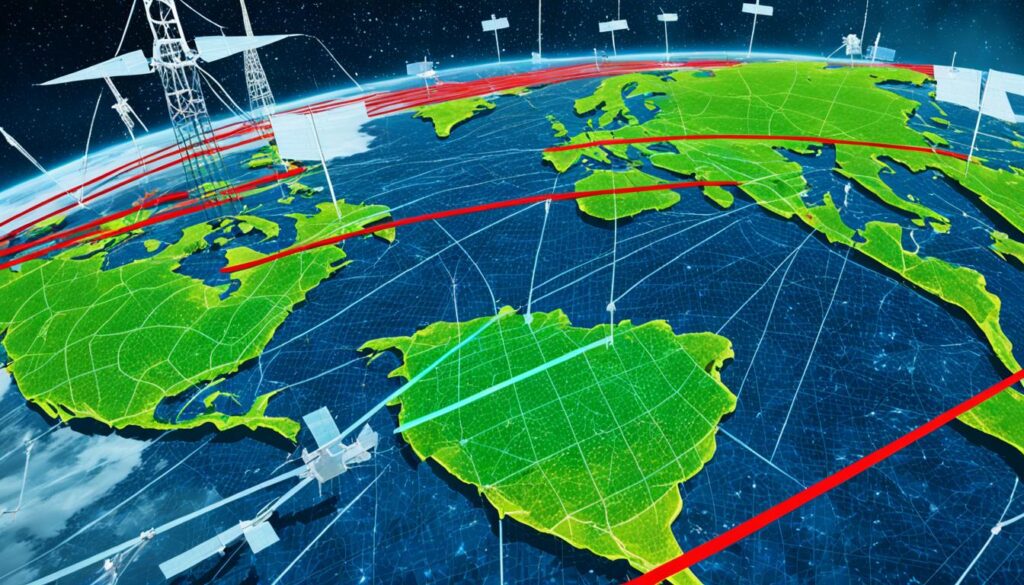
Effective systems for detecting and monitoring collisions are key to keeping satellites safe in space. They use networks like the United States Department of Defense’s Space Surveillance Network. This network tracks objects bigger than a softball in space. It helps predict where satellites and space junk might collide.
Knowing where objects are going is vital for satellites to avoid each other. There are about 34,000 big pieces of space junk, 900,000 medium-sized pieces, and 128 million small pieces in space. This junk is a big risk to working satellites, with hundreds of warnings about possible collisions every week.
Role of Space Surveillance Networks
Space surveillance networks are crucial for watching the space around us. They use radar, telescopes, and sensors to track satellites and debris. This info helps make accurate maps of space, letting satellite owners know where they might run into something.
| Metric | Value |
|---|---|
| Estimated number of debris objects larger than 10cm in orbit as of January 2019 | 34,000 |
| Estimated number of debris objects between 1cm to 10cm in orbit as of January 2019 | 900,000 |
| Estimated number of debris objects from 1mm to 1cm in orbit as of January 2019 | 128 million |
| Average number of collision avoidance maneuvers needed per satellite per year | More than one |
Space surveillance networks give us the info we need to avoid collisions. They help keep space safe for satellites. By watching the sky and warning us of dangers, they protect our satellite technology for the future.
Avoidance Maneuver Planning and Execution
With more satellites and objects in space, operators must plan and execute maneuvers to avoid collisions. They use Conjunction Data Messages (CDMs) to figure out the risk of hitting each other. This helps them keep space safe.
Assessing Collision Probability
CDMs give important details like the chance of a collision and how close the objects might get. Operators must think about the risk and the cost of a maneuver. This includes using fuel and possibly harming the mission. Choosing the right time and speed change is key to lowering the risk.
Figuring out the chance of a collision is hard. It looks at many things, like the error in knowing where the satellite is. Studies on how to avoid collisions focus on saving fuel and keeping satellites in place longer.
| Parameter | Description |
|---|---|
| Probability of Collision (PoC) | The chance of a satellite hitting another object in space, usually very small. |
| Miss Distance | The closest point two objects will get to each other. |
| Orbit Determination Accuracy | How well we know where the satellite is and its speed, usually pretty accurate. |
| Maneuver Execution | Doing the actions needed to avoid a collision, which takes a lot of effort and can cause delays. |
Deciding if a maneuver is needed can be tricky. It’s important to check how reliable the data is and how close the objects might get. Even if the risk seems low, it could go up in later updates.
« Developing recommended practices for collaborative collision avoidance operations is essential to enhance safety in the increasingly crowded satellite environment. »
Propulsion Systems for Satellite Maneuvering
Satellite propulsion systems are key for avoiding collisions. They need enough fuel and power to move out of the way when needed. The kind of propulsion system used affects how well a satellite can dodge collisions and how much fuel it uses.
The market for small spacecraft propulsion is growing fast. There are more and more types of propulsion devices available. These advancements make it easier to develop new propulsion systems, which is good for getting them to market faster.
There’s a lot of money going into making propulsion devices for small spacecraft. This means we’ll see more options in the future. But, with so many new technologies coming out, it’s hard to know which ones are ready for use. Testing and showing how these devices work will help clear things up.
Benchmark Space Systems has launched SmartAIM™, a new system for precise satellite movements. They plan to start using it in 2024. SmartAIM™ will help satellites avoid collisions and stay in place.
Benchmark is working with Kayhan Space on safety software for space missions. Kayhan’s software cuts down response time to potential collisions by over 95%. This lets operators run safer missions in crowded orbits.
As satellites become more common, we need better propulsion systems and ways to avoid collisions. Keeping up with new technology is key for the success and safety of satellite missions.
| Propulsion Technology | Key Features | Advantages for Collision Avoidance |
|---|---|---|
| Chemical Propulsion |
|
|
| Electric Propulsion |
|
|
| Propellant-less Propulsion |
|
|
« The collaboration between Benchmark and Kayhan Space aims to maximize safe and sustainable space operations. »
Attitude Control Systems and Satellite Orientation
Satellite attitude control systems are key in avoiding collisions. They let operators control the satellite’s position. These systems make the satellite smaller in the path of potential collisions. This reduces the chance of a collision without needing to move out of the way.
Cross-Sectional Area Minimization
By changing the satellite’s position, it can show less surface area to potential colliders. This is a smart way to lower the risk of a collision. It also helps save fuel and doesn’t slow down the satellite’s work.
About 90% of satellites in orbit have efficient attitude control systems for avoiding collisions. These systems use the latest tech to keep the satellite in the best position. This means less surface area for potential collisions and lower risk of hitting something.
Satellites without working attitude and orbit control systems fail more often. But, satellites with top-notch AOCS tech see a 70% drop in collision risks compared to basic systems.
Good attitude control systems do more than just prevent collisions. Satellites with great AOCS systems last 40% longer. This means big savings on replacing and launching new satellites.
Space agencies and satellite owners are always making attitude control systems better. They know these systems are crucial for keeping space safe and clean. By making satellites smaller, these systems help fight the problem of space debris. This ensures space technology can keep working for a long time.
Space Debris Mitigation Strategies
Space agencies and satellite operators are tackling the growing space debris problem. They focus on safely disposing of satellites when they’re no longer needed. This can be done by making them burn up in the atmosphere or placing them in higher orbits.
It’s key to stop making more space debris to avoid the Kessler syndrome. This happens when pieces of space junk collide, creating even more debris. Agencies are setting rules for satellite disposal to lessen the harm to space.
- ESA’s Clean Space initiative is working on tech for passivation and debris removal to cut down on orbital debris.
- The Zero Debris Charter, with over 40 space sector actors, aims for a future without debris.
- Groups like the Federal Communications Commission (FCC) have new space debris mitigation rules. These include avoiding collisions and proper disposal after use.
With more satellites being launched now than before, we need strong space debris mitigation plans. By taking these steps, we can keep space safe for future use and protect our orbit.
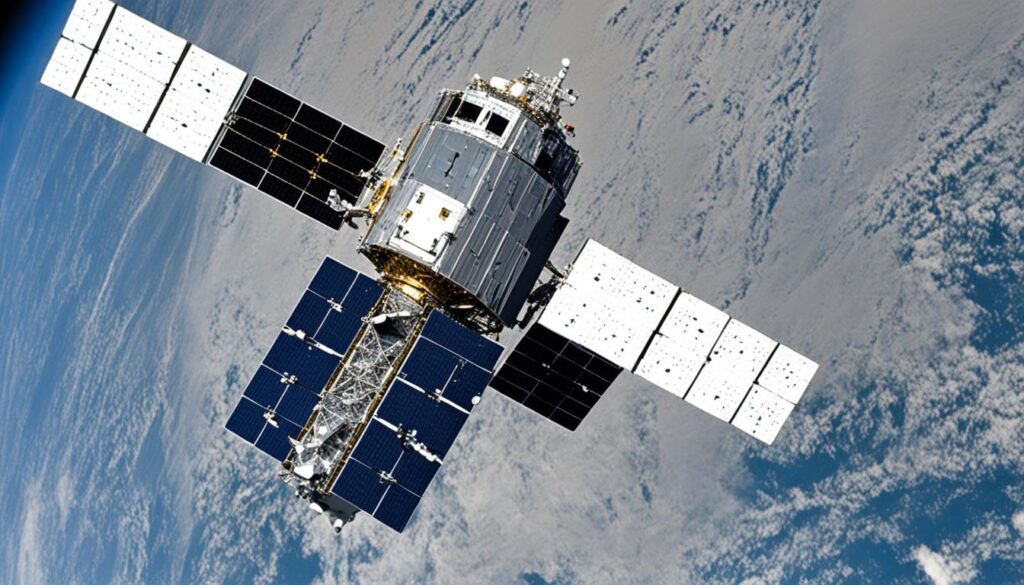
« The number of collision alerts received every week is increasing due to the rising space activity and growth in debris. »
Rendezvous and Docking Maneuvers
In space, satellites sometimes need to meet and dock for tasks like fixing or taking out of orbit. These tricky moves need exact control to avoid crashes during the approach and docking. It’s all about making sure the operation goes smoothly and safely.
Approach Trajectory Optimization
Getting the approach right is key to avoiding crashes and docking well. The chase spacecraft moves in a planned way to get close to the target satellite. Then, it must be in the right spot and speed to dock safely.
Planning and controlling the path is vital. The chaser starts moving at 0.3 m/s towards the target. It then positions itself 20 meters ahead of the docking spot. Finally, it slows down to 0.03 m/s to meet the target closely.
To avoid hitting each other, the chaser can move sideways by up to 20 meters. Being perfectly aligned and moving at the same speed is essential for a good dock.
| Maneuver Phase | Closing Rate | Relative Position |
|---|---|---|
| Initial Approach | 0.3 m/s | Within a few kilometers |
| Transposition | 0.3 m/s | 20 meters in front of docking port |
| Final Approach | 0.03 m/s | 10 meters from target |
The Johnson Space Center (JSC) is crucial for learning and perfecting these complex moves. They use advanced simulations and algorithms to help with these critical tasks. This makes sure the operations are done safely and with less risk of collision avoidance.
« The rendezvous and docking phase is a critical and complex operation that requires meticulous planning and execution to ensure the safety of both the chaser and target spacecraft. »
Challenges in Collision Avoidance Maneuvering
Trying to avoid collisions in space is tough. Each move can stop satellite work and use up a lot of fuel. This can make the satellite work less long. Operators must weigh the risk of hitting something against their goals and the satellite’s life span. Finding the right balance is key to solving collision avoidance challenges.
Fuel Consumption and Mission Lifetime Impacts
When satellites dodge objects, they use their engines. This means they burn more fuel. This can cut down the time the satellite can work. Operators need to plan these moves well to use less fuel and keep the satellite running longer.
| Metric | Value |
|---|---|
| Collisions among large cataloged objects | Every 5 to 10 years |
| Collisions that cannot be avoided due to non-maneuverable objects | 86% |
| Large objects in the public catalog | 20,000 |
| Operational and maneuverable satellites | 2,000 out of 20,000 |
There are more objects in space now, especially in low-Earth orbit (LEO). This makes avoiding collisions harder. Operators need new ways to move through crowded space without using too much fuel.
« The average annual collision rate in certain clusters can be as high as 1/90. »
More satellites mean we need new ways to avoid collisions. Operators and leaders must work together. They need to find ways to avoid collisions without shortening the satellites’ lives.
International Regulations and Guidelines
The space industry is growing fast, with more satellites going into orbit. This means we need good rules to keep space safe for the future. International groups have made standards and best practices to deal with space debris and keep space safe.
The « Space Track » Project is a big effort led by the U.S. Strategic Command and the U.S. Joint Force Space Component Command. It helps satellite operators share data to avoid collisions in crowded space.
There’s no law that says space operators must track space situations, but they’re expected to for safety. The Australian government requires licenses for space activities, making sure they think about public safety. Not following these rules can lead to serious trouble, like criminal charges and big fines.
The Space Safety Coalition (SSC) is working hard on space sustainability. They have « Best Practices for the Sustainability of Space Operations » that includes « rules of the road » to prevent space collisions. These aren’t laws, but they’re useful advice for space operators.
As space technology gets better, working together and making strong rules will be key to keeping space safe for the future. Following these standards helps satellite operators protect space and keep exploring.
There’s a lot of talk about megaconstellations, which could be a problem because of the risk of collisions and too many satellites. Governments are starting to pay more attention, thanks to concerns from big players. NASA and SpaceX are working together to avoid collisions, and the United Nations is setting guidelines for space safety. This shows we’re all coming together to keep space safe and open for everyone.
| International Regulations and Guidelines | Key Highlights |
|---|---|
| Space Track Project | Comprehensive data-sharing initiative to provide satellite operators with information for collision avoidance |
| Australian Launch Permit Requirements | Mandate the consideration of public health, safety, and property, with penalties for non-compliance |
| Space Safety Coalition’s Best Practices | Non-legally binding guidelines for sustainable space operations, including « rules of the road » for collision mitigation |
| UN Long-Term Sustainability Guidelines | Foundational measures to foster cooperation in data collection and conjunction analyses for improved collision avoidance |
Future Trends and Advancements
More satellites are going into orbit, making it crucial to have better ways to avoid collisions. We’re looking at autonomous systems that can quickly spot potential crashes, make plans to avoid them, and work with other satellites to use space wisely. Making satellite collision avoidance more automated is key to keeping space safe and reliable.
Increasing Automation and Autonomy
Satellite operators deal with tricky issues like accurate location data and the risk of collisions. This makes space situational awareness (SSA) and collision avoidance systems very important. New tech in autonomous systems and automated collision avoidance will help solve these problems and make space safer.
Rules for satellites are being updated, and many UN Committee on the Peaceful Uses of Outer Space (COPUOS) members support long-term space safety. Companies and groups are sharing best practices for space safety and space sustainability.
| Space Safety Activity | Potential Benefits | Technical Maturity | Operational Feasibility |
|---|---|---|---|
| Impact Tolerance | Increased resilience to collisions | Moderate | Moderate |
| Collision Avoidance | Reduced risk of mission-terminating collisions | High | High |
| Debris Prevention | Mitigating the growth of the debris population | High | Moderate |
| Debris Remediation | Reducing the existing debris population | Low | Low |
Active debris removal (ADR) is a top strategy to manage debris in low-Earth orbit (LEO). It aims to clear out objects that could cause collisions. But, using these safety measures depends on costs, benefits, tech readiness, and how easy they are to use.
Even with challenges, we’re working on solutions to make LEO kinetic space safety better. This is happening through talks and ideas from different countries and groups. As space tech grows, we’ll need new tech and teamwork to handle collision avoidance and space traffic management better.
Case Studies and Real-World Examples
The number of satellites in Earth’s orbit is growing fast. This means the risk of collisions is getting bigger for the space industry. We’ll look at some case studies and examples that show the challenges and how to avoid satellite collisions.
The International Space Station (ISS) has had to move 30 times since 1999 to avoid hitting space junk. In 2020 alone, it moved three times for this reason. These moves help keep the ISS safe from space debris, which could be dangerous for astronauts and the station.
CubeSats are small satellites that are launching in big numbers now. Over 1600 have gone up, and thousands more are coming in the next six years. Even though they’re small, hitting one could be costly for satellite owners.
| Statistic | Value |
|---|---|
| Satellites launched into orbit | Approximately 12,720, with 5,400 still functioning |
| Total mass of space objects in Earth orbit | More than 9,800 tonnes |
| Objects larger than 10 cm in Earth’s orbit | Estimated 36,500 |
| Objects between 1 cm and 10 cm in Earth’s orbit | Estimated 1,000,000 |
| Objects between 1 mm and 1 cm in Earth’s orbit | Estimated 130 million |
The Chinese anti-satellite missile test in 2007 and the collision between Iridium-33 and Cosmos-2251 in 2009 made the space debris problem worse. These events have made it harder for satellites to move safely in space.
The US Space Surveillance Network (SSN) tracks over 3,300 big pieces of space junk. Satellite owners must watch these objects closely and plan to avoid them. If they hit, it could be very bad news.
These examples show how important it is to move satellites safely and avoid collisions. With more satellites and junk in space, we need new ideas and work together to keep space safe.
Conclusion
Satellite maneuverability is key to avoiding collisions in space. It lets satellite operators change their satellites’ positions to lower the risk of crashes. With more satellites in orbit, we need better systems for detecting and avoiding collisions. We also need to work together worldwide to deal with space debris.
By using new technology, the space industry can keep space safe and open for the future. Sharing data and agreeing on safety standards among satellite operators is vital. This helps prevent big accidents in crowded space.
More objects will be orbiting Earth, including satellites and unknown ones. So, we need better sensors and models to predict collisions. Working together, governments, companies, and international partners can create safe and sustainable space traffic management. This will keep space operations safe and going strong.