
The real estate market is always changing. It reacts to many factors like the economy, society, and demographics. Knowing the cycles of the housing market is key for investors, homeowners, and professionals. It helps them make smart choices and handle risks and chances.
The U.S. housing market has shown strength, even in tough times like the pandemic. But, there’s a big gap between the number of homes and people wanting them. Since 1963, home prices have gone up, with some drops during recessions. The big drop in 2007-2009 gave smart investors a chance to buy cheap properties.
Key Takeaways
- The U.S. housing market has seen steady price increases, even with recessions.
- Changes in demographics and government policies affect housing demand and investment plans.
- Knowing the current market cycle is vital for good investment strategies.
- Using market analysis tools and data can improve investment results.
- Diversifying and managing risks are key to dealing with real estate’s ups and downs.
Understanding the Fundamentals of Real Estate Cycles
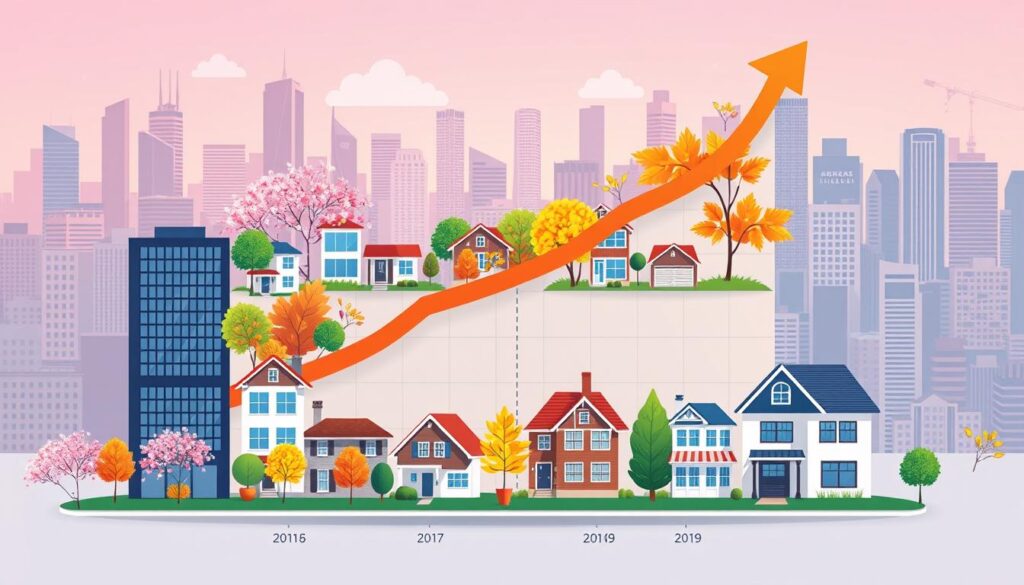
Real estate markets go through different cycles. Each cycle has its own traits that affect things like how full buildings are, how much rent goes up, and how much new construction happens. Knowing about these cycles is key for investors and others in the field. It helps them predict trends and find good chances to make money.
Definition and Basic Concepts
The real estate market cycle has four main parts: recovery, expansion, hypersupply, and recession. How long each part lasts can change. This is because the economy and market trends play big roles in how fast we move from one phase to the next.
Importance for Investors and Stakeholders
It’s very important for investors and others to understand the real estate cycle. This knowledge helps them guess how much money they’ll make, how much their investments will grow, and how to get the best returns. By knowing what each phase is like, they can make smart choices and put their money in the right places.
Historical Patterns in Real Estate Cycles
Real estate cycles usually last between 10-18 years. But since the 1920s, it’s gotten harder to guess when and how long these cycles will be. Looking at past trends can give clues about what might happen next. This helps with better planning and making smart decisions.
« Understanding the cyclical nature of the real estate market is crucial for investors and stakeholders to navigate the ever-changing landscape and capitalize on emerging opportunities. »
The Recovery Phase: Emerging from Market Bottom

The real estate market cycle is key for investors and stakeholders to grasp. The recovery phase is when the market hits its lowest point. It’s marked by low occupancies, little leasing, and not much new building.
Rent growth is often flat or going down, even below inflation. Spotting when the recovery starts can be tough. The market still feels like it’s in a recession.
Good investment moves in this phase include:
- Buying distressed properties
- Making value-add investments with careful planning
- Getting core properties with lots of lease rollover potential
This phase is vital for investors to understand the market and get ready for the next growth phase. By knowing the real estate cycle timing and market cycle risk management, investors can make smart choices. They can take advantage of the recovery period’s opportunities.
| Real Estate Cycle Phase | Key Characteristics | Investment Strategies |
|---|---|---|
| Recovery |
|
|
« Identifying the beginning of the recovery phase is challenging as market conditions still resemble recession. »
Real estate market cycles Analyzing housing market
Understanding real estate market cycles is key for investors and stakeholders. It helps them navigate the changing housing landscape. By analyzing key metrics, they gain insights into the market’s current state. This helps in making data-driven decisions.
Key Metrics and Indicators
Monitoring various metrics is crucial for real estate evaluation. These include occupancy rates, rent growth, property valuations, and supply-demand balance. These economic indicators for real estate give a full view of market conditions. They help investors spot opportunities and risks.
Market Analysis Tools and Techniques
Advanced predictive analytics for housing markets are powerful tools. Techniques like demographic studies, interest rate analysis, and policy evaluation offer deep insights. They help understand the factors behind market trends.
Data-Driven Decision Making
In the fast-changing real estate world, data-driven decisions are vital. By analyzing market data and economic indicators, investors make informed choices. They decide on property acquisition, development, and investment strategies. This way, they can confidently navigate market cycles and achieve success.
« The real estate market is a complex and dynamic ecosystem, and understanding its cycles is crucial for making informed decisions. By leveraging data-driven insights, we can navigate the ebbs and flows of the market with confidence and capitalize on emerging opportunities. »
The Expansion Phase: Growth and Opportunities
The real estate market is growing fast during the expansion phase. This is a great time for investors. The market is getting better, with more demand and higher property values.
The economy is getting stronger, with more jobs and higher GDP. This means more people want to buy or rent homes and office spaces. Builders are working hard to meet this demand, creating more properties. This leads to fewer empty spaces as people quickly find places to live or work.
Savvy property investment strategies during this phase include:
- Starting new development or redevelopment projects to meet the growing demand
- Buying « core-plus » assets for stable income and potential growth
- Improving existing properties to increase their value
- Buying any remaining distressed properties from the last cycle
As the expansion phase goes on, it’s important for investors to watch the market closely. They should be ready for changes that might come with the peak phase. Keeping a balanced portfolio and diversifying can help manage risks in the cyclical real estate market.
| Expansion Phase Characteristics | Investor Strategies |
|---|---|
| Improving market conditions | Property development or redevelopment |
| Increasing demand and rising prices | Core-plus acquisitions |
| Dropping vacancy rates | Value-add investments |
| Robust GDP growth and job creation | Opportunistic purchases of distressed assets |
Market Dynamics During Hypersupply
The real estate market goes through cycles, including recovery, expansion, and hypersupply. When we hit the hypersupply stage, businesses and investors face many challenges and chances.
Signs of Market Saturation
At the start of hypersupply, you’ll see more empty spaces and slower rent increases. Markets with too much supply face tough competition. Owners find it hard to fill spaces and keep people in their homes. This shows the market is out of balance, leading to uncertainty and risk.
Risk Management Strategies
- Manage your money well to handle possible value drops.
- Think about selling some properties to soften the downturn’s blow.
- Look for properties with solid, long-term leases to protect your investment.
Investment Considerations
The hypersupply phase is tough but also offers chances for smart investors. Buying at lower prices from worried sellers can be good, if you’re patient and can handle ups and downs. Also, focusing on properties with strong, long-term leases can shield your investment from market swings.
| Metric | Hypersupply Phase | Recession Phase |
|---|---|---|
| Vacancy Rates | Increasing | Peaking |
| Rent Growth | Slowing | Declining |
| Investor Sentiment | Cautious | Pessimistic |
| Foreclosure Rates | Rising | High |
By grasping the hypersupply phase’s market dynamics and using smart risk management, you can tackle the real estate cycle. This way, you can make the most of market trends forecasting and cyclical phases in housing markets.
Navigating the Recession Phase
The real estate market goes through different stages, and the recession phase is one of them. It brings its own set of challenges and chances for smart investors. With more properties available than people wanting them, vacancies rise, and rent growth slows down.
Property owners might offer deals and lower rents to keep tenants. But, this time also offers chances for those who are ready and have enough money. They can buy properties at low prices, planning to fix them up for sale when the market gets better.
To get through the recession, investors need a solid plan and enough money. They must be ready to wait for the market to improve. It’s important to stay focused, keep an eye on real estate cycle timing and market cycle risk management, and grab opportunities as the market starts to get better.
| Key Indicators of the Recession Phase | Investor Strategies |
|---|---|
|
|
« The key to navigating the real estate recession phase is to remain patient, well-capitalized, and disciplined in your approach. By identifying and acquiring distressed assets at steep discounts, you can position yourself for success during the next recovery or expansion phase. »
Economic Indicators Impacting Real Estate Cycles
The real estate market’s performance is tied to many economic indicators. It’s key for investors and stakeholders to grasp how these indicators affect real estate cycles.
GDP and Employment Correlation
GDP growth and employment rates are closely linked to the real estate market’s health. A growing economy, shown by rising GDP, often means more people want to buy homes. This leads to higher property values. Low unemployment and steady job growth also boost the market, as more people can afford homes.
Interest Rate Effects
Interest rates have a big impact on the real estate market. High rates make borrowing for mortgages pricier, cutting demand and property values. But, low rates make homes more affordable, sparking more investment and sales.
Consumer Confidence Impact
Consumer confidence, shaped by job security, wage growth, and overall economic mood, is vital. When people feel good about the economy and their finances, they’re more likely to invest in real estate. A drop in confidence, however, can slow down the market.
The relationship between economic indicators and the real estate market is complex. Investors and industry players must watch these factors closely. This helps them make smart choices and take advantage of the real estate cycle’s ups and downs.
| Economic Indicator | Impact on Real Estate Cycles |
|---|---|
| GDP Growth | Increased housing demand and rising property values |
| Employment Rates | Higher employment contributes to a robust real estate market |
| Interest Rates | High rates decrease affordability, low rates stimulate demand |
| Consumer Confidence | Optimistic consumers are more likely to invest in real estate |
The real estate market is shaped by many factors, including GDP, employment rates, interest rates, and consumer confidence. Knowing these economic indicators for real estate and their effects on cyclical real estate investment models is essential. It helps in making informed decisions and navigating the industry’s ups and downs.
Investment Strategies Across Different Cycle Phases
Real estate investment strategies must change with the housing market’s ups and downs. In the recovery phase, smart investors find property investment strategies for undervalued assets. They look for chances to add value. As the market grows, they consider development, core-plus acquisitions, and value-add repositioning.
In the hypersupply phase, investors might sell strategically or buy assets that are well-protected. The recession phase offers a chance to buy distressed assets at low prices. This way, investors can get ready for the next upswing.
It’s key to understand cyclical real estate investment models to handle the housing market’s ups and downs. By matching investment plans with the current real estate cycle, investors can boost their returns and lower risks.
| Cycle Phase | Investment Strategies |
|---|---|
| Recovery | Opportunistic purchases, value-add investments |
| Expansion | Development, core-plus acquisitions, value-add repositioning |
| Hypersupply | Strategic sales, acquiring defensively positioned assets |
| Recession | Distressed asset acquisitions at significant discounts |
By keeping up with the real estate market and adjusting strategies, investors can make the most of each phase. This way, they can succeed in the cyclical housing market.
Geographic Variations in Market Cycles
Real estate market cycles vary by location. Each area has its own rhythm. Knowing these differences is key for investors and stakeholders.
Regional Market Divergences
Major cities often lead the market recovery. But, smaller areas might take longer. This shows why location matters in real estate.
Urban vs. Suburban Trends
In big cities, urban and suburban markets move at different paces. For example, suburban offices might recover slower than city ones. This knowledge helps investors plan better.
| Market Segment | Expansion Phase | Peak Phase | Contraction Phase | Trough Phase |
|---|---|---|---|---|
| Gateway Markets | High Demand, Robust Construction | Saturation, High Prices | Declining Activity, Reduced Investment | Stabilizing Prices, Minimal New Development |
| Secondary/Tertiary Markets | Moderate Demand, Steady Construction | Moderating Growth, Property Values Peak | Slower Contraction, Lower Price Declines | Gradual Recovery, Gradual Improvement |
| Urban Areas | High Occupancy, Rent Growth | Oversupply, Declining Occupancy | Vacancy Increase, Rent Decline | Stabilizing Vacancy, Moderate Rent |
| Suburban Areas | Steady Demand, Measured Development | Some Oversupply, Moderate Price Appreciation | Slower Contraction, Lower Price Decline | Gradual Recovery, Stable Rents |
Understanding local market cycles is vital for investors. By watching regional trends, they can find good opportunities and avoid risks.
Property Type Performance Through Cycles
In the world of real estate, different types of properties react differently to market cycles. It’s key for investors to know these differences. This knowledge helps them spread out their investments and manage risks better.
Multifamily properties, like apartment buildings, stay strong during tough economic times. People always need a place to live, making these properties a steady choice.
Industrial properties, especially those for e-commerce, also hold up well even when the economy slows down. The rise of online shopping keeps the need for warehouses and logistics high. This offers chances for investors to profit from market cycles.
Retail properties, however, follow big economic trends closely. They do well when the economy grows but can struggle during recessions. This is because people’s spending and confidence can change a lot.
The office sector is changing fast, thanks to new work styles. With more people working from home or in hybrid setups, the need for traditional offices is dropping. Investors need to keep up with these shifts and adjust their plans.
Knowing how different property types perform helps real estate experts and investors make smart choices. They can spread out their investments and move through market cycles more easily and effectively.
Risk Assessment and Mitigation Strategies
Navigating the real estate market cycles needs a proactive risk management approach. Each cycle phase has its own challenges. These must be tackled to ensure success in market cycle risk management and cyclical real estate investment models.
Cycle-Specific Risks
In the recovery phase, the risk of missing the market bottom is high. The expansion phase worries about overbuilding and oversupply. Hypersupply risks include falling property values and more vacancies. The recession phase is marked by low returns for a long time.
Portfolio Diversification Approaches
- Diversify investments across different geographic markets to mitigate regional risks.
- Invest in a mix of property types, such as residential, commercial, and industrial, to spread risk.
- Maintain adequate liquidity reserves to weather market fluctuations and capitalize on opportunities.
- Adjust investment strategies to align with the current phase of the real estate cycle.
| Risk Mitigation Strategies | Benefits |
|---|---|
| Geographic Diversification | Reduces exposure to regional market risks |
| Property Type Diversification | Spreads risk across different asset classes |
| Maintaining Liquidity Reserves | Provides flexibility to navigate market changes |
| Cycle-Aligned Investment Strategies | Capitalizes on opportunities in different cycle phases |
« Effective risk management is the cornerstone of successful real estate investing, especially during volatile market cycles. »
By using a detailed risk assessment and mitigation plan, investors can handle the complex real estate market cycles better. This approach helps them stay confident and resilient, aiming for long-term success.
Market Timing and Cycle Prediction Methods
Understanding the real estate market is key. It involves studying economic indicators, trends, and past patterns. Important metrics include occupancy rates, rent growth, and construction activity. Also, look at GDP growth and interest rates.
While perfect timing is hard, knowing these indicators helps investors make better choices. This knowledge can lead to more successful investments.
Predictive analytics and data-driven methods are vital for forecasting market trends. They help identify good investment opportunities. Real estate experts can adjust their strategies and seize new trends by following these insights.
- Watch economic indicators like interest rates, employment, and inflation to predict housing demand.
- Study construction activity and supply-demand to understand market balance and price changes.
- Notice seasonal changes and demographic shifts to time investments well.
- Use historical data and benchmarks to spot patterns and predict future real estate cycles.
| Real Estate Cycle Phase | Timing Strategies | Opportunities |
|---|---|---|
| Recovery | Focus on foreclosure properties and distressed sales | Substantial value gains through strategic renovations and upgrades |
| Expansion | Optimize interest rates and time investments | Capitalize on rising demand and growing rental income |
| Peak | Strategically price and negotiate to sell at the right time | Maximize profitability by understanding buyer psychology |
| Contraction | Diversify investments and focus on cash flow | Identify opportunities in distressed properties and repositioning |
By using a data-driven approach to real estate cycle timing and predictive analytics for housing markets, investors can succeed. They can better navigate the real estate market’s ups and downs.
« Timing the real estate market is considered easier than timing the stock market due to the slower movement of real estate markets. »
Demographic Influences on Real Estate Cycles
Demographic trends deeply affect real estate cycles. Factors like population growth, migration, and age distribution shape demand for properties. For example, millennials want urban, small homes, while baby boomers look for retirement-friendly areas.
It’s key to understand these trends for market forecasting and investment planning. By tracking population and generational changes, we can see what buyers and renters need. This helps real estate pros find new opportunities and avoid risks.
Demographic data is also a crucial economic indicator for real estate. It helps predict housing demand and rental market changes. By watching population growth and age trends, investors can make smarter choices and adjust their strategies.