
ESA’s Space Debris Office is working hard to know everything about objects in space. They keep track of this info through the DISCOS database. This database has info on about 38,700 objects tracked since Sputnik-1, with nearly 10 million orbit records.
The US Space Surveillance Network sends in orbit data for all tracked objects. DISCOS is a trusted source of space object data, used by almost 40 customers worldwide.
Space debris modeling and prediction are key for keeping track of space. They help us understand debris risks and how to reduce them. The NEODEEM model, made by JAXA and Kyushu University, predicts the future space environment.
Future projections show that debris will keep going up, even with current safety rules. This is because objects in orbit sometimes collide, creating more debris.
New tech like the Space Surveillance Network and ground-based radar helps us track and understand space debris. Tools like DISCOS and ESA’s MASTER help us figure out risks and how to avoid them.
Key Takeaways
- Comprehensive space debris databases, such as DISCOS, consolidate knowledge on thousands of tracked objects in orbit.
- Advanced modeling and prediction tools, like NEODEEM, forecast the future space debris environment, highlighting the need for mitigation measures.
- Tracking and measurement technologies, including the Space Surveillance Network, provide critical data for understanding and managing the space debris challenge.
- Debris risk assessment models, such as ESA’s MASTER, enable the evaluation of mitigation strategies and the development of effective space traffic management policies.
- Collaborative efforts among space agencies and research institutions are essential for advancing space debris modeling and prediction capabilities.
Introduction to Space Debris
Space debris, also known as orbital debris, are human-made objects in Earth’s orbit that are no longer useful. This growing issue of space pollution is a big risk to working spacecraft and human space missions.
Definition and Sources of Space Debris
Space debris comes from many sources. These include old satellites, debris from missions, pieces from satellite explosions and collisions, radiator coolant droplets, rocket motor exhaust, and micro-particle impacts. NASA says the U.S. military tracks about 20,000 objects and has listed over 40,000 objects. They expect the number of space debris to go over 100,000 soon.
Impacts and Risks of Space Debris
Even small pieces of space debris can be a threat to working spacecraft because of their high speeds. Small collisions can cause big damage, ending a mission. Big collisions can break apart the objects involved. The risk of these collisions is high, with about four happening every year for the next 30 years. It’s important to reduce this threat to keep space safe.
| Statistic | Value |
|---|---|
| Tracked Objects by U.S. Military | 20,000 |
| Cataloged Objects Over the Years | Over 40,000 |
| Estimated Objects in the Future | Over 100,000 |
| Predicted Impact Rates in the Next 30 Years | About 4 per year |
« Space debris, even small fragments, can be dangerous to operational spacecraft due to the extremely high relative velocities involved. »
Space Debris Tracking and Measurement
The United States Space Surveillance Network (SSN) tracks objects over 10 cm in size. It uses radar systems to keep an eye on more than 9,000 objects in low Earth orbit. Now, new radar can track objects as small as 5 cm, but it’s not for all sizes.
For objects between 1 cm and 10 cm, we use special radar systems. These include the Haystack and Haystack Auxiliary radars. They help us keep an eye on the smaller pieces of space debris.
Ground-based Radar Systems
Ground-based radar systems are key for tracking small space debris. The Haystack and Haystack Auxiliary (HAX) radars in the U.S. track objects as small as 5 mm and 1 cm, respectively. They’ve been doing this since the early 1990s.
There are likely hundreds of thousands of objects too small to track. But, these radars give us important data on them. This helps us understand the space debris around us.
| Radar System | Debris Size Tracked | Location |
|---|---|---|
| Space Surveillance Network (SSN) | Objects larger than 10 cm | Worldwide network of radar systems |
| Haystack Radar | Objects down to 5 mm | United States |
| Haystack Auxiliary (HAX) Radar | Objects down to 1 cm | United States |
| Goldstone Radar | Objects down to 2-3 mm | United States |
| Michigan Orbital Debris Survey Telescope (MODEST) | Surveys the GEO and near-GEO environment | Chile |
| Meter Class Autonomous Telescope (MCAT) | Monitors the orbital debris environment | Ascension Island |
ESA’s DISCOS Database
ESA’s DISCOS (Database and Information System Characterizing Objects in Space) is a key source of space object data. It is used by almost 40 customers around the world. The database tracks about 38,700 objects since the start of space exploration, with over 10 million orbital records.
This database is crucial for understanding space debris and ensuring orbital safety. It’s the main source for ESA’s Space Debris Office. It gives a detailed look at the space object catalog.
Accessing the DISCOS Database
You can get an account to use the DISCOS database online if you really need it. You must be part of a research institute, government group, or an ESA Member State’s company. Only groups and not individuals get access.
Supporting Space Debris Modeling and Prediction
The DISCOS database is key for ESA’s tools on space debris modeling and prediction. These tools include:
- DRAMA (Debris Risk Assessment and Mitigation Analysis) – Helps figure out how often spacecraft need to move to avoid collisions. It looks at risk levels and debris impact.
- MASTER (Meteoroid and Space Debris Terrestrial Environment Reference) – Gives the data and tools needed to assess debris impacts on spacecraft in any orbit.
- PROOF (Program for Radar and Optical Observation Forecasting) – Offers stats on space debris and how it moves. It also gives details on tracking objects with ground and space sensors.
- Oriundo (On-ground Risk estimation for UNcontrolled re-entries tool) – Makes it easier to predict the risk of objects falling back to Earth without control.
These tools, with DISCOS data, help in modeling space debris. They make it easier to assess risks and make smart decisions for space use.
Space Debris Modeling Techniques
Space agencies around the world use advanced modeling to understand and predict space debris. They use math and stats to figure out how much debris is out there, where it is, and where it will be. This helps them see the dangers of space debris and how to reduce it.
NASA’s Orbital Debris Engineering Model (ORDEM) is a key tool. The latest version, ORDEM2000, gives a clearer picture of the debris in Earth’s orbit. It has more data and a better design than its older version. The EVOLVE 4.0 model is also important for studying space debris over a long time. It has improved ways to understand and model debris.
There are also special tools like the Debris Assessment Software (DAS) 1.5 and the Object Reentry Survival Analysis Tool (ORSAT) Version 5.0. These tools help with specific issues, like making sure NASA follows safety standards and dealing with satellites that fall back to Earth.
These models are vital for making decisions about space. They help with things like planning launches, figuring out how to get rid of debris, and understanding risks. By making these models better, space agencies can keep space safe for the future.
| Model | Description | Key Features |
|---|---|---|
| ORDEM2000 | NASA’s updated orbital debris engineering model | Provides a more accurate Earth orbital debris population representation, with a broader array of output products compared to ORDEM96 |
| EVOLVE 4.0 | Model for long-term space debris environment studies | Includes significant advances in debris characterization and breakup modeling |
| DAS 1.5 | Debris Assessment Software | Improved Windows compatibility and graphic functions for NASA Safety Standard compliance |
| ORSAT Version 5.0 | Object Reentry Survival Analysis Tool | Upgraded to address risks from uncontrolled satellite reentries |
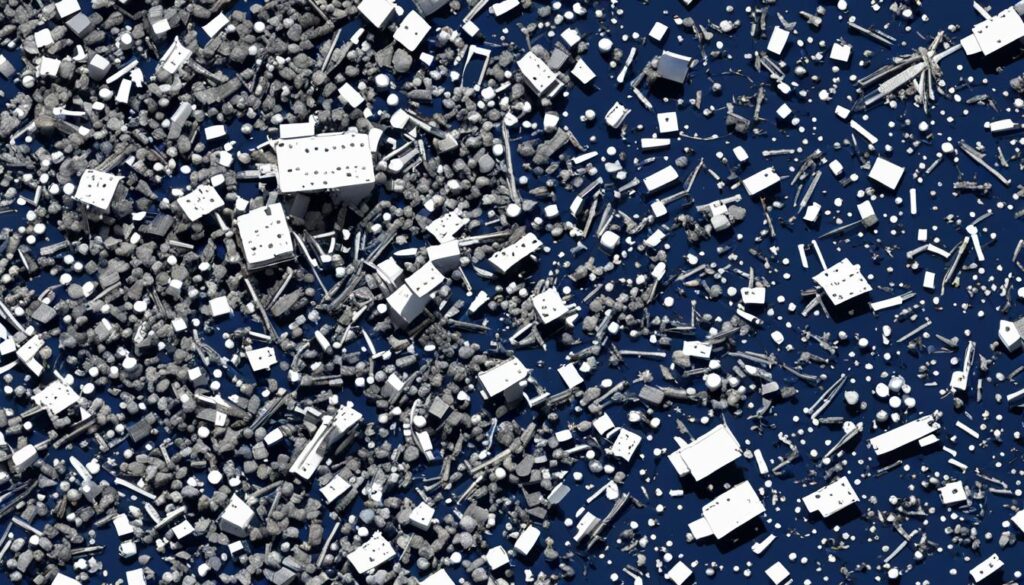
« By incorporating data from various sources, including the cataloged objects tracked by the SSN and observations from ground-based radar systems, these models enable analysts to assess the risks posed by space debris and evaluate the effectiveness of mitigation strategies. »
ESA’s MASTER Model
The European Space Agency’s (ESA) MASTER model is a key tool for understanding risks from debris and meteoroids in space. It covers debris and meteoroids from tiny to huge, helping spacecraft designers and planners a lot.
Debris and Meteoroid Risk Assessment
The MASTER model uses data from over 290 in-orbit events, 2,000 rocket firings, and 16 reactor ejections. This lets it accurately describe the debris and meteoroid environment. It uses advanced math to figure out how many impacts a spacecraft might face each year.
Impact Flux Calculations
The 2019 version of the MASTER model is even better, now including Lagrange point orbits. It also has new ways to show how accurate it is. Now, it gives uncertainty bars to show how likely its predictions are.
By November 1, 2016, the MASTER model said there were about 911,000 objects over 1 cm in Earth’s orbit. These objects come from different sources like old rocket parts and insulation. The model checks its accuracy with radar data from TIRA and EISCAT.
| Object Size | Estimated Number |
|---|---|
| Larger than 10 cm | 29,000 |
| Larger than 5 cm | 60,000 |
| Larger than 1 cm | 700,000 |
| Millimeter-class | 200 million |
| Sub-millimeter | Trillions |
The MASTER model’s detailed data and advanced methods are crucial for spacecraft designers. They use it to plan how to protect their vehicles from debris and meteoroids.
space debris modeling and prediction
The DELTA (Debris Environment Long-Term Analysis) model is a key tool for space debris modeling. It was created by the European Space Agency (ESA). This model helps predict the future of space debris and the risks of collisions in space.
It looks at the initial number of objects in space and how they will change over time. The model includes the main forces that affect these objects. It also considers future events like launches and rocket firings to see how different debris mitigation strategies will work.
Using the DELTA model, space agencies and researchers can understand the future of space debris. This helps them make smart choices and find ways to reduce space debris. This is important for keeping space safe for future missions.
« The DELTA model is a critical tool in our efforts to understand and manage the growing space debris problem. Its ability to forecast the long-term evolution of the debris environment allows us to proactively implement mitigation measures and safeguard our space-based assets. »
– Dr. Jane Doe, Space Debris Scientist, ESA
Debris Mitigation Strategies
Keeping space clean for the future is vital. Debris mitigation strategies are key to this goal. One main strategy is using end-of-life maneuvers for spacecraft. This means operators send vehicles back to Earth or move them to a safe orbit at the end of their life. This stops them from becoming space junk.
End-of-Life Maneuvers
End-of-life maneuvers are vital for keeping space clean. Spacecraft operators plan these carefully to dispose of their vehicles safely. By doing this, they avoid creating new debris. This helps keep space safe for future missions.
Passivation and Disposal
Passivation is another way to prevent space junk. It means removing energy sources like batteries to stop explosions that could create more debris. Together with controlled disposal, it follows international rules for space debris. These rules, made by the IADC, are key to stopping space junk from growing.
The Orbital Debris Implementation Plan lists 43 actions for agencies to take. These actions focus on three main areas: reducing debris, tracking debris, and cleaning up debris. By doing these, we can make space safer for the future.
| Debris Mitigation Strategy | Description | Impact |
|---|---|---|
| End-of-Life Maneuvers | Controlled deorbiting or relocation of spacecraft at the end of their mission | Reduces the risk of creating new debris through uncontrolled reentry or collisions |
| Spacecraft Passivation | Depletion of residual energy sources to prevent future uncontrolled explosions | Limits the generation of additional fragmentation debris |
| Compliance with IADC Guidelines | High adherence to international debris mitigation guidelines | Prevents the uncontrolled growth of the space debris population |
Active Debris Removal
More objects are going into Earth’s orbit, making it crucial to remove space debris. There are now about 3,200 objects in low-Earth orbit. From 2004-2012, 72 satellites went up each year. But from 2013-2016, that number jumped to 125 per year.
This increase highlights the need for active debris removal, space debris remediation, and controlling the debris population. We must act fast to prevent more collisions that create new debris.
Starting to remove debris in 2060 will only help a bit, compared to starting now. This shows we need to act quickly.
The European Space Agency (ESA) sees removing debris as key. NASA’s Tournament Lab is also working on it. They’re offering a $120,000 prize for the best ideas by November 15, 2023.
Good solutions for active debris removal need to track debris in real-time. They must know where it is, how fast it’s moving, and if it could collide with other objects. Better sensors are needed to spot even the smallest pieces.
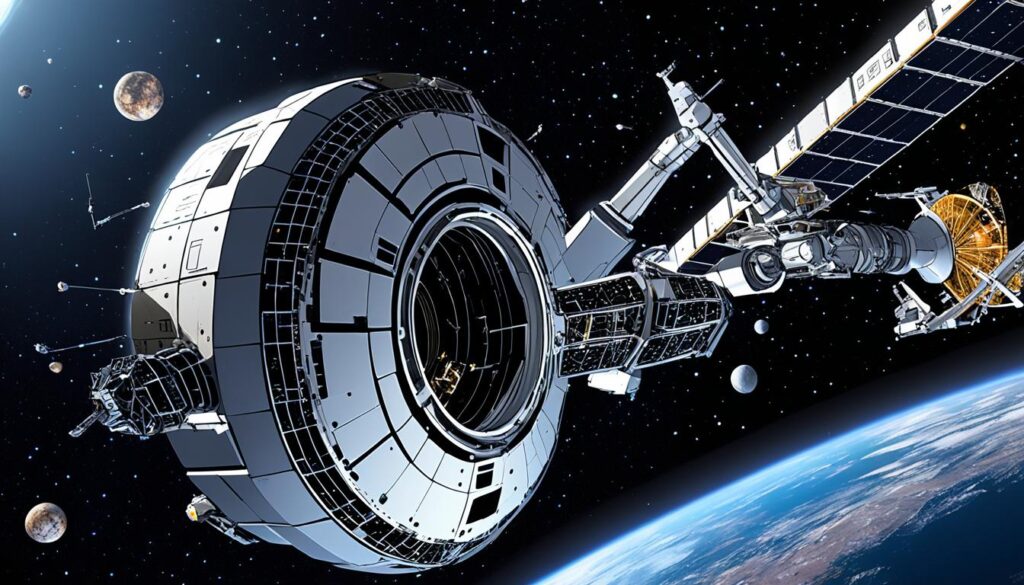
Keeping space clean is vital for future space travel. With the right active debris removal tech, we can keep space safe for everyone. This will help space exploration continue for years to come.
Future Traffic Models
The space industry is always changing, so it’s important to know what the future holds for launch activity and explosion events. This helps us predict how the space debris will grow. Models like ESA’s DELTA (Debris Environment Long-Term Analysis) use future traffic data to see how the debris in orbit will change over time.
Launch and Explosion Activity
More launches are happening, both for companies and governments, which means more debris in space. Also, explosions of spacecraft and upper stages can create even more small pieces of debris. These things make keeping space clean a big challenge for the future.
- Since 1956, the number of objects in Earth’s orbit has kept going up.
- About 6,300 tons of debris are thought to be in orbit, with 2,700 tons in low-Earth orbit (LEO).
- Debris can be as small as a softball or as tiny as a grain of sand, with millions of pieces the size of a millimeter.
We need to find ways to deal with the growing debris problem to keep space safe for the future. Scientists and space experts are working together to come up with solutions.
« The growth of launches and the chance of explosions in space are big problems. We need to find ways to stop the debris from getting worse to keep space safe for everyone. »
Space Debris Environment Evolution
The space debris environment is facing a big challenge. It’s getting more objects because of collisions. This is known as the « Kessler syndrome » and is a big threat to spacecraft. If we don’t change how we act, the debris will keep growing, causing more collisions.
Collisional Cascading Process
The process of collisional cascading is a cycle that makes space debris grow fast. More objects in space mean more chances of hitting each other. When objects collide, they break into smaller pieces, which can hit other objects, starting the cycle again.
This cycle is caused by many things, like more objects in some orbits, big satellites that don’t work anymore, and new spacecraft being launched. Experts say if we don’t stop it, some orbits will be unusable. This would make space missions harder in the future.
To stop this, we need to work together and remove debris from space. Following rules set by the United Nations and taking out big pieces of junk are key steps. This will help keep the space around Earth safe for future use.
| Metric | Value |
|---|---|
| Estimated number of trackable space debris objects | 25,000 |
| Estimated total number of space debris objects | Millions |
| Percentage of operational spacecraft in near-Earth space | Less than 8% |
| Percentage of fragmentation debris | 50% |
As more debris fills space, we need better ways to predict what will happen. Researchers are using powerful computers and new methods to see how debris will grow and how to stop it. By understanding how collisions affect debris, we can make smart choices to protect space for the future.
Space Debris Mitigation Handbook
The European Space Agency (ESA) has made a « Space Debris Mitigation Handbook » for mission planners and spacecraft designers. It covers key areas like understanding space debris, assessing risks, and protecting spacecraft. This guide is packed with tables and charts to help tackle the space debris issue.
It focuses on space debris mitigation, spacecraft protection, and environmental sustainability. This makes it a key tool for the space industry.
The handbook brings together the latest research from groups like the COPUOS, IADC, and ISO. It covers important topics such as:
- Understanding the space debris environment
- Assessing risks and calculating impact flux
- Protecting spacecraft and mitigating debris
- Forecasting the future of debris in space
- Working together internationally
This guide makes complex information easy to use. It helps space professionals make smart choices. By following its advice, they can protect their space assets and help keep space clean.
| Key Statistics | Value |
|---|---|
| Tracked objects as of 31 Dec 1997 | 25,130 from 3,896 launches |
| Fragmentation events contribution | 43% of tracked objects |
| Untracked objects larger than 1 cm (MASTER Model) | Over 360,000 |
| Yearly collision probability among objects larger than 1 cm | About 7% |
| Total objects placed into Earth orbits by 31.01.2002 | 27,061 |
The « Space Debris Mitigation Handbook » is a must-have for the space industry. It offers a detailed plan for space debris mitigation, spacecraft protection, and keeping space clean.
Space Traffic Management
The space industry is growing fast, making space traffic management more important. With more satellites and space debris, we need to work together to keep space safe for the future.
International Cooperation and Guidelines
The Inter-Agency Space Debris Coordination Committee (IADC) and the United Nations help countries work together. They set rules for managing space debris. These rules include actions like moving satellites when they’re done working to avoid more debris.
We need to keep improving these rules as space activities grow. The space industry could be worth over $1 trillion by 2040. So, having good space traffic management is key.
| Key Statistic | Value |
|---|---|
| Active Satellites in Space | Approximately 6,900 |
| Trackable Debris Objects (10 cm or larger) | Over 36,500 |
| Objects (1 cm to 10 cm) | Approximately 1 million |
| Projected Satellite Launches by 2030 | Tens of thousands |
| Projected Growth of Global Space Economy by 2040 | Over $1 trillion |
We need international cooperation and strong debris mitigation guidelines. By working together, we can use space responsibly and keep it safe for the future.
« The space industry, valued at 350 billion USD, is forecasted to exceed 1 trillion dollars by 2040, with debates suggesting this could be closer to 10 trillion dollars. »
Challenges and Future Outlook
The growing problem of space debris is a big challenge for space operations. More satellites and rocket parts in orbit mean a higher risk of collisions. This risk is made worse by launch activities, explosions, and the way debris can create more debris.
To tackle space debris, we need a plan that includes new technology, working together, and good practices. Tools like ESA’s MASTER model and the DELTA tool help us understand and predict debris in space.
Working together and following guidelines is key to managing space debris. Strategies like end-of-life maneuvers, passivation, and active debris removal are important. They help keep space safe for the future.
As space gets busier, we need new ways to track and manage debris. New technologies can help remove debris and make space safer. Dealing with space debris is key to keeping space safe for science, business, and exploration.
« Challenges in space, such as space debris, are global and require coordination among all space-faring nations for effective solutions. International law and agreements need further development and enforcement to address challenges like space debris on a global scale. »
- The space debris removal efforts focus on actively removing five or more massive pieces of debris from the orbit annually to control the growing population of space debris.
- Deorbiting kg-level debris can be achieved within several orbital periods using the existing magnetorquer technology.
- Over 60 percent of survey participants agreed or strongly agreed that the world has entered a « New Space Age » which prompted the workshop discussion on the challenges and opportunities at this critical phase.
| Publication | Citations | Views |
|---|---|---|
| « Theoretical and Experimental Investigation of Geomagnetic Energy Effect for LEO Debris Deorbiting » by Guanhua Feng et al. | 2 | 1711 |
| « Impedance Control Using Selected Compliant Prismatic Joint in a Free-Floating Space Manipulator » by Piotr Palma et al. | 7 | 1691 |
Conclusion
Space debris is a big problem for the future of space use. Tools like ESA’s MASTER and DELTA help us understand and predict space debris. But, the debris keeps growing because of launches, explosions, and collisions. We need to work together and use new technologies to fix this.
Working on space debris helps keep space safe for us to use. We must track objects in space, understand the debris, and find new ways to deal with it. By working together, we can make space safe for future space use.
The space industry is getting bigger, making the debris problem more serious. Using advanced tools and working together, we can make space safe and useful for everyone. This will help us explore and use space without the dangers of debris.