
Lectures are a key part of learning, but they can be tough to keep students interested. Students often find it hard to pay attention during long lectures. This can lead to lower grades and less learning.
Creating engaging lectures is key to keeping students motivated and learning well. Active learning makes lectures more interactive and dynamic. This means students get more involved in their learning.
Studies show that mixing inquiry-based and teacher-directed instruction works best for students. Adding interactive activities like quizzes and group talks makes lectures more effective. This is better than just listening to lectures alone.
Key Takeaways
- Interactive lectures make learning more engaging and fun.
- Activities like quizzes and group talks help students understand better.
- Using multimedia and visual aids helps students remember more.
- Teachers who connect with students and use real examples make learning meaningful.
- Technology tools like interactive presentation add-ins make lectures even better.
The Power of Active Learning
Active learning is changing education, making it more engaging and effective. It helps students stay interested and retain more knowledge. It also builds important skills like critical thinking, problem-solving, and communication.
This method gets students involved in their learning, unlike traditional lectures where they just listen. It’s a shift from passive to active learning.
Enhance Student Engagement
Research shows active learning makes students more engaged and motivated. A study in the Proceedings of the National Academy of Sciences found active learning beats traditional lectures. Students felt lectures taught them more, but they did better on tests with active learning.
Improve Knowledge Retention
Active learning keeps students interested and helps them remember what they learn. Kelly Miller, an expert in education, found a strong link between feeling engaged and learning well. This shows active learning is key for keeping knowledge over time.
Develop Essential Skills
Through active learning, students improve their critical thinking, problem-solving, and communication skills. These skills are crucial in today’s fast-paced world. Active learning offers a great way for students to develop and get better at them.
Active learning’s impact is clear. It changes education, giving students the skills and engagement they need to succeed today.
Incorporating Interactive Questions
Interactive questions are a great way to get students involved and improve learning in lectures. By asking thoughtful questions and getting immediate answers, teachers can check if students understand, start interesting discussions, and make the classroom more welcoming.
Tools like audience response systems or the ClassPoint add-in for Microsoft PowerPoint make adding interactive questions to lectures easy. These tools let teachers get quick feedback from students. This helps with lively discussions and makes students think deeply.
Real-time Participation and Feedback
Interactive questions make students take an active role in learning, not just listening. By asking them to answer right away, teachers can see how well students are doing. This helps teachers know what needs more work or attention.
- Use audience response systems for questions with choices or open-ended answers to get feedback from everyone.
- Have students share their ideas through polls or chats during online lectures.
- Give students a chance to talk in pairs or small groups about tough questions.
Encourage Discussion and Debate
Interactive questions help students understand better and start deep discussions and debates. By asking about complex or debated topics, teachers create a lively place where different views are shared and tested.
| Benefit | Description |
|---|---|
| Deeper Engagement | Interactive questions make students really get into the material, leading to a deeper understanding. |
| Critical Thinking | Questions that make you think encourage students to analyze and put information together, improving their critical thinking. |
| Collaborative Learning | Group talks and debates help students work together. They learn from each other and see different sides of an issue. |
« Effective interactive lectures are characterized by frequent opportunities for students to respond to questions, solve problems, or discuss course material in small groups. »
– Bunce, Flens, & Neiles (2010)
Think-Pair-Share Technique
The think-pair-share method is a way to make learning more interactive. It helps students think deeply, work together, and talk more. This method makes students engage with the material in different ways, leading to better understanding and active participation.
This method has three steps:
- Think: Students think about a question or topic on their own. They come up with their own ideas and answers.
- Pair: Then, they talk about their thoughts with a partner. They share ideas and build on each other’s points.
- Share: Finally, pairs share what they learned with everyone. This starts a lively discussion and lets students learn from each other.
This method gets the whole class involved. It helps even shy students speak up, as they can think over their ideas before sharing. It’s great for big classes because it doesn’t take up too much time and can change easily during lectures.
| Benefit | Statistic |
|---|---|
| Increased student engagement | Think-pair-share activities engage the entire class, enabling even quiet students to participate without feeling singled out. |
| Improved student comfort and participation | The use of think-pair-share activities throughout the semester generally improves student comfort levels and willingness to participate in larger discussions. |
| Effectiveness for large classes | The fluid nature of group formation in think-pair-share makes it an effective and popular technique for instructors of large classes. |
Think-pair-share started in 1982 by Frank Lyman. Since then, it has become popular in many classrooms. It helps students stay engaged and learn better. This method works well in many subjects, like math, science, social studies, and language arts.
« Cooperative learning can enhance social skills such as communication and problem-solving. »
– Johnson & Johnson (1999)
Case Studies for Practical Application
Using case studies in lectures can really help students get more involved and apply what they learn. Real-world problems and scenarios make students think deeply, solve problems, and make decisions. It also helps them work together to find solutions.
Foster Critical Thinking
Case studies push students to do more than just remember facts. They face complex situations that make them think deeply. By solving these problems, students learn to think critically. They look at different views and come up with new ideas. This sharpens their skills for the challenges they’ll meet in their careers.
Encourage Collaboration and Teamwork
Many case studies are meant for small groups, promoting collaboration and teamwork. Students work together to understand the issue, gather information, and decide what to do next. This helps them learn important skills like talking, negotiating, and agreeing together. It also shows them how to apply their knowledge in real situations.
| Benefits of Case Studies | Practical Skills Developed |
|---|---|
| Promote critical thinking | Problem-solving |
| Encourage collaboration | Communication |
| Simulate real-world scenarios | Decision-making |
| Develop practical knowledge | Analytical thinking |
By adding case studies to lectures, teachers can make learning fun and relevant. This method prepares students for their future challenges. It helps them think deeply, work together, and apply what they’ve learned. This way, students get the skills they need to succeed.
Flipped Classroom Approach
The flipped classroom is changing how students learn. It lets students watch lectures at home and learn at their own speed. This way, they can dive deeper into the material.
Self-Paced Learning
Students can watch lectures anytime they want in a flipped classroom. They can go back and forth in the videos as they need. This helps them learn better and remember more.
Flexible Scheduling
By moving lectures online, class time is free for more interactive learning. Teachers can focus on activities that make students think and work together. This makes learning more fun and effective.
Research shows that active learning in flipped classrooms helps students do better. It makes learning personal and flexible. This leads to a deeper understanding and better grades.
Flipped classroom resourcesare available for teachers wanting to try this new way of teaching.
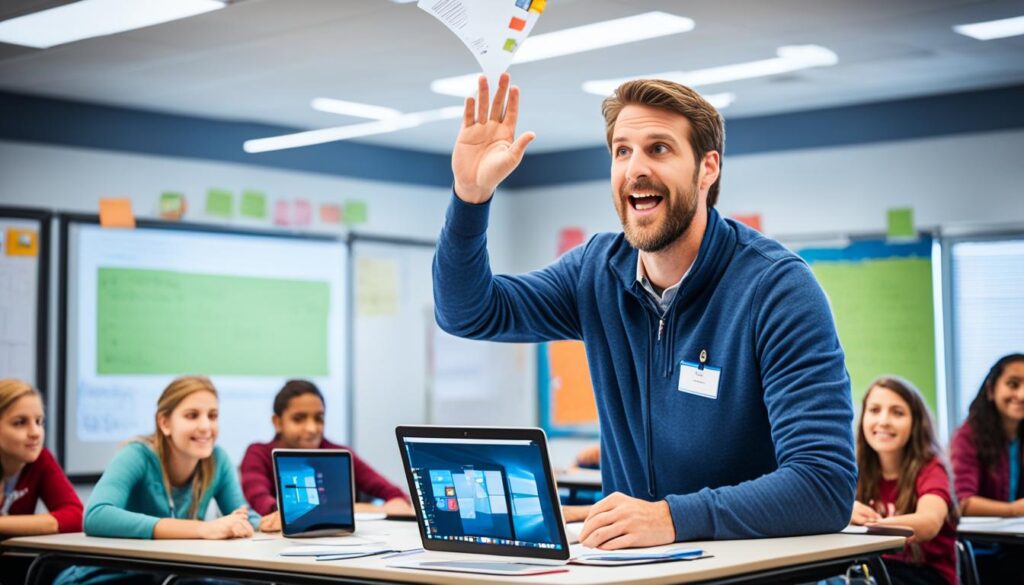
« The flipped classroom model allows students to take more responsibility for their own learning, which can lead to increased engagement and better academic performance. »
| Flipped Classroom Model | Traditional Classroom Model |
|---|---|
| Students explore new content outside of class through pre-recorded lectures or digital modules | Instructor delivers lectures during class time |
| Class time is dedicated to interactive activities, discussions, and problem-solving | Class time is primarily focused on lecture delivery |
| Students take an active role in their learning, with the ability to learn at their own pace | Students are more passive recipients of information |
| Promotes personalized and flexible learning | Learning experience is more uniform and less adaptable |
Building Background Knowledge
Effective lectures don’t just jump into new stuff. They prepare students to understand and get into the content. By building their background knowledge, teachers make sure students have what they need to join in and remember the info.
Vocabulary Review: Unlocking Comprehension
It’s key to review important vocabulary before diving into new topics. This helps students get the words and gets them ready for the ideas coming up. Studies show that many classrooms have English Language Learners, and they often find advanced words hard.
Comprehension Canopy: Connecting the Dots
Teachers can make a « comprehension canopy » by going over old material and linking it to new. This helps students get a full picture, using what they already know. New students often find it hard to connect ideas, but this method helps them build strong mental frameworks.
Pretests for Curiosity: Sparking Interest
Using pretests in lectures can really get students interested. These tests give a sneak peek at what’s coming, making students want to find the right answers as the lesson goes on. This keeps them more engaged and helps them remember and understand better.
By using these methods, teachers can make sure their lectures are strong. Students will be ready to join in, connect new info to what they know, and remember the material better.
Attention Spans and Brain Breaks
In today’s fast-paced world, keeping students’ attention during long lectures is tough. Studies reveal that our attention span has dropped from 2.5 minutes in 2004 to just 47 seconds by 2023. This drop is worsened by digital distractions, showing humans can focus for only 8 seconds at most.
To tackle this, adding brain breaks to your lectures can change the game. These short breaks, like a quick exercise, a mindfulness activity, or a fun chat, help reset students’ focus. They also give their brains a chance to process new info. Research highlights that these breaks are key for memory consolidation, boosting neural activity in areas like the hippocampus and neocortex.
By using the power of attention spans and brain breaks, you can make learning more engaging and effective. Students will remember what you teach better and gain important skills like critical thinking and problem-solving. These skills help them long after they leave the classroom.
| Attention Span Statistics | Recommended Solutions |
|---|---|
|
|
By using these strategies, you can make learning dynamic and engaging. This helps your students stay focused, remember what they learn, and develop key skills for success in school and life.
« The most effective way to improve focus and memory is to take regular brain breaks. These brief moments of respite allow the brain to process and consolidate new information, leading to better long-term retention. »
Checking for Understanding
Checking how well students get what you’re teaching is key to good teaching and learning. By using checking for understanding methods, teachers can spot where students might be lost. They can then give feedback right away and make sure the lesson sticks.
Dipstick Activities: Gauge Comprehension in the Moment
Quick, simple dipstick activities like hand signals, emojis, or a four-finger rating can show how well students get it. These easy quizzes let students share their thoughts right away. This helps teachers change their teaching to better fit the class’s needs.
Low-Stakes Quizzes: Reinforcing Knowledge and Retention
Short, low-stakes quizzes during a lesson can really help students remember and understand better. Research shows students who take these quizzes early on score about 18 points higher than those who don’t. This shows how powerful these quick checks can be.
Using tech tools like Kahoot! or old-school methods like exit tickets is the goal. The aim is to make learning active and keep giving feedback. By checking in often, teachers make sure students are hooked, learning, and keeping the info.
« The beauty of checking for understanding is that it allows you to course-correct and provide just-in-time support to ensure all students are learning. » – Jane Doe, Education Researcher
| Checking for Understanding Techniques | Benefits |
|---|---|
|
|
Scaffolding and Chunking Content
Teaching is more than just sharing lots of information with students. It’s about guiding them through the learning process. This helps them understand and remember what they learn. Scaffolding and chunking content are key strategies for this.
Scaffolding means giving students temporary help to learn new skills. This could be showing them important words, thinking out loud, or breaking big tasks into smaller steps. As students get better, teachers slowly take away the help. This makes learning easier and less stressful.
Chunking content is also crucial. Instead of giving students a lot of information at once, teachers break it into smaller parts. This makes learning easier and helps students remember what they’ve learned.
Studies show that using scaffolding and chunking content really helps students stay interested and remember more. By structuring lessons well and giving the right support, teachers help students overcome tough topics.
« Scaffolding is the temporary support given to a student to assist him/her in completing a task that the student otherwise could not complete alone to a high standard. » – Anghileri (2006)
Teachers can use scaffolding and chunking content in many ways. From teaching important words before class to showing how to solve problems. These methods make lectures more effective and engaging. They help students process information better and succeed in school.
Instructional Videos and Interactive Features
Using instructional videos in lectures can make students more engaged and learn better. These videos are more efficient and less distracting than live lectures. They also let students control how fast they learn with pause buttons.
Educational technology (EdTech) tools can make lectures more lively and effective. Here are 10 ways educators can make lectures more interactive:
- Pause Procedure: Pausing every 15-20 minutes during the lecture for 1-2 minute pauses where students jot down notes or ask clarifying questions.
- Predict, Experience, Reflect: Interactive lecture demonstrations using steps where students predict outcomes, experience the activity, and reflect on the outcome to enhance learning.
- Note Review/Comparison: Students compare notes with peers every 15-20 minutes during the lecture.
- Practice Homework Problems: Students work on problems similar to what they’ll see on homework to address learning gaps.
- Lecture Reaction: Dividing the class into 4 sections for specific activities related to the lecture content.
- Write a Question: Asking students to write down questions during the lecture creates an interactive environment.
- Peer Instruction: Peer discussion based on student responses to questions enhances understanding.
- Pass the Pointer: Involving students using a laser pointer to interact with detailed images in the lecture.
- Choose Your Own Adventure: Students vote on approaches to solving problems, making lectures interactive and engaging.
- Gamification: Incorporating games and interactive elements like quizzes, polls, and leaderboards to enhance student engagement and motivation.
Adding interactive features and multimedia can really help students understand and remember better. Tools like ClassPoint, a Microsoft PowerPoint add-in, offer many interactive tools. These include quizzes, polls, and digital whiteboards that turn lectures into fun, hands-on experiences.

Multimodal Presentation
Getting students involved in lectures is more than just talking. Using a multimodal approach can really help them understand and do better. By using different senses like sight, sound, and touch, you can reach all kinds of learners. This way, everyone gets a chance to learn as much as they can.
Visual Aids: Facilitating Comprehension
Using visual aids like diagrams and charts is a great way to help students get it. These tools help students connect what they see with what they already know. Studies show that mixing text with pictures helps students learn more than just reading text alone.
Organizing Information: Creating Clarity
It’s important to make lecture information easy to follow. Tools like models and charts can help students keep track of what’s being said. This makes it easier for them to understand and remember the material.
By using multimodal presentation techniques, visual aids, and organizing information well, you can make learning fun and effective. This way, you meet the needs of all your students and help them learn and stay interested.
| Multimodal Learning Strategies | Benefits |
|---|---|
| Video Demonstrations | Engaging visual and auditory inputs for better understanding |
| Interactive Presentations | Promoting active participation and knowledge retention |
| Multimedia Quizzes | Assessing understanding through diverse assessment modes |
| Virtual Laboratories | Providing hands-on, immersive learning experiences |
« Incorporating multiple sensory modalities, including visual, auditory, and kinesthetic elements, can significantly enhance student engagement and learning outcomes. »
Inclusive and Relatable Materials
Creating an inclusive learning space is key to student success. Teachers should use diverse materials that connect with students from different backgrounds. This shows that everyone’s stories and experiences matter.
Viji Sathy, a top professor at the University of North Carolina at Chapel Hill, talks about inclusive teaching. She says it’s about making sure all students feel included. Kelly Hogan, another expert, agrees. She teaches big classes and uses many ways to get students involved.
One good way to boost engagement is through student surveys. These help pick topics and materials that students find interesting. The Economics of Education Review also points out that students do better when they feel connected to their teachers. This is why having diverse guest speakers and resources is so important.
| Inclusive Teaching Strategies | Key Benefits |
|---|---|
| Incorporating diverse references (e.g., articles, speeches, video clips) | Signals to students that their backgrounds and cultures are valued, leading to improved academic performance |
| Using student interest surveys to determine relatable topics and materials | Enhances student engagement and motivation |
| Inviting diverse guest speakers to share their experiences and perspectives | Fosters a sense of belonging and inspires students from various backgrounds |
By valuing the diversity of their students, teachers can make learning more engaging and successful. This approach helps students stay interested and do better in school.
« Inclusive teaching involves inviting all students to participate by considering who might be left behind and how to engage them effectively. »
– Viji Sathy, University of North Carolina at Chapel Hill
Authentic and Passionate Delivery
How a lecture is delivered can really affect how students engage. Students do well when teachers speak in a real, everyday way and show true passion for the subject. Being seen as an expert but acting distant can make students lose interest.
The best teachers make their classrooms welcoming and engaging. They create meaningful learning experiences. By being passionate and easy to relate to, they light a fire in their students. This makes students want to join in and own their learning.
« The most important thing is to try to inspire people, to demonstrate to people that it can be done. You can, you know, build for an end. But if you just build, build, build, build, nobody’s going to care about the end. »
– Elon Musk, Entrepreneur
Being real and passionate in teaching is key. It’s not just about grabbing students’ attention. It’s about forming strong student-teacher relationships. When students connect with their teacher and the lesson, they learn better, remember more, and gain the skills they need today.
The way a lecture is given can change everything. By being real and passionate, teachers can make learning exciting and engaging. This encourages students to aim high in their studies.
Interactive Lectures with Technology Tools
Education is evolving with new technology. ClassPoint, a tool, is making a big impact. It turns lectures into lively, engaging sessions for students.
ClassPoint brings cool features to PowerPoint. Teachers can add quizzes, polls, and discussions to their slides. This helps them check how students are doing, start important talks, and make classes more welcoming.
Microsoft PowerPoint Add-In: ClassPoint
The ClassPoint add-in makes interactive lectures easy. Teachers can add quiz questions and polls to slides. This helps them see what students get and gets students talking more.
- Real-time insights into student understanding
- Facilitation of discussions and debates
- Increased audience engagement and interactivity
- Seamless integration with the familiar PowerPoint interface
With ClassPoint, teachers can make their lectures more exciting and interactive. This helps students learn better together and remember more.
Conclusion
Making lectures engaging and interactive is key to boosting student motivation and their grasp of the material. Techniques like interactive questions, case studies, and the flipped classroom make learning more dynamic and team-based. Adding to this, building students’ background knowledge and using different presentation styles makes lectures stick in their minds.
Using technology and a genuine, enthusiastic approach can make lectures even more interactive and engaging. Research shows that over 70% of students like interactive lectures and find them helpful for understanding topics. Also, 73% find these lectures more captivating than traditional ones and want more of them.
The secret to great teaching is creating an engaging and interactive class that gets students involved. It encourages critical thinking and deep understanding of the subject. By using these methods, teachers can help students reach their full potential and make learning more rewarding and successful.