
Looking for new ways to teach or keep students interested? Try adding educational games to your lessons. These games are great at keeping students excited about learning. They also help with communication, handling failure, and thinking critically.
There are many interactive learning tools and educational simulations out there. By using brain games and classroom games, you can make learning fun and unforgettable. This can change how your students see education, making it more fun and memorable.
Key Takeaways
- Educational games keep students motivated and engaged in the learning process.
- Gamified learning develops essential skills like communication, problem-solving, and critical thinking.
- Edutainment software and learning apps offer a fun and interactive way to supplement traditional teaching methods.
- Educational technology allows for personalized learning experiences and data-driven insights.
- Incorporating educational games into lesson plans can create a more welcoming and inclusive classroom environment.
The Importance of Educational Games
Educational games are key for keeping students interested and active in learning. Studies prove they boost engagement, participation, and memory in kids of all ages. They are vital for kids’ growth, as experts say. Doctors and teachers see play as a serious way to build skills for success.
Keeping Students Motivated and Engaged
Games need to be real and connected to everyday life to work well. When games are meaningful, they make learning memorable and fun. This was shared at a recent talk at the Graduate School of Education (GSE).
Developing Essential Skills
Games are great for learning because they measure progress in new ways. Traditional classrooms might not encourage important traits like persistence and teamwork. But games can help students develop these skills, leading to better success.
« Gaming to learn » has been around Stanford for nearly a decade. In 1971, Stanford students created the first coin-operated video game.
Constance Steinkuehler, co-director of the Games+Learning+Society (GLS), believes games are powerful for learning. Giving students choices in what they learn improves their performance. Games offer that kind of choice and engagement.
Why Use Games in the Classroom?
Adding classroom games to learning can really help students stay engaged, motivated, and do better in school. Games make learning fun and help students learn from each other. They also create a friendly classroom and teach important skills.
Higher Motivation and Peer Engagement
A study by the American Psychological Association found that games can make students want to learn harder subjects like math. When middle-school students played the game FactorReactor together, they became more interested in learning. They also had more fun playing with a friend.
Increased Learning Engagement
Gamifying Activities Increases Student Engagement: Making activities into games gets students more excited and involved. This leads to better focus and attention. Working Memory Improvement through Games: Games like Concentration help students improve their working memory.
Building Critical Thinking Skills with Games: Games make students think critically and solve problems. This helps them develop important thinking skills.
Creating a Welcoming Environment
The American Academy of Pediatrics says play is key for learning skills like solving problems, working together, and being creative. Executive Function Skills Enhancement: Games help students improve skills like listening, following directions, and finishing tasks. This prepares them for real life.
Boosting Language Skills through Games: Playing games helps students practice talking and understanding language. This is especially helpful for students with dyslexia. Fostering Creativity: Games let students be creative, which motivates them and helps them share their ideas with others.
« Games not only make the learning experience more enjoyable but also facilitate peer learning, foster a welcoming environment, and develop essential skills. »
Benefits of Educational Games for Kids
Educational games are great for kids. They help lower stress and boost memory and thinking skills. These games make learning fun and build confidence, making kids feel good about school.
They also make the brain work better. Kids get faster thinking, better decision-making, and stronger memory.
Lowering Stress Levels
Adding educational games to class helps kids deal with stress and anxiety. These games make learning fun and less stressful. They help kids focus better, especially those with ADHD.
Games also make teaching more student-focused. This approach helps everyone feel included and valued.
Improving Memory and Cognitive Skills
Educational games make learning fun and help kids develop important thinking skills. Through games, kids get better at solving problems, thinking critically, and making decisions. Games also help kids remember things better.
Teachers use educational games to make learning fun and rewarding. These games help reduce stress and improve important thinking skills. This prepares kids for success in school and life.
« Games contribute to inclusive teaching approaches that are student-centered, reflecting the educational emphasis in the 21st century. »
Interactive Learning through Games
Educational games make learning fun and interactive for students. By using gamified education, teachers can make learning more immersive and enjoyable. This approach helps students remember what they learn and improves their skills.
These interactive learning tools are great for Pre-K to Grade 5 students. They cover subjects like math, English Language Arts, general knowledge, art, and logic. Games help students learn important concepts in a fun way.
Math games focus on fractions, decimals, geometry, and word problems. ELA games improve reading and writing skills. Edutainment games cover a wide range of topics, from food and animals to professions and colors. This gives students a well-rounded education.
| Game Type | Skill Development |
|---|---|
| Math Games | Number sense, arithmetic operations, fractions, decimals, geometry, measurement, algebra, word problems |
| ELA Games | Reading and writing skills |
| General Knowledge Games | Diverse topics like food, animals, professions, colors |
| Art & Creativity Games | Nurturing imagination and creative interests |
| Logic & Thinking Games | Puzzles and challenges to enhance cognitive skills |
| Multiplayer Games | Teamwork, healthy competition, strategic thinking |
| Motor Skills Games | Fine and gross motor skills for physical coordination and cognitive development |
Teachers like Shannon Jones and Jennifer Bay-Williams use educational games in their classes. Shannon uses « Mall Math, » « Battleship, » and « Minecraft » to help students learn. Jennifer likes games like « Rectangle Fit » and « Strategies » for their reasoning and learning value.
« Infusing fun and learning into transition times with games like ‘Sink or Spell,’ an adaptation of Battleship using spelling or vocabulary words, can be a valuable strategy, » says Molly Ness, an education expert.
By using interactive learning through games, teachers can make learning more engaging and effective. This approach helps students stay motivated, improves their skills, and builds a love for learning that lasts a lifetime.
Incorporating educational games into Lesson Plans
When adding educational games to lesson plans, having a clear plan and goals is key. Teachers should think about the game’s, like for intervention, enrichment, or reinforcement. They must make sure the game fits their curriculum. Testing the game first can spot and fix any problems.
Having a Clear Plan and Objectives
Adding educational games to lesson plans needs careful planning and clear goals. Teachers should set the learning goals they want to reach with the game. This makes sure the game supports the curriculum. It also boosts the game’s educational value and keeps students interested and learning well.
Testing Games Before Implementation
It’s vital to test an educational game before using it in class. This lets teachers check if the game works well, spot any tech or content issues, and fix them. By testing the game, teachers can be sure it works well and fits their lesson plans.

« Integrating educational games into the classroom can be a powerful way to engage students and enhance their learning, but it requires careful planning and preparation to ensure the games align with the curriculum and learning objectives. »
By using these tips, teachers can add educational games to their lesson plans well. This creates a fun and engaging learning space for their students.
Types of Educational Games
Educational games come in many fun formats, each aimed at making learning fun and effective. They range from quiz games that test knowledge to games that help students remember important facts. These games turn boring classrooms into exciting places to learn.
Quiz-Based Games like Jeopardy
Games like Jeopardy challenge students to remember facts and apply what they’ve learned. They keep students interested and encourage teamwork as they work together to answer questions. This format makes learning fun and engaging for students of all ages.
Bingo for Reinforcement
Bingo games are great for reinforcing learning. Students match information or pictures to a board, making learning active and fun. It’s a versatile tool for any subject, from spelling to science, making learning fun and effective.
| Game | Learning Areas Improved | Suitable Ages |
|---|---|---|
| Quiddler | Spelling skills | 8-adult |
| The Sentence Zone | Writing skills, grammar skills | 8-adult |
| Apples to Apples Junior | Vocabulary, comparison skills | 9-adult |
| Settlers of Catan | Executive function, working memory | 12-adult |
| Which Word Is It? | Phonics, vocabulary, word attack | 8-12 |
| SET | Visual perception | 5-adult |
| Rummy Cube | Math skills | 8-adult |
| Equate | Math skills | 8-adult |
| Blokus | Executive function, planning, strategizing, math, fractions, spatial awareness | 5-adult |
| KLASK | Hand-eye coordination, spatial awareness | 8-adult |
There are many educational game types, from quiz games to reinforcement games. These games give teachers many ways to make learning fun and active. By using these games in class, teachers can make learning exciting and help students develop important skills for school and life.
Gamified Learning Platforms
Gamified learning platforms are changing the way we learn. They mix fun with learning, making education exciting. Platforms like Starfall use games to make learning fun and engaging.
Starfall for Multisensory Learning
Starfall is a top choice for learning through games. It’s made for young learners and uses different ways to teach, like seeing, hearing, and doing. Kids learn letters, numbers, and more in a fun way.
Studies show that Starfall helps students remember things better and think sharper. It makes learning fun and important. This makes students love learning and do well in school.
« Gamified learning platforms like Starfall have revolutionized the way we approach education, transforming the learning process into an engaging and immersive experience. » – Dr. Emily Gonzalez, Educational Psychologist
As education changes, platforms like Starfall lead the way. They offer rich, engaging learning experiences. These platforms help students reach their highest potential.
educational games and Different Learning Styles
In the classroom, one size does not fit all when it comes to effective learning. Students have different learning styles, like visual, auditory, kinesthetic, and read/write. Luckily, educational games can be adjusted to meet these varied needs. This makes learning more personal and fun.
A study with 120 secondary school students in Erzurum showed that educational games boost learning for all types of learners. There was no big difference in how well students with different preferences did. This shows how well game-based learning can work for everyone.
Teachers can use different games to reach students with various learning styles and needs. Visual learners do well with games that have bright graphics and interactive visuals. Those who prefer hearing things might like games with lots of sound and music.
Kinesthetic and tactile learners enjoy games that let them move and touch things. This makes learning more fun and engaging for everyone.
| Learning Style | Suitable Educational Games |
|---|---|
| Visual | Interactive puzzles, matching games, digital flashcards |
| Auditory | Rhythm games, audio-based trivia, storytelling games |
| Kinesthetic | Movement-based games, building/construction games, dexterity-focused activities |
| Read/Write | Word games, spelling bees, interactive quizzes |
By thinking about these learning style preferences, teachers can make learning more welcoming and engaging. Educational game adaptability helps make sure all students can do their best and reach their goals.
Math Games for Skills Development
Math games are a great way to boost students’ computational fluency and problem-solving skills. They make learning math fun and help students grasp important concepts in a lively way.
Studies show that 100% of teachers welcome math games in the classroom. There are 18 different math games for students from 1st to 8th grade. Teachers can pick the right game for their students.
- For 1st and 2nd-graders, games like Math Baseball, Math Facts Race, and Math Facts Bingo help with basic math skills. They make learning fun and competitive.
- 3rd and 4th-graders can try Math Is Fun, 101 and Out, and One-Meter Dash. These games improve math reasoning, measurement, and problem-solving.
- Whole-class games like Back-to-Back, Math Tic-Tac-Toe, and Get the Math work for many grade levels. They promote teamwork, critical thinking, and applying math to real life.
Teachers can try math games for free with Happy Numbers’ limited-time trial. This gives them access to fun lessons and exercises. Using these tools, teachers can make learning math exciting and help students develop skills development and computational fluency.
« Educational games are a highly effective way to make math engaging and fun for students of all ages, while also reinforcing essential skills and concepts. »
Reading and Literacy Games
Educational games are great for improving reading and literacy in kids. They help with finding main ideas, understanding the author, drawing conclusions, and using context clues. Teachers can use reading games and literacy games to make learning fun and engaging.
Phonics teaches the link between letters and sounds, which helps kids decode words. Sight words are also important for reading smoothly. Reading comprehension lets kids understand and analyze texts, which is key for learning.
Reading games can make phonics and comprehension better. Games with bright colors and fun characters keep kids interested. Online literacy games for kids make learning fun and easy.
- Alphabet match games teach kindergarten kids about letters and help with movement.
- Phonics fun games with colorful letters and dice make learning interactive.
- Paper plate letters games help kids spot letters and throw a softball at the right one, making reading fun.
Scavenger hunts improve reading and teach about shapes and colors. Water balloon alphabets games help kids recognize letters in a fun way. Even simple activities like a nature walk can boost language skills and vocabulary.
Literacy games cover speaking, reading, writing, listening, spelling, comprehension, and vocabulary. They suit different ages, from sound games for babies to rhyming words for older kids.
« Engaging reading games can reinforce phonics skills and enhance comprehension abilities. »
Using reading games and literacy games in class makes learning exciting and motivating. It helps kids develop important reading and literacy skills.
Word Games for Grammar and Spelling
Word games are great for teaching grammar and spelling to students. They make learning fun by taking kids on adventures and solving puzzles. Kids learn about language arts in a fun way.
About 85% of grammar games are hands-on, using things like LEGO bricks. 70% of them use physical objects to make learning fun. 60% use color-coding to help with grammar, and 50% are done in groups.
Games cover simple grammar to complex topics like adverbs and compound sentences. They help kids at different levels learn new things. Some games focus on specific grammar skills like contractions and synonyms.
Games that teach direction words help kids with spatial awareness and understanding. These skills are key for their brain development.
Online word games make learning fun and interactive. They improve skills like memory, language, and problem-solving. Using flashcards helps kids remember words better, and phonics games help with reading and spelling.
Learning about metaphors, similes, and idioms makes communication richer. Word-picture matching games boost vocabulary and visual literacy.
Using word games, grammar games, and spelling games in class makes learning exciting. Students get to develop important skills while having fun.
Typing and Computer Skills Games
In today’s world, knowing how to type and use computers is key for students. Luckily, games can make learning fun. These games help kids get comfortable with tech and boost their typing speed and accuracy.
TypingGames.Zone has 139 fun typing games for different levels and interests. WordTris tests players to make as many words as they can with falling letters. Defend your homeland! Welcome to Knight Fight! is for those 10 and up, showing the wide range of players these games attract.
HexType is a fast 3D racing game that teaches players to use the home row keys. Key Memory Game helps kids focus and get better at typing, setting the stage for touch-typing later.
| Game | Description | Skill Focus | Target Audience |
|---|---|---|---|
| WordTris | Create words from falling letters | Typing, Reflexes | All Ages |
| Defend your homeland! Welcome to Knight Fight! | Guide a spaceship using home row keys | Keyboarding, Spatial Awareness | Ages 10+ |
| HexType | Fast-paced 3D space racing game | Typing, Reflexes | All Ages |
| Key Memory Game | Improve concentration and keyboarding skills | Memorization, Keyboarding | Children |
As tech gets more common in schools, learning keyboard skills early is crucial. Elementary schools start teaching typing, using sight, sound, and touch to help learn. By playing typing games and computer skills games, students get used to the keyboard and build a positive view of typing. This helps them get better at digital literacy and prepares them for today’s world.
Interactive Educational Tools
Interactive tools like random number generators and classroom timers are great for teachers. They make learning fun and engaging for students. These tools help teachers plan activities that keep students interested and active.
Random Number Generators
Random number generators add excitement to the classroom. Teachers can use them to pick students randomly or decide on tasks. This keeps students guessing and makes learning more dynamic.
Classroom Timers
Classroom timers are essential for managing time well. They help teachers keep lessons on track and make sure everything fits in the class time. Students stay focused with these timers, learning important time management skills.
Using tools like random number generators and classroom timers makes learning fun. Teachers can create engaging lessons that get students involved and improve their understanding.
| Educational Tool | Key Features | Classroom Applications |
|---|---|---|
| Random Number Generator |
|
|
| Classroom Timer |
|
|
Social Studies and Trivia Games
Educational games are not just for math and language arts. They also cover social studies like history, geography, and civics. These social studies games and trivia games make learning fun and interactive. They help students think critically and learn across different subjects.
About 60% of educational games focus on various subjects. Language learning games and cultural exploration games are almost equally popular. Math games are more common than social studies ones.
One in five games teach kids to care for the environment. Forty percent of multiplayer games help students connect with others. Most games focus on today’s world rather than the past.
Games often teach teamwork and community values. They highlight cultural diversity more than any single culture. This shows how games can bring people together.
| Social Studies Game Statistics | Value |
|---|---|
| Total number of Social Studies games listed | 28 |
| Out of stock items | 6 |
| Average price of the games | $28.74 |
| Highest priced game | $44.99 (The Constitution Quest Game) |
| Lowest priced game | $12.99 (U.S. Constitutional Amendment Card Sort and World Geography Puzzles Book) |
| Average customer rating of games | 4.5 stars out of 5 |
These social studies games cover many topics, like U.S. history and world geography. You can find puzzle books, the Geo Bee Geography Trivia Game, and the America-Opoly Game. There are also tools like Answer Buzzers and Erasable Cool Cubes™ for the classroom.
For trivia lovers, there are games like the Timeline Inventions Card Game and the FRECK! American Revolution Game. These trivia games are a fun way for students to test their knowledge in social studies.
Game Themes and Categories
Teachers can easily find and pick the right educational games by using themes and categories. This helps them find games that match their lesson plans and goals.
There are many themed categories in educational games. Teachers can choose from a wide range of options to keep their students engaged. These educational game themes are key for organizing games well and making learning fun.
- Classic Categories: Quiz-based games like Jeopardy, Bingo, and Trivia make learning fun.
- Skill-Building Games: Math, reading, typing, and computer skills games help students get better at important skills.
- Thematic Categories: Games based on social studies, science, and other subjects make learning more interesting.
- Interactive Tools: Tools like random number generators and classroom timers make learning more interactive.
- Gamified Learning Platforms: Platforms like Starfall offer fun ways for young students to learn.
Putting educational games into different themes and categories helps teachers plan their lessons better. It makes learning fun and engaging for students.
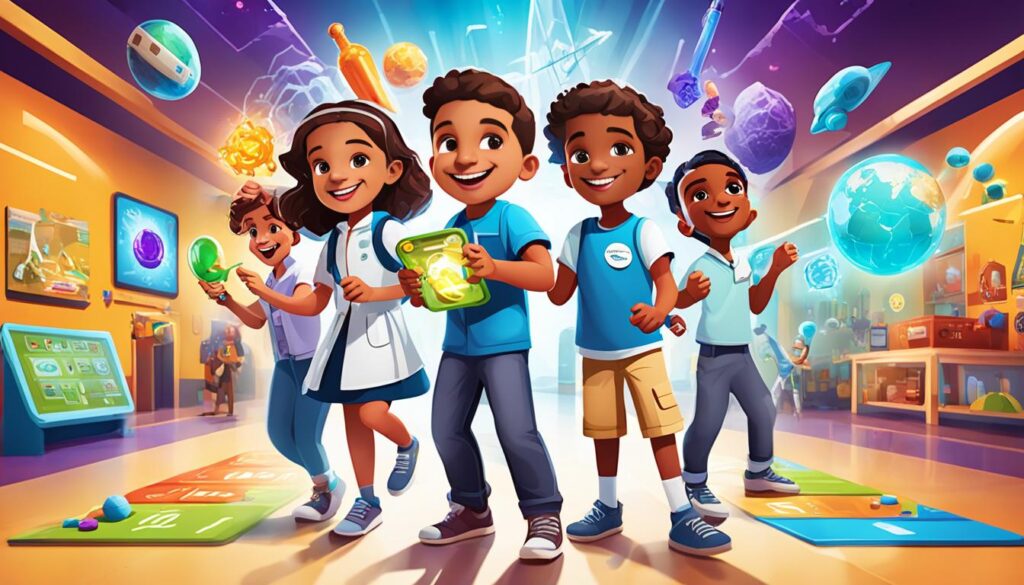
« Games increase motivation in students by helping them relax and open up while learning. Playing games in the classroom can boost energy levels, reduce stress, and promote problem-solving skills. »
With so many educational game themes, teachers can easily find games that fit their teaching goals. This makes learning fun and keeps students interested.
Conclusion
Educational games make learning fun and engaging for students. Teachers can make lessons more exciting by adding these games to their plans. This approach helps students develop important skills and knowledge.
When teachers learn and use educational games, they feel more confident. This confidence helps them teach better. Support from others, like technical help and recognition, makes it easier to use games in the classroom.
Schools that work together and support technology tend to do well with educational games. Teachers who share ideas online and get help with resources use games more effectively. By supporting teachers and helping them feel comfortable with technology, schools can make the most of educational games.