
Creating a personalized trading plan is key for traders aiming for steady success in the financial markets. This guide will help you make a trading plan that fits your needs. It covers basic and advanced strategies. You’ll learn how to set goals, manage risks, and execute trades effectively. It also touches on the mental side of trading to help you reach your goals.
Key Takeaways
- Developing a personalized trading plan is crucial for trade success.
- Incorporate key elements such as trading strategy, risk management, and market analysis.
- Tailor your plan to align with your financial goals, risk tolerance, and investment timeframe.
- Maintain a trading journal and continuously review and refine your strategy.
- Discipline and patience are essential in executing your personalized trading plan.
What is a Trading Plan?
A trading plan is a detailed guide for traders. It outlines their strategies, how they manage risks, and their financial goals. It acts as a roadmap for consistent and successful trading. The plan includes clear goals, a trading strategy, risk rules, market analysis, and ways to keep emotions in check.
Components of a Trading Plan
Creating a good trading plan means thinking about these key parts:
- Trading Strategy: A clear trading strategy matches the trader’s risk level, market study, and financial goals. It’s the base of a winning trading plan.
- Risk Management Rules: Rules for managing risk, like setting stop-loss levels and risk-reward ratios, are key. They help protect money and limit losses.
- Market Analysis: Studying market trends and economic signs helps traders spot good trades and make smart choices.
- Trading Psychology: Techniques for staying disciplined, controlling emotions, and avoiding biases are vital for steady trading.
- Financial Goals: Setting clear, SMART financial goals gives traders a clear path to their goals.
- Record-keeping and Evaluation: Keeping a trading journal and reviewing performance helps traders see what to improve and tweak their plan.
By focusing on these elements, traders can make a trading plan that fits their risk level, trading style, and financial goals. This boosts their chances of doing well in the markets over time.
« Success in trading relies on creating a personalized, dynamic trading plan incorporating individual financial goals, risk tolerance, and trading style. »
Importance of a Trading Plan
Creating a detailed trading plan is key for traders aiming for long-term success in the financial markets. It acts as a guide that helps with trading discipline, staying consistent, and making objective decisions. By sticking to a plan, traders can improve their performance and manage risk better.
A trading plan keeps traders on track with their goals. It sets clear objectives, strategies, and rules for managing risk. This roadmap helps traders stay calm and make smart choices, avoiding quick, emotional trades.
It also helps traders trade consistently, sticking to their strategies and risk rules. This is key for success, as it reduces the effect of emotions and biases that can mess up trading.
- Research shows that traders with a personal trading plan do better than those without one.
- Studies say traders with a plan make fewer emotional decisions, leading to more disciplined trading.
- Successful traders often credit their discipline to a solid trading plan.
A good trading plan is a strong tool for traders to deal with the financial markets and aim for steady success. It helps with objective decision-making, risk management, and performance improvement. This way, traders can make smart choices and reach their long-term goals with confidence and discipline.
« A good trade plan sets rules for how much risk you take on any trade, like not risking more than 2% – 3% of your account on one trade. »
Motivation and Time Commitment
Starting a trading plan means knowing why you want to trade and how much time you can give. It’s key to ask yourself why you’re entering the financial markets. Do you want financial freedom, the excitement of trading, or to grow your wealth over time? Figuring out your goals will help you make a plan that fits your dreams.
Understanding your motivation is just the start. You also need to know how much time you can spend trading. Trading isn’t just a hobby; it takes a lot of time and effort. You’ll need to spend time on market analysis, strategy making, and learning new things.
To make your trading plan work, set aside specific hours each week for it. This could be for research, putting your strategies into action, and managing risks. Having a set schedule helps you stay disciplined and use your time well.
| Trading Motivation | Time Commitment |
|---|---|
|
|
Finding the right balance between your trading goals and time commitment is key. By matching your goals with a realistic time frame, you lay the groundwork for a lasting and fulfilling trading career.
« The key to successful trading is to develop a plan that aligns with your personal goals and lifestyle. Understand what drives you and how much time you’re willing to dedicate to the process. »
Setting Realistic Trading Goals
Creating clear and reachable trading goals is key to a good trading plan. These goals should be specific, measurable, attainable, relevant, and time-bound (SMART). This makes them clear and actionable. Think about financial goals like target returns or portfolio growth. Also, consider performance benchmarks like a win-loss ratio or consistency in profits.
SMART Goals
The SMART framework is useful for setting trading goals. SMART means:
- Specific: Clearly define your trading goals, such as aiming for a 10% or 20% gain in your portfolio.
- Measurable: Quantify your goals, such as targeting a certain win-loss ratio or maximum drawdown percentage.
- Attainable: Make sure your goals are realistic based on your trading experience, resources, and market conditions.
- Relevant: Align your trading goals with your overall financial and lifestyle objectives.
- Time-bound: Set a specific timeline for achieving your goals, like within a 3-month or 6-month period.
By setting SMART trading goals, you create a roadmap for your trading journey. You can track your progress and adjust your plan as you learn and grow.

« Successful trading is about setting realistic goals, managing risk, and maintaining discipline. SMART goals can help you stay focused and motivated throughout your trading journey. »
Well-defined trading goals are a powerful tool. They help drive your portfolio growth, improve your trading performance, and enhance your risk management strategies.
Risk Management and Risk-Reward Ratio
Managing trading risks is key to a successful trading plan. Traders need to know their risk tolerance and set clear rules. This includes how much to invest, using stop-loss orders, and setting profit targets. The risk-reward ratio is important for making smart decisions and keeping risks low.
A trade with a reward:risk ratio of 2:1 was started at $100, with a stop at $90 and a profit target at $120. But, if the trade went well, the ratio changed to 1:2. This shows how the ratio changes as the trade moves in your favor.
When the price dropped to $95, the reward:risk ratio became 5:1. But, the trade conditions got tougher because the price had to move more to reach the profit target.
Using break-even stops isn’t a safe way to trade. Unrealized profits can still be lost. Instead, set stops at reasonable levels behind the price. Closing a trade early cuts the reward:risk ratio, making it 1:1.
Cutting losses early is smart because it limits potential losses. But, adding to losing trades is risky and can wipe out your account. Adding to winning trades is also not advised, as it can lower the reward:risk ratio.
Calculating the risk-reward ratio in trading is about dividing the profit by the maximum risk. A ratio of 1:2 means you could double your investment. For stocks, knowing this ratio helps figure out how profitable a trade could be.
Professionals look for risk-reward ratios above 1:2. Ratios below 1:1.6 are seen as too low. This ratio is a way to measure potential profits and losses objectively.
Investors aim for risk-reward ratios between 1:2 and 1:4. A 1:2 ratio is the minimum for many. Adjusting stop-loss limits can improve the risk-reward ratio for a better balance.
Managing risk well is important for traders, as big losses often lead to quitting. Never risk more than you can afford to lose. A good Risk Reward Ratio (RRR) is key for trading success.
Most pros recommend a Risk Reward Ratio (RRR) above 1. The 1% rule is popular, meaning not risking more than 1% of your account on one trade. This rule helps protect your account during losing trades. Aim for a risk reward ratio over 1 and a win rate above 50% for profits.
Improving your returns from 20% to 30% can grow your trading account a lot. Avoid risking too much on each trade. Proper position sizing is vital to keep risks at the right level. Understanding risk management and calculating risk before trading is key to making consistent profits.
Capital Allocation and Trading Capital
Figuring out how much trading capital to use is key to making a good trading plan. Traders need to look at their money and how much risk they can take. It’s important to only risk what they can afford to lose. Trading comes with risks and can lead to big losses.
For portfolio allocation, spreading investments across different assets and markets is smart. This helps reduce risk and makes trading more balanced. When deciding how much to put into each trade, it’s wise to risk no more than 2% of your total trading account size.
Leveraged trading, like with CFDs (Contracts for Difference), can make gains or losses bigger. While it can lead to bigger profits, it also means more risk. Traders should know the risks of leveraged trading and make sure they have enough capital to handle the ups and downs.
The main aim is to create a trading plan that fits with your financial goals, how much risk you can take, and your trading style. By wisely using your trading capital and managing risk exposure, you can boost your chances of doing well in the long run.
« At least six months to a year should be the minimum time period to measure any investment. »
When thinking about trading capital allocation, remember that investing and trading need patience and a long view. Traders should be ready to wait at least six months to a year to see if their trading plan works and make changes as needed.
With a solid trading plan that includes smart capital allocation and risk management strategies, traders can up their chances of doing well in trading over time.
Developing a Trading Strategy
Creating a trading strategy is key to trading success. Traders should think about their trading styles, like position trading or day trading. They should also match their strategy with their goals, risk level, and market knowledge. Using technical analysis, fundamental analysis, or both is vital for spotting good trades.
Trading Styles and Market Analysis
Every trader has a unique strategy that fits their risk level, capital, and goals. Building a winning strategy takes time and effort. It’s important to spend time learning about trading techniques and market analysis methods.
- Study: Learn about various trading strategies to find the right one for you.
- Backtest: Test the strategy on past data to see how it performed and what to improve.
- Practice: Use paper trading or a demo account to get used to the strategy before real trading.
- Implement: Be ready for market changes and adjust your strategy as needed.
- Journal: Keeping track of your trades helps you spot patterns and refine your strategy.
There are many resources available for learning trading strategies, like online platforms and educational materials. A good strategy needs clear rules for entering trades, setting stop-losses, and setting targets. Staying disciplined and journaling your trades can greatly improve your trading results.
« The first step in the development of a trading strategy is to determine what type of trader you are, your time frame of trading, and what products you will trade. »
Don’t expect your first trading strategy to make money right away. Keep trying, adapting, and learning to find a strategy that fits your trading style and market analysis.
Trading Journal and Record Keeping
Keeping a detailed trading journal is key to a personalized trading plan. Traders should write down their trades, reasons behind them, and how they felt. This helps them see patterns, strengths, and what needs work. It lets them keep improving their trading strategy.
Industry stats show that 97% of successful traders keep a journal to track their trades. Also, 85% say it helps them stick to their trading plan better.
About 70% of traders use special software for their journals. This software has extra features and tools. 63% of traders use risk management rules in these journals to limit losses.
- 55% of traders check their journals often to spot patterns in their trades.
- 42% set goals in their journals to see how they’re doing.
- 36% see their journals as a way to keep getting better at trading.
But, 25% of traders miss important details in their journals. This can affect their analysis and growth. Also, 18% have bad journaling habits that make their journals less useful.
10% of traders try different journal formats to see what works best for them.
| Conviction Level | Probability of Success |
|---|---|
| High Conviction | 80% |
| Low Conviction | 20% |
Looking at success rates by conviction levels helps traders improve their strategies. A trading journal is a key tool for this. It gives insights for better trading decisions.
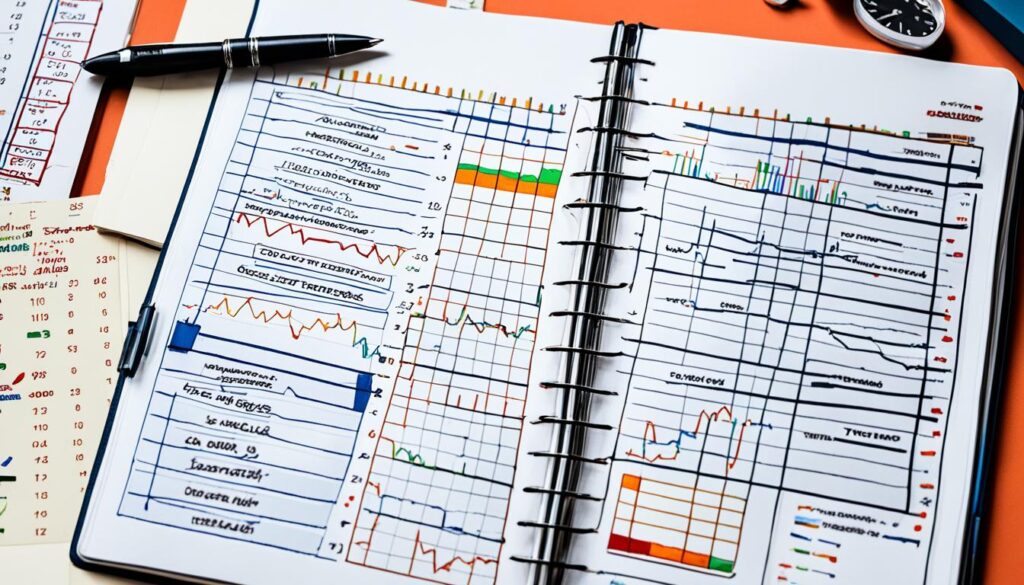
« Maintaining a detailed trading journal is essential for traders seeking to optimize their performance and continuously enhance their trading strategies. It serves as a powerful tool for self-reflection, pattern identification, and strategic refinement. »
Developing a Personalized Trading Plan Today
Creating a personalized trading plan is key for traders wanting consistent success. It involves setting goals, managing risks, and keeping records. This plan should match your trading style, goals, and how much risk you can take.
It’s important to keep updating your plan as markets and your life change. Sticking to a plan keeps you disciplined and in tune with the market. This leads to better trading results and less stress.
Successful traders plan their trading sessions ahead. They look at the big picture using the Daily timeframe to spot trends. They use support and resistance levels from this timeframe to make their trading decisions.
A good trading strategy includes defining how you trade, setting rules for stop-loss and targets, and managing risks. Where you set stop-loss and take-profit affects your trade’s success. It’s smart to size your trades by percentage to keep risks even.
To make a profitable trading strategy, follow five steps: study, backtest, practice, implement, and journal. It’s important to learn from online sources like YouTube, Twitter, and Discord groups. Knowing when to enter, set stop-loss, and aim for targets is crucial.
Testing your strategy in backtesting shows how profitable it could be and lets you tweak it. Some say to start with paper trading or a demo account. But, implementing a strategy means being disciplined, patient, and flexible. Keeping a journal of your trades is also key for spotting patterns and improving your strategy.
By making a trading plan that fits you and sticking to it, traders can improve their trading journey. This leads to more consistent and rewarding results in the markets.
Continuous Education and Improvement
Successful traders know the value of learning and getting better all the time. They keep up with market trends, economic news, and new trading methods. They do this by reading books, going to seminars, following financial news, and talking with seasoned traders.
It’s key to regularly check and tweak their trading plan with new info and their own trading stories. A solid trading plan helps with risk management strategies. This includes setting stop-loss levels, figuring out how much to invest, and setting limits on losses.
Trading objectives help track progress and check how well you’re doing. They set clear goals like ROI targets and improving consistency. It’s important to make these goals realistic to avoid getting discouraged.
Trading styles vary, like day trading and swing trading, needing different time, resources, and emotional strength. Traders should pick a style that fits their life, risk level, and what they like. The right strategy should match their skills, the market, and their goals.
Testing strategies with backtesting and demo trading is crucial. It lets traders test and improve their plans before risking real money. Risk management principles like how much to invest are key for Forex, stock, and cryptocurrency traders to protect their money and cut losses.
Learning and getting better is what makes a trader successful. By staying updated, improving their trading plan, and checking their performance, traders can make their strategies and performance better. This helps them reach their financial goals.
« Analyzing past trading decisions can help identify recurring patterns in behavior, such as exiting positions too early or chasing news headlines. »
In conclusion, trading education resources and a dedication to ongoing market research and self-improvement are key for traders aiming to succeed in the financial markets.
Maintaining Trading Discipline
Sticking to Your Trading Plan
Successful trading isn’t just about having a good plan. It’s also about sticking to it, even when the market changes or surprises you. Trading discipline is key to making money in the long run.
Traders who can’t manage their emotions and make impulsive decisions often lose money fast. Following their trading plan helps them stay disciplined. This plan includes strategies, risk rules, and plan adherence to help them through market challenges.
Keeping to your trading plan is important for trade execution. It’s hard to resist the chance for a quick profit. But, sticking to the plan’s rules is vital for steady and profitable trading.
« Discipline is the bridge between goals and accomplishment. » – Jim Rohn
Having a regular trading routine helps with discipline. This means setting time for market analysis, planning trades, and checking your portfolio. It keeps the trader focused and true to their approach.
By being disciplined and following their plan, traders can beat the emotional and psychological hurdles that can ruin trading. This leads to a more successful and profitable trading life over time.
Trade Evaluation and Monitoring
Keeping an eye on your trading is key to a good trading plan. It’s important to check your trading journal and look at your performance. Look at things like your win-loss ratios, average gains and losses, and how much you’ve lost. This helps you spot patterns, see what you’re good at, and find areas to get better.
By watching the market and looking at your trading data, you can learn a lot about how you make decisions and execute them. This info helps you tweak your trading strategies, change how you manage risks, and make smarter choices. This can lead to better trading performance.
Using AI-based engines from platforms like Tickeron is a great way to check your trading. These engines use neural networks and historical data to spot price patterns and trends. They give traders insights to improve their trade performance analysis and choices.
Staying on top of your trading helps you make smart moves and keep improving your trading journal review and strategy. This focus on getting better is what sets successful traders apart. They’re all about making the most of their market potential.
« Traders who survive and prosper in the long term are prepared for any eventuality. A comprehensive trading plan should encompass responses to a myriad of market scenarios. »
| Key Components for a Trading Plan |
|---|
| Setting clear goals |
| Emphasizing realistic expectations |
| Market analysis |
| Risk management techniques |
| Trade management plan |
| Trading discipline and consistency |
| Regular monitoring and evaluation |
| Continuous education and market updates |
Conclusion
Creating a personalized trading plan is key for traders wanting to do well in the financial markets. It includes setting goals, managing risks, developing strategies, and keeping detailed records. This plan should match the trader’s style, goals, and how much risk they can take.
Using this plan, traders should keep learning and stick to their discipline. This helps them deal with the market’s challenges and aim for long-term profits.
With a good trading plan, traders boost their chances of reaching their financial goals. Making and improving this plan is a journey that needs flexibility and a desire to learn. This approach gives traders an edge, helps them manage risks, and raises their success chances.
For both new and experienced traders, building a personalized trading plan is a smart move. Focusing on managing risks, learning more, and sticking to a disciplined approach boosts confidence. This way, traders can better meet their long-term trading goals.