
The founding fathers would be worried about today’s civic engagement in America. In 1776, the idea of self-governance was bold. The Declaration of Independence and the Constitution became key to American democracy. But without people taking part, our democracy won’t stand.
Ben Franklin urged « we the people » to protect our self-rule. Now, for many years, fewer people are getting involved in civic activities. Many Americans doubt the strength of our democratic system.
Key Takeaways
- Civic engagement is key for a strong American democracy and healthy communities.
- Volunteering and political action have dropped over the years.
- To keep the spirit of 1776 alive, citizens must engage with their communities and government.
- Volunteering and helping out in the community can help fix social and political issues.
- Young people need to be encouraged to take part in civic life and shape their community’s future.
The Importance of Civic Engagement
Civic engagement is key to self-government, but it’s been falling in the U.S. for years. Politics is often seen as broken, and civic education is lacking. This has made many Americans doubt our democratic system. To bring back the spirit of 1776, we all need to get involved in our communities and country.
Reviving the Democratic Spirit of 1776
Self-government takes hard work and action. It’s crucial to keep our democracy strong. Back in the 1960s, nearly 80 percent of Americans trusted the government. Now, less than 20 percent do. We must all work together to participate in decisions that affect our communities and nation.
| Civic Engagement Metric | Statistic |
|---|---|
| U.S. adults who consider themselves somewhat or very civically engaged | 56% |
| U.S. adults who believe voting can have an impact on their communities | 76% |
| U.S. adults who identify as « disengaged » due to lack of time, belief that participation won’t make a difference, or other factors | 44% |
| U.S. employers that grant time off for employee volunteering or community service | 26% |
We need to revive the democratic spirit and boost civic participation. By working together, we can make our democracy stronger. This will ensure self-government remains a force for good change.
« Civic engagement is the glue that holds self-government together. Yet, civic participation has been declining in the United States for decades. »
Understanding Civic Engagement
Civic engagement is more than just voting or going to town hall meetings. It means being active in community and democratic processes. Civic engagement lets people have a say in decisions that affect their lives. It’s about working for the good of the community.
Being invested in one’s community is at the heart of civic engagement. It depends on having access to resources and opportunities. If some don’t have equal access, they can’t fully participate. That’s why making civic spaces welcoming to everyone is key. It ensures all voices are heard and decisions benefit everyone.
| Division | Focus |
|---|---|
| Division 9 | Society for the Psychological Study of Social Issues (SPSSI) has been represented as an NGO at the United Nations since 1987 and has consultative status with the UN’s Economic and Social Council since 1991. |
| Division 18 | Psychologists in Public Service is comprised of five sections representing different settings, including Community and State Hospital Psychologists, Criminal Justice, Police and Public Safety, Program Evaluation, and Veterans Affairs (VA) Psychologists. |
| Division 27 | Society for Community Research and Action promotes the development of theory, research, and practice focused on the relationships between individuals and the social system within a community context. |
Civic engagement is key to a healthy democracy. It’s not just a personal duty. By getting involved, people can bring about positive change. They can shape their neighborhoods, cities, and the nation’s future.
« Civic engagement is about being involved in and caring about your community. It allows people to participate in community decisions and policies that affect their day-to-day lives, working toward the common good. »
Volunteering, attending meetings, or advocating for causes are all ways to engage. Civic engagement is crucial for a society that’s inclusive and democratic. By taking part, people can make a real difference. They can help create a better future for everyone.
Vote and Engage in the Voting Process
Voting lets you make your voice heard and keep elected officials in check. It’s key to vote in all elections, like primaries and local ones. These elections shape the decisions that affect your everyday life.
To help the voting process and get more people to vote, you can:
- Help others register to vote and make sure they know how to cast their ballots.
- Volunteer for get-out-the-vote efforts in your area, pushing your neighbors to vote.
- Support efforts to make voting easier for everyone, like improving language access.
- Push for laws that make voting easier and protect voting rights.
The right to vote is key to democracy. By voting, you hold your leaders accountable and shape policies that impact you. By voting, you can truly change your community and the nation.
« The right to vote is the foundation of any democracy. Protecting and expanding voting rights is essential to ensuring an inclusive, just, and equitable society. » – Stacey Abrams, Founder of Fair Fight Action
As the National Geographic article highlights, « Voting is the main way citizens in a democracy can shape their future. » By voting and encouraging others to do the same, you can lead the way in shaping your community and country’s future.
Stay Informed and Seek Credible News
Being well-informed is key to civic engagement. Today, it’s hard to know what news to trust. Look for reliable local news, fact-check info, and try to see things from different views.
Groups like AllSides, ProCon, and The Better Arguments Project offer balanced, non-partisan news. They help us make informed choices on political issues and candidates. By using various reliable sources and thinking critically, we can improve our news literacy.
Combating Misinformation and Echo Chambers
With political polarization on the rise, we must watch out for media bias. Look for different views, check facts, and avoid echo chambers. By opening our minds and questioning our beliefs, we can be more engaged and thoughtful citizens.
- Use fact-checking sites and tools to make sure info is true before sharing it online.
- Read news from local, regional, and national sources to understand events fully.
- Talk respectfully with people who think differently, and be open to their views.
« An informed citizenry is the foundation of a healthy democracy. Staying up-to-date and critically evaluating news is key for making informed decisions and shaping our future. »
By focusing on news literacy and seeking credible info, we can be more active and powerful citizens. This helps us face the challenges our society has.

Get to Know Your Representatives
Knowing who your elected reps are and what they care about is key to civic engagement. Sites like the Common Cause database and Ballotpedia let you check their votes, roles, and donations. You can also follow them on social media and sign up for newsletters to keep up with their work and views.
Talking often with your local and national elected officials is crucial for your political representation. By learning about their backgrounds and what they focus on, you can better speak up for what matters to you. This way, you can also keep them on their toes.
- Look into your reps’ votes, roles, and donations with databases like Common Cause and Ballotpedia.
- Keep up with your reps on social media and sign up for their newsletters to know what they’re doing.
- Talk directly to your reps by calling, emailing, writing, or meeting them to share your thoughts.
By getting to know your elected officials, you become a stronger civic engagement advocate. You help shape policies and decisions that affect your community and the whole country.
Contact Your Elected Officials
Getting involved in civic activities starts with talking to your elected reps. You can speak up for a cause, share concerns, or make sure they listen to you. Working with others and applying public pressure can really change things.
Go to public meetings, city council sessions, and community events to stay updated and speak out. Join groups like neighborhood clubs and Parent-Teacher Associations to help your area. Remember, your elected reps are there for you, so be active in shaping policies that affect you.
As per the resources, a unique, well-thought letter can be more powerful than many pre-written ones. Keep it short, focus on three key points, and add a personal story for more impact. Make sure to address officials correctly and follow up after your first contact.
Civic engagement is key to a strong democracy. By taking part in politics and keeping our reps in check, we can bring about real change in our communities and beyond.
« The best way to find yourself is to lose yourself in the service of others. » – Mahatma Gandhi
Take on the role of an active citizen and let your voice be heard. Together, we can influence local, state, and national politics.
Join Local Groups and Volunteer
Civic engagement is more than just voting. By joining local groups and volunteering, you can actively shape your community. You can volunteer with your local government or even run for office to make a difference. Being part of a local group strengthens your sense of community and civic duty. It also gives you a way to tackle big challenges and support social justice.
Volunteering is good for both the community and you. Studies show that those who volunteer have better mental health and happiness. It can reduce anxiety and depression, especially for older people, helping to keep their minds sharp.
There are many ways to help out, like working at a food bank, cleaning up the neighborhood, or being on a local board. Start by finding groups that match your interests and values. Working with others lets you make a bigger difference and improve your community.
| Metric | Statistic |
|---|---|
| Percentage of citizens who volunteer in their community | 26.6% |
| Voter turnout rate during elections | 66.1% |
| Percentage of citizens participating in digital citizen platforms for community input | 18.4% |
| Ratio of citizens supporting local businesses | 3:1 |
| Environmental impact data on waste reduction and recycling rates | 12% increase in the past year |
Civic engagement is a duty, not just a right. By volunteering and joining groups, you help make your community stronger and more connected. You also gain from social connections and a sense of purpose.
Civic Engagement for Youth
It’s vital to teach young people about community and civic duty for our democracy’s future. By taking part in civic activities, they learn how to make a difference in their communities. They can volunteer, join national service, or work on service-learning projects to become active citizens.
Empowering Youth Through Civic Engagement
Only about half of young Americans vote in presidential elections, and just 10% of those 18-24 were well-informed in 2012. This is a big issue for Hispanic, Black, and low-income students, who often don’t get enough civics education.
Teachers and community leaders are trying to change this. They offer more chances for young people to get involved. Service-learning, for example, helps students use what they learn in school to solve real problems. This has been shown to make students more likely to talk about tough issues, join groups, and get involved in politics.
Also, making sure students’ activities match their interests helps keep them engaged. By letting young people help out in their communities, we’re building a future with more informed and active citizens.
| Civic Engagement Activity | Impact on Youth |
|---|---|
| Volunteering | Develops a sense of civic duty and community responsibility |
| National Service | Fosters leadership skills and a commitment to public service |
| Service-Learning | Connects academic knowledge to real-world problem-solving |
By doing these civic activities, young people learn why it’s important to participate. They get the skills to be active, informed citizens. As we aim to strengthen our democracy, focusing on youth civic engagement is key for a brighter, more inclusive future.
Resources for Civic Engagement
Civic engagement is key to a strong democracy. There are many resources to help people and communities join in. The U.S. Department of Education’s Office of Safe and Drug Free Schools, AmeriCorps, and the YSA Knowledge Center offer guidance and tools.
These groups aim to boost civic engagement and character education. They give people the skills and motivation to take part in civic life. You can find resources on voting, community projects, and programs for young people.
Civic Education and Community Resources
- The California Department of Education (CDE) offers resources for SSCE programming for K–12 students.
- Chief Justice Tani G. Cantil-Sakauye and then-State Superintendent of Public Instruction Tom Torlakson started the California Task Force on K–12 Civic Learning in 2013. They held civic learning summits in 2013 and 2017.
- The Civic Learning Award for California Public Schools has three levels: Awards of Excellence, Distinction, and Merit.
- Senate Bill 955 amended Education Code Section 48205 in 2022 to include excused absences for middle or high school students for civic or political events.
Youth Engagement and Character Education
For young people, check out AmeriCorps and the YSA Knowledge Center. They offer programs and tools for youth to become active, engaged, and informed citizens.
| Resource | Description |
|---|---|
| Through this online game from iCivics, students will discover what it takes to become an informed voter. | Students can watch candidates discuss important issues in Town Hall debates, identify issues that matter to them, and rate candidates’ stances. |
| The Project Citizen Curriculum | This program is anchored in student voice, public policy knowledge, and advocacy, empowering young people to address community issues. |
By using these resources, people and communities can learn, grow, and get involved in civic life. This helps build the democracy we all want.
The Power of Collective Action
Civic engagement is more than just individual actions. It’s about working together to make a difference. When people unite for common goals, they can tackle big challenges, fight for social justice, and make democracy stronger.
Studies say that combining specialized knowledge with community values leads to better decisions. This shows how important it is to listen to the community. By doing so, we can get more support and action from the community itself.
Community engagement aims to bring together different people for lasting solutions to big problems. It’s becoming more popular. People who really get involved in their communities are more likely to help make better choices.
History shows us how groups can change society and politics. For example, in 2010, people in France protested against raising the retirement age. In Italy, there were big rallies against the government. These actions showed how citizens can stand up for what they believe in.
There are many reasons why people join groups to act together. Some think it’s smart, others feel it’s right because of who they are, and some are driven by strong feelings or beliefs. But no matter why, when people speak up together, they can really make a difference.
« Calls for increased community engagement have been made as policymakers and practitioners realize that incorporating community values into decisions can increase the likelihood of community acceptance and community-led action. »
By working together, communities can face big challenges and shape their democracies’ future. This is what makes citizens powerful and engaged.
Civic Engagement and the Future of Democracy
Civic engagement is key to a healthy democracy. It makes sure everyone’s voice is heard and decisions benefit the community. By taking part in civic life, we shape our nation’s future and keep democracy alive. It’s a way for citizens to make a difference in their lives and communities.
Today, we see more young people joining causes like fighting climate change. This shows how civic engagement is changing and adapting. Social entrepreneurship and civic action are now linked, bringing new solutions to society and politics.
But, some groups still face barriers in joining in. We need to make sure everyone can take part, no matter their background or access to technology. Amplifying the voices of marginalized communities is key to making real change happen.
Platforms like the Instant Input platform help people share their views and connect with others. They make it easier for citizens to get involved and build a stronger community.
Programs like the six-week intensive studio teach the next generation about civic engagement. They learn how design affects politics and the history of civic action. This prepares them to be active citizens who can bring about change.
Looking ahead, our democracy’s success relies on everyone’s active civic engagement. By embracing new ways to participate, tackling inequality, and empowering people to speak up, we can keep our democracy strong. This will guide us into the future.
| Statistic | Value |
|---|---|
| Budget allocated for projects related to reshaping democracies | €9,000,000 |
| Date of closure for applications | April 20, 2022, at 17:00 |
| Focus area | Civic participation and co-creation in democratic life at scale |
| Expected outcomes | Enhance civic participation and improve the articulation between deliberative processes and representative institutions |
« Civic engagement is not just a responsibility but a powerful tool for citizens to influence the policies and decisions that affect their lives and their communities. »
The « Democracy 76 » Checklist
In today’s world, the « Democracy 76 » checklist is a key guide for boosting civic engagement. It offers clear steps for all Americans to get involved, no matter their political views. This guide aims to bring back the democratic spirit of the United States’ founding.
The checklist includes many activities, like staying updated and voting. It also covers taking part in politics and helping your community. By following this guide, citizens can fight the loss of trust in government. They can keep self-government strong and alive for the future.
- Register to vote and take part in elections at all levels.
- Learn about important issues by reading a variety of trustworthy news sources.
- Talk to your elected officials and go to town hall meetings.
- Help out with local groups to tackle big issues.
- Encourage others, especially the young, to get involved in civic activities.
- Support policies that improve civic education and democratic structures.
- Have respectful conversations with people who think differently.
- Join in on local government meetings and help make decisions.
- Push for changes that make politics more open, honest, and accessible.
- Do more than just vote; consider running for office or joining a campaign.
The « Democracy 76 » checklist is a call to action for those who care about civic engagement, civic participation, and democratic citizenship. By doing these things, we can make our communities stronger. We can also make our democratic system better. This will keep the spirit of 1776 alive in our country’s future.
| Key Statistic | Significance |
|---|---|
| In the 1960s, nearly 80% of Americans trusted the government to do the right thing always or most of the time; presently, less than 20% of the American public trusts the government. | This drop in trust shows we need to boost civic engagement and democratic citizenship. |
| Almost one in four Americans thinks a dictator could be a good way to run the country. | This fact shows why it’s crucial to promote civic participation and community involvement to uphold democratic values. |
| Civic participation and engagement have been falling for many years. | The « Democracy 76 » checklist aims to reverse this trend. It encourages more civic engagement among all Americans. |
By following the « Democracy 76 » checklist, we can work together to bring back the democratic spirit of our nation. Through active civic engagement and a strong commitment to democratic citizenship, we can keep our values of self-government and community involvement alive for the future.
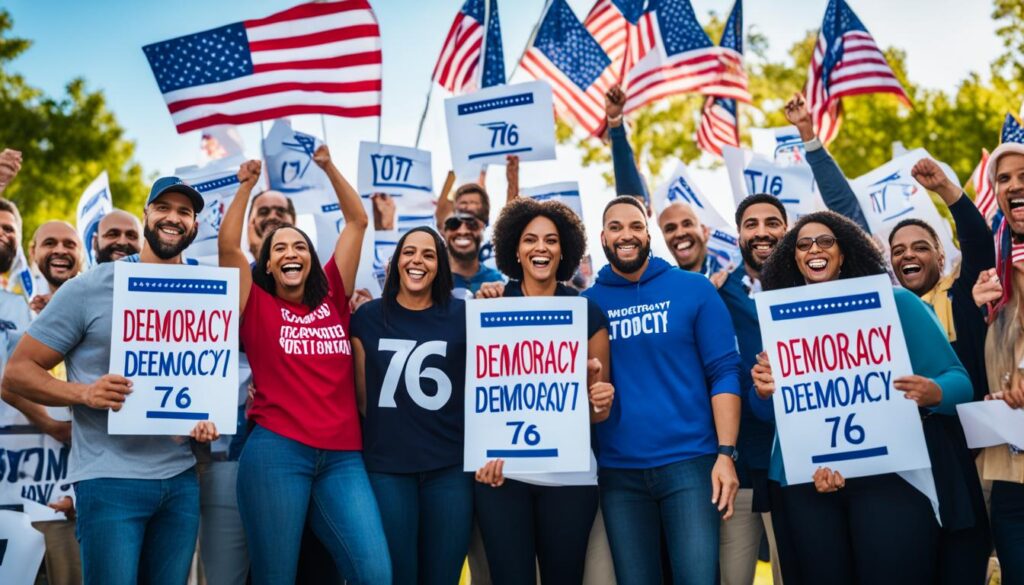
Civic Engagement in Action
Around the U.S., people are getting involved in their communities. They’re tackling big issues and making democracy stronger. They’re signing up voters, going to meetings, volunteering, and even running for office. This shows how people are taking action to use their rights and duties.
These actions show the strength of working together. They highlight how active citizens can change their communities and the country for the better.
Empowering Communities through Collaborative Initiatives
A clothing drive for Sheridan Prison showed the power of helping inmates after release. It helped them reintegrate into society. Students talked to Illinois legislators about the need for physical education in schools. They showed how important it is for kids to stay active.
Graphic design students worked with community groups, learning by doing. They helped with local projects. Students in another class raised money to help a child in Congo go to school. This stopped the child from working too early.
Fostering Sustainable Solutions and Community Dialogue
Students in psychology helped Pet Central Helps Animal Rescue and Shelter. They worked on behavior plans and training programs. The Fashion Design and Merchandising Association fixed clothes for free to cut down on waste and support sustainable fashion.
A rally called Take Back The Night was held on campus. It focused on safety and fighting gender-based violence. A fraternity helped Habitat ReStore, supporting housing projects and community development.
Amplifying Voices and Addressing Social Issues
The Illinois State Theatre brought up social issues through plays. This sparked conversations in the community. A study found civic engagement comes in three forms: civic, electoral, and political voice.
More young people are volunteering but fewer are voting or getting involved in politics. This shows a change in how people participate. The State of the World’s Volunteerism Report 2015 pointed out the importance of volunteers in improving governance.
37 online volunteers from around the world worked together. They helped with the UN E-Government Survey. This shows global efforts in civic engagement.
Conclusion
Civic engagement is key for every American. It keeps our self-government strong. By staying informed and participating in elections, we keep our democracy alive.
Our founding fathers asked us to protect self-government. It’s our duty to keep our democratic values alive. Active participation is how we show our commitment to our country.
Let’s keep our focus on democratic self-government. Together, we can build a strong community. With passion and purpose, we’ll keep the U.S. a symbol of freedom and self-determination for the future.