
The Olympic Games are the top event in global sports, but they’ve seen many scandals. Athletes have broken rules on doping, eligibility, and more. These actions can lead to serious penalties, like being banned or losing medals.
This article looks at big cases that shook the Olympics. It also talks about the challenges the International Olympic Committee (IOC) and sports groups face in enforcing rules.
Key Takeaways
- The Olympic Games have a long history of scandals and controversies related to rule violations by athletes.
- Consequences of breaking Olympic rules can include disqualifications, suspensions, bans, and stripped medals.
- Doping and performance-enhancing drugs are major issues, with anti-doping rules strictly enforced.
- Eligibility and nationality disputes have led to controversial cases and disqualifications.
- Unsportsmanlike conduct, such as bribery and age fraud, can also result in severe penalties.
Eligibility Rules and Controversies
The debate over who can compete in Olympic events has been ongoing. It centers on sex verification testing and testosterone level restrictions. Cases like Caster Semenya and Dutee Chand have made us think about gender identity and biological differences in sports.
Sex Verification Testing in Women’s Sports
Creating eligibility rules for women’s sports has been tough. The International Olympic Committee (IOC) has changed its rules many times. They used to require genital surgery for gender transition but now look at testosterone levels instead.
But, these rules are not without their critics. Some say they unfairly target athletes like Semenya and Chand because of their natural body traits. The Caster Semenya case and the Dutee Chand case have made people talk about what’s fair in women’s sports.
The ongoing changes in gender identity and testosterone rules in the Olympics mean these debates will keep going. They challenge sports groups to find ways that are fair and welcoming to everyone.
Doping and Performance-Enhancing Drugs
Olympic athletes often use banned performance-enhancing drugs, a big problem for the Games. Athletes use steroids, blood doping, and designer drugs to cheat. These doping scandals have hurt the Olympics’ reputation. This article looks at how athletes cheat, the fight against it, and the harsh punishments for those caught.
A 2015 study in Sports Medicine found that 14% to 39% of elite athletes use performance-enhancing drugs. Endurance athletes might use erythropoietin (EPO) to increase their oxygen supply. This helps them perform better.
Anabolic steroids help athletes build lean muscle and recover faster. Human growth hormone is banned but used by some to grow muscle and get stronger. But, these drugs can cause serious health issues like heart problems and mood changes.
« Despite health risks, many athletes are still attracted to using performance-enhancing drugs due to the competitive advantages they offer. »
The history of doping in the Olympics goes way back. The first athletes were banned in 1972 for using stimulants. Anabolic steroids became popular in the 1950s for strength and power. Erythropoietin was used in the 1990s to boost endurance.
Anti-doping efforts have been hard to keep up with as athletes find new ways to cheat. Despite tough penalties like disqualification and long bans, some athletes still risk it all for Olympic success.
The fight against doping is a big challenge for the International Olympic Committee and sports worldwide.
breaking olympics rules
The Olympic Games are a top event in sports, known for fair play and sportsmanship. Yet, they’re not perfect. There have been cases of athletes and teams breaking rules or cheating to win. These cases include doping and issues with who can compete.
In the 2012 London Olympics, badminton players from several countries were accused of losing matches on purpose. They wanted to change the tournament’s seeding for easier matches later on. This action was seen as a big betrayal of the Olympic spirit and led to the disqualification of many players.
Swimmers have also faced scrutiny for bending the rules. At the 2016 Rio Olympics, one swimmer was caught using an illegal technique called « dolphin kicking » during a race. This small rule-breaking can challenge the fairness of the Olympics.
These examples show how the rules and rewards can sometimes lead to bad behavior. By looking into violating Olympics rules, Olympic rule breaking, and cheating Olympics, we can see the challenges in keeping the Olympics fair and honest.
| Infraction | Consequences | Impact on Sportsmanship |
|---|---|---|
| Badminton players intentionally losing matches | Disqualification | Undermined the spirit of fair competition |
| Swimmer admitting to illegal « dolphin kick » | Unknown | Highlighted the temptation to bend the rules for a competitive edge |
« The Olympic Games are a lot more than just a competition between individual athletes or teams of athletes. They’re really about promoting understanding, tolerance, and goodwill between the countries of the world. » – Juan Antonio Samaranch, former President of the International Olympic Committee
As the Olympics change, keeping a balance between competition and ethics is hard. By dealing with cases of violating Olympics rules and Olympic rule breaking, the organizers and athletes can keep the Olympics fair and true to their values.
Nationality and Representation Issues
The Olympic Games have always brought up big questions about national identity and how countries are represented. There have been debates over which countries can take part and athletes changing their national teams. These issues show the complex mix of politics and culture in national identity.
Controversies Over National Identities
One big debate is about national representation in the Olympics. Some athletes can’t compete for their country because of political issues or questions about their citizenship and nationality. These cases make us think about how to balance individual rights, world politics, and the Olympic spirit of fair play.
Also, showing national symbols like flags and anthems has caused arguments. Some say these symbols can divide people and go against the Olympic idea of unity. The debate on national representation in the Olympics keeps going. It mirrors wider talks on what it means to be part of a nation and how sports affect our culture and politics.
« The Olympics have always been a platform for the expression of national identity, but we must ensure that this expression is inclusive and respectful of the diverse backgrounds and perspectives of all athletes. »
The Olympic movement aims to bring people together worldwide. Yet, figuring out how to handle the mix of nationality, citizenship, and national representation is still a big topic of talk and argument.
Disqualifications and Suspensions
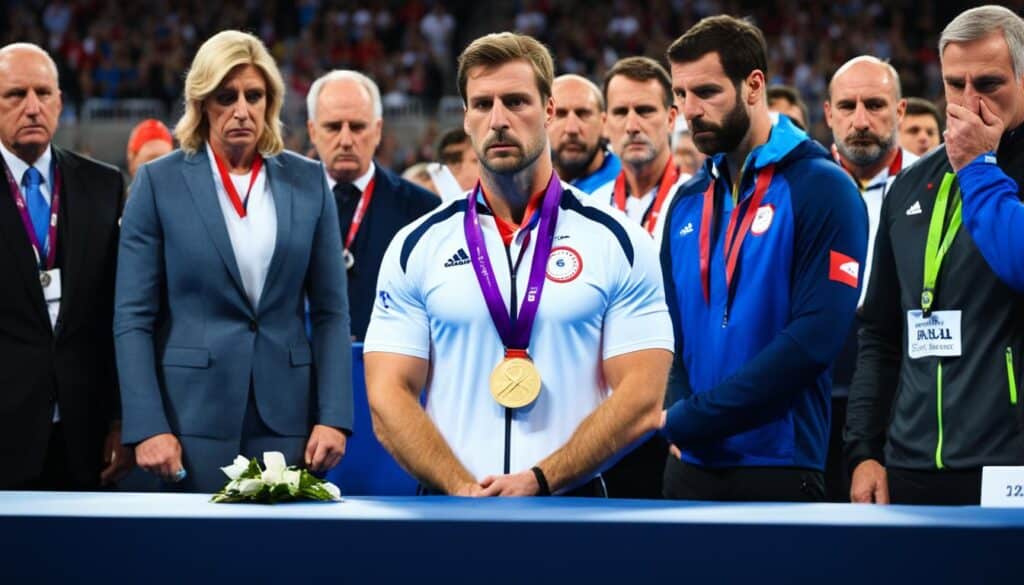
The Olympic Games are known for their commitment to fair play and sportsmanship. Yet, the drive for victory can push athletes to cross ethical lines. This leads to disqualifications and suspensions that can greatly affect their careers and legacies. Doping violations and unsportsmanlike behavior are just a few reasons athletes face harsh penalties.
In recent times, we’ve seen many athletes get disqualified or suspended from the Games. Badminton players were disqualified for not trying in matches. Others lost their chance to compete for tweeting questionable tweets or posing with guns for photos. Even a simple error, like a runner being disqualified for jogging during his qualification heat in the 800 meters, can have a huge impact.
The issue of performance-enhancing drugs (PEDs) is a big problem in the Olympics. Athletes caught doping, like Lance Armstrong and Marion Jones, have faced harsh penalties, including the stripping of their medals. The World Anti-Doping Agency (WADA) is key in stopping the use of banned substances. Athletes who test positive may be suspended from competing for a long time.
| Violation | Consequence |
|---|---|
| Doping (PEDs, stimulants, opioids) | Suspension, stripped medals |
| Unsportsmanlike conduct | Disqualification, expulsion |
| Failure to meet requirements (age, gender, uniforms) | Disqualification |
Being disqualified or suspended can be very hard for athletes, changing their careers and legacies forever. The Olympic movement keeps up the values of fair play and ethical behavior. This means enforcing rules and regulations is key to keeping the Games honest.
« The Olympic Games are a competition where the world comes together to celebrate the values of fair play and sportsmanship. When athletes break the rules, they not only damage their own reputations, but they also undermine the trust and respect that the Olympics strive to promote. »
Boycotts and Political Protests
The Olympic Games have been a place for political statements and protests. Countries and athletes have boycotted the event to speak out on various issues. The history of Olympic boycotts is complex, filled with Cold War conflicts and recent events that have changed the Olympics forever.
Historical Boycotts of the Olympics
Olympic boycotts have greatly affected the Games. Countries have pulled out to make political statements. Some key examples are:
- The 1936 Berlin Olympics were under Nazi Germany’s shadow. Jewish athletes from many countries boycotted the event.
- At the 1956 Melbourne Olympics, countries like Egypt, Lebanon, Iraq, Netherlands, Spain, and Switzerland didn’t attend due to political issues.
- The 1968 Mexico City Olympics saw American athletes make the Black Power salute during their national anthem.
- In 1976, twenty-five African countries boycotted the Montreal Olympics because of New Zealand’s rugby team tour to South Africa.
- The 1980 Moscow Olympics were boycotted by the U.S. and over 60 countries, in response to the Soviet Union’s invasion of Afghanistan.
- The 1984 Los Angeles Olympics were boycotted by the Soviet Union and other Eastern Bloc countries, citing security concerns.
These boycotts and protests have deeply influenced the Olympic movement. They show how sports and global politics are connected.
« Sports and politics have always been intertwined. The Olympic Games are no exception, and political protests have become a regular feature of the event. »
Judging Controversies and Scandals
The judging controversies, scoring scandals, and refereeing issues have been a big problem in the Olympics. Many have accused judges of bias, incompetence, and even corruption. This has led to debates about the fairness of the games.
At the 1988 Summer Olympics, American boxer Roy Jones Jr. lost to South Korea’s Park Si-Hun, despite throwing more punches. This led to big changes in how boxing was judged.
In the 2002 Winter Olympics, figure skating was hit by a scandal. Marie-Reine Le Gougne of France said she was forced to give Russia the win. This led to a big update in how figure skating was judged.
| Year | Event | Controversy | Outcome |
|---|---|---|---|
| 1988 | Boxing | Roy Jones Jr. vs. Park Si-Hun | Jones lost despite landing more punches |
| 2002 | Figure Skating | Marie-Reine Le Gougne controversy | Judging system overhauled |
| 2004 | Gymnastics | Yang Tae-young missed gold by 0.1 points | Scoring error discovered later |
| 2016 | Boxing | Scoring system revamped | Only 3 out of 5 judges’ scores counted |
These examples show how big of an impact judging controversies and scoring scandals have on the Olympics. The people in charge have tried to make judging more transparent and fair. But, these issues keep happening, leading to debates on how to fix them.
Age Fraud and Misrepresentation
Some athletes have faked their age to win in the Olympics. They do this to look younger or to get ahead of others. This cheating has been a big problem for sports leaders who want everyone to play fair.
Cases of Age Manipulation
Claims of age cheating in the Olympics are not new. Even in ancient times, some athletes were caught cheating. Today, we see athletes lying about their age, gender, or using drugs to win.
According to Merton’s theory, some athletes use illegal ways to win, like steroids. This is seen as a sign of confusion or not knowing what’s right.
| Breakdown of Age Fraud Cases | Age Misrepresentation Ratio | Frequency of Age Fraud Cases |
|---|---|---|
| Out of the total reported fraud cases in competitive dance events, X% were related to age misrepresentation. | The ratio of age fraud cases compared to other forms of fraud in dance competitions stood at X:Y in the past year. | An average of Z age fraud cases were detected per dance competition season. |
| Impact of Age Fraud | Age Fraud Across Dance Categories | Legal Consequences of Age Fraud |
| Age fraud resulted in an average suspension period of X months for the athletes involved. | Among the different dance categories, Latin dance had the highest percentage of age fraud cases, representing X% of total fraud instances. | Age fraud led to legal actions being taken against athletes in Z% of the cases reviewed. |
Sports leaders have a hard time checking athletes’ ages, especially when documents are missing or wrong. The Olympics aim for fair play and ethics. Stopping age fraud is very important to them.
Unsportsmanlike Conduct and Fair Play
The Olympic Games showcase amazing athletic feats but also see unsportsmanlike acts. These actions hurt the fair play spirit. It’s not just breaking rules that’s a problem, but also hurting sportsmanship and teamwork.
At the 2016 Rio Olympics, Egyptian judoka Islam El Shehaby didn’t shake hands with his Israeli opponent, Or Sasson, after losing. This move was seen as a big disrespect. It led to El Shehaby being suspended from the Games.
« The practice of sport is a human right. Every individual must have the possibility of practicing sport, without discrimination of any kind and in the Olympic spirit, which requires mutual understanding with a spirit of friendship, solidarity and fair play. »
– Olympic Charter
Fair play is key to the Olympics, standing for integrity, respect, equality, and responsibility. The International Fair Play Committee says fair play means more than just following the rules. It’s about friendship, respecting others, and playing with the right spirit.
The Olympic Charter bans discrimination and pushes for values like excellence, friendship, and respect. The International Olympic Committee (IOC) has a program to teach these values to young athletes and fans.
Fair play isn’t just on the field. It’s also in education, where classes and sports leagues teach respect and inclusion. This helps build a positive sporting culture.
As the Olympics grow, keeping up high standards of sportsmanship and fair play is key. The IOC and the sports world must keep these values alive. This is crucial for the Olympic spirit’s integrity and legacy.
Consequences and Penalties
Breaking Olympic rules can lead to serious penalties. Athletes might lose their medals, get suspended, or even banned from future Games. These actions not only affect their careers but also shadow their legacies and the Olympic movement’s integrity.
Sanctions and Punishments
One common punishment is being disqualified from the event. This means losing any medals or standings earned. Athletes could also face bans from future Olympics, either temporarily or for life.
Teams and countries can also be punished for their athletes or officials’ actions. This can include losing medals, having accreditation withdrawn, or being banned from future Olympics.
| Violation | Penalty | Notable Examples |
|---|---|---|
| Doping | Disqualification, suspension, stripping of medals | Ben Johnson (1988 Seoul), Marion Jones (2000 Sydney) |
| Age Fraud | Disqualification, suspension | Gymnasts from China and North Korea |
| Unsportsmanlike Conduct | Disqualification, warning, fine | Looting and vandalism at the 2016 Rio Olympics |
The impact of breaking Olympic rules is huge on athletes’ careers and reputations. The strict penalties aim to maintain the Olympic spirit of fair play. They act as a warning to others and highlight the Olympics’ commitment to integrity.
Code of Conduct and Ethical Standards
The International Olympic Committee (IOC) has set a strong Olympic code of conduct and ethical standards for athletes, coaches, and officials. These rules help keep the Olympic Games fair and true to the Olympic values and principles of excellence, friendship, and respect.
The Olympic code bans doping, betting, and other unfair play. It also stops the misuse of secret info. Breaking these rules can lead to penalties like being suspended or banned for life, based on how serious the offense is.
| Violation | Average Sanction |
|---|---|
| Betting Offence | 11 years |
| Manipulation of Competition and Corrupt Conduct | 12 years |
| Inside Information | 14 years |
| Failure to Report and Failure to Cooperate | 15 years |
The Olympic Movement Code on the Prevention of the Manipulation of Competitions says a lifetime ban is the top penalty for big violations. The International Convention against the Manipulation of Sports Competitions also stresses the need for strong rules and penalties to stop such wrongdoings.
There’s a debate on how to balance enforcing the Olympic code with letting athletes express themselves. As sports change, the IOC and sports groups must keep updating their rules. This helps protect the Olympic spirit.
Technological Advancements and Rule Changes
The Olympic Games are always changing, and so are the rules to keep up with new tech. The International Olympic Committee (IOC) and sports groups face a big task. They must balance fairness and new tech solutions.
Adapting to New Technologies
Technology has greatly changed the Olympics. In swimming, for example, new swimsuits have changed the game. In 1924, the 100m freestyle gold took over a minute to win. But by 2020, the time was down to 46.4 seconds.
Women’s swimming has seen even bigger changes. The time for the 100m freestyle went from over 1 minute in 1924 to 51.96 seconds in 2020. This is thanks to tech advances in swimsuits.
Full-body swimsuits in 2008 led to many world records. But, these suits were banned in 2009 to keep the sport fair. Now, men’s suits cover the waist to knees, and women’s from shoulders to knees.
| Event | 1924 Record | 2020 Record | Percentage Improvement |
|---|---|---|---|
| Men’s 100m Freestyle | 59.0 seconds | 46.4 seconds | 21.4% |
| Women’s 100m Freestyle | 72.2 seconds | 51.96 seconds | 28.0% |
Other sports have seen big changes too. Football got goal-line technology, and diving got the DiveCam. These tools give athletes and fans better data. But, keeping the Olympics fair and true is still a big challenge.
« The Olympic Games are a constant evolution, and as technology continues to advance, we must be vigilant in ensuring that the rules and regulations keep pace to preserve the spirit of fair play and the purity of competition. »
Governance and Rule Enforcement
The Olympic movement has a complex system for governance and rule enforcement. This system keeps the Games fair and honest. The International Olympic Committee (IOC) and sports federations make rules for athletes and competitions.
They face a big challenge. They must balance Olympic ideals with changes in sports technology and global politics. The Olympic governance and rule enforcement need to keep up with new issues and controversies.
Collaborative Efforts to Ensure Integrity
The IOC works with groups like Interpol to fight against sports corruption. They have started the Integrity in Sport program to protect sports from cheating. This program watches betting, raises awareness, and shares information to stop corruption and match-fixing.
- The IOC’s Integrity Betting Intelligence System (IBIS) helps watch betting and find cheating in real-time.
- They also use data protection laws and training to fight threats to the Olympic Games.
Evolving Governance Principles
The IOC has made its governance better, following the Basic Universal Principles of Good Governance. These principles were first set in 2009 and updated in 2021. They help with making decisions in a fair, open, and responsible way.
- They make sure at least 30% of leaders are women.
- They publish financial statements and reports every year.
- They have clear rules for electing leaders.
- They keep their websites updated and informative.
The IOC and its partners keep working on Olympic governance and rule enforcement. They aim to keep the Olympic Games fair and honest, even with new challenges.
Athlete Perspectives and Reactions
Voices of Olympic Athletes
The world is excited for the 2024 Paris Olympics and the new sport of breaking. Olympic athletes share their thoughts and experiences. They talk about the highs and lows of competing at the top level.
Logan Edra is a rising star in breaking and made it to the Paris Olympics last month. He was ranked 14th in the world. Edra says breaking is big worldwide but not as much in the U.S. He talks about the challenge of performing an American dance form against international competition.
At the Olympics, 16 men and 17 women will compete in breaking. The women’s event has an odd number of participants. This means two of the lowest-seeded women will have a special round to see who moves on. This shows how athletes must adjust to new rules and criteria.
« Breaking transformed from a party dance to a competitive art form with hundreds of events globally, highlighted by events such as Red Bull BC One. »
Olympic athletes face a lot of pressure but love their sport and the chance to represent their countries. As breaking debuts at the Paris Olympics, their views will shape the story of this new Olympic sport.
Conclusion
The Olympic Games have always been a place for top athletes and big debates. They face challenges like rule-breaking and unsportsmanlike behavior. These issues test the Olympic movement’s integrity and leadership.
As the Games change, having strong and flexible rules is key. A deep commitment to sportsmanship and fair play is also vital. This helps keep the Olympic Games true to their values.
Adding breakdancing to the 2024 Paris Olympics is a big change. It brings in younger fans and celebrates the creativity of this urban dance. But, adding breakdancing has brought its own problems, like rules and judging issues.
At the 2024 Paris Games, everyone will watch how the International Olympic Committee handles these problems. The way they deal with these issues will affect the future of the Olympics. It will make sure the Games stay true to fairness, integrity, and the real spirit of sportsmanship.