
Short-term trading in the stock market can be both lucrative and risky. To navigate this complex landscape successfully, it’s essential to master various analysis techniques that can help you make informed trading decisions. Whether you’re a beginner or an experienced trader, understanding these techniques is crucial for maximizing profits and minimizing losses.
Short-Term Trading Basics
Spotting good short-term trades requires a solid understanding of the basics. This involves watching moving averages, identifying overall cycles or patterns, and staying informed about market trends. Additionally, controlling risk is paramount. Utilizing sell stops or buy stops can help limit potential downside, ensuring you protect your investments at all times.
Technical Analysis Tools
Technical analysis plays a vital role in short-term trading. By examining past price and volume patterns, you can predict future market movements. With the help of various tools, such as buy and sell indicators like the relative strength index (RSI) and the stochastic oscillator, you can identify optimal entry and exit points for your trades. Additionally, analyzing stock charts that display patterns like head and shoulders, triangles, double tops, and double bottoms can help predict price movements, giving you an edge in the market.
Fundamental Analysis vs. Technical Analysis
Both fundamental and technical analysis are essential components of successful stock market analysis. While fundamental analysis focuses on evaluating a security’s intrinsic value based on earnings, costs, assets, and liabilities, technical analysis relies on historical price and volume data to predict future market trends. By understanding the strengths and weaknesses of each approach, you can make well-informed trading decisions that consider both a security’s fundamentals and its technical indicators.
Gann Theory and Analysis Techniques
Gann theory is another powerful tool used by traders to analyze the stock market. Developed by the legendary trader W.D. Gann, this theory combines elements of geometry, time cycles, and price levels to predict future market movements. By applying Gann analysis techniques, you can gain valuable insights into market trends and potential trading opportunities.
Gann Indicators
Gann indicators are specific tools derived from Gann theory that assist in identifying key levels and trends in the market. These indicators, such as Gann angles, Gann squares, and Gann fans, help traders make more accurate predictions and determine optimal entry and exit points for their trades.
Gann Time Cycles Analysis
Gann time cycles analysis is a technique that involves studying historical time patterns in the market to predict future price movements. By understanding the cyclical nature of the market, traders can anticipate potential trend reversals and plan their trades accordingly.
Gann Square of Nine
The Gann Square of Nine is a powerful tool used to predict support and resistance levels in the market. By applying a specific mathematical formula, traders can identify key price levels that may act as barriers for the price to move beyond.
Gann Fan Tool Usage
The Gann fan tool is another valuable instrument in Gann theory. It helps identify potential areas of support and resistance by drawing trendlines at specific angles. By analyzing the relationship between price and time, traders can make informed decisions about when to enter or exit trades.
Gann Swing Trading Strategies
Gann swing trading strategies are based on the principle that price movements in the market follow certain patterns. By identifying these patterns, traders can anticipate potential trend reversals and capture profits. Gann swing trading strategies can be an effective approach for short-term traders looking to take advantage of market fluctuations.
Gann Fibonacci Relationships
Gann Fibonacci relationships involve applying the Fibonacci sequence to market analysis to predict potential price levels. By using mathematical ratios derived from the Fibonacci sequence, traders can identify key support and resistance levels in the market, helping them make informed trading decisions.
Using Fundamental and Technical Analysis Together
Combining fundamental and technical analysis can provide a comprehensive view of the stock market. By integrating both approaches, traders can make well-informed decisions based on a security’s intrinsic value, as well as its past price and volume patterns. This balanced approach can enhance trading strategies and increase the probability of making profitable trades.
Schwab Equity Ratings and Stock Screening
Schwab Equity Ratings and stock screening tools are valuable resources for traders. These tools analyze various factors, such as earnings growth, price performance, and industry trends, to assign ratings and identify potentially favorable stocks. By utilizing these tools, traders can narrow down their options and focus on securities that meet their specific criteria.
Technical Stock Screening and Entry Strategies
Technical stock screening involves using specific technical indicators to identify stocks that meet predefined criteria. By applying various technical analysis tools, traders can screen for stocks with favorable price patterns or specific technical signals. This approach can help them identify potential entry points for their trades.
Conclusion
Developing expertise in stock market analysis techniques is vital for success in trading. By mastering various analysis methods, understanding market cycles, and utilizing effective risk management strategies, traders can increase their chances of making profitable trades. By continuously refining their skills and staying informed about market trends, traders can navigate the stock market with confidence and achieve their financial goals.
Short-Term Trading Basics
Short-term trading is a dynamic strategy that focuses on the fluctuating price action of financial instruments for quick profits. It is also known as active trading and is speculation-based. Unlike long-term investors who consider the fundamentals and long-term prospects of an asset, short-term traders rely on technical analysis to make rapid trading decisions.
In short-term trading, the goal is to capitalize on short-lived opportunities in the market. While this approach can yield substantial rewards, it also comes with inherent risks. It is essential, therefore, for traders to understand the risks and rewards associated with each trade and take necessary measures to protect themselves.
Spotting Good Trades
One of the key skills in short-term trading is spotting good trades. This involves utilizing various technical analysis tools to identify potential opportunities. Traders often rely on moving averages, which are calculated by averaging the closing prices of an asset over a specific period. The most common moving average time frames for stocks are 15, 20, 30, 50, 100, and 200 days.
In addition to moving averages, traders also look for cycles and patterns in the market. Historical data shows that the S&P 500 has experienced the most gains in the November to April timeframe. By understanding these cycles, traders can anticipate potential opportunities and adjust their strategies accordingly.
Market trends also play a significant role in spotting good trades. Traders analyze price trends for minutes, hours, or days to determine the direction of an asset. This information helps them identify potential entry and exit points.
Protecting Yourself
Protecting yourself is crucial in short-term trading, as the volatility of the market can lead to substantial losses. Traders often use stop-loss orders to manage their risk. These orders aim to limit losses by automatically selling an asset if it reaches a predetermined price level. Short-term traders typically set sell stops or buy stops within 10% to 15% of the purchase price to manage losses effectively.
It’s also essential to utilize risk-management measures such as position sizing and diversification. By carefully determining the amount of capital to allocate to each trade and spreading investments across different assets, traders can minimize their exposure to individual risks and protect their overall portfolio.
Furthermore, understanding technical analysis tools is crucial in short-term trading. Tools like the Relative Strength Index (RSI) and stochastic oscillator provide valuable insights into overbought and oversold conditions. RSI readings above 70 indicate a topping pattern, while readings below 30 suggest oversold stocks. Stochastic oscillator readings of 80 suggest stocks are overbought, while readings of 20 indicate oversold conditions.
Moving Averages
| Time Frame (Days) | Description |
|---|---|
| 15 | Short-term price fluctuations |
| 20 | Short-term price trends |
| 30 | Intermediate-term trends |
| 50 | Medium-term trends |
| 100 | Longer-term trends |
| 200 | Long-term trends |
In conclusion, short-term trading requires a deep understanding of the risks and rewards involved. By spotting good trades through the analysis of moving averages, cycles, and patterns, and protecting yourself with risk-management measures, you can navigate the dynamic world of short-term trading with confidence.
Technical Analysis Tools
When it comes to analyzing the stock market, technical analysis plays a crucial role in predicting future price movements. By evaluating statistical trends in trading activity, technical analysis focuses on price movement and volume to identify trading and investment opportunities.
Technical analysts believe that past trading activity and price changes can serve as indicators of a security’s future price movements. They utilize various tools and indicators to gauge momentum, trend strength, and market sentiment.
One of the key tools used in technical analysis is stock charts. These charts visually represent the historical price data of a stock and are analyzed to identify patterns that may suggest future price directions. Patterns such as head and shoulders, triangles, double tops, and double bottoms can provide valuable insights into potential price movements.
In addition to stock charts, technical analysts rely on a range of buy and sell indicators. Two popular indicators are the relative strength index (RSI) and the stochastic oscillator. The RSI measures the momentum and trend strength of a security, while the stochastic oscillator compares the current price to its price range over a specific period.
Other technical analysis tools include moving averages, which smooth out price fluctuations to reveal underlying trends. The moving average convergence divergence (MACD) indicator helps traders identify trend direction and momentum. The on-balance volume (OBV) measures the flow of positive and negative volume in a security over time, and the accumulation/distribution line tracks money flow in and out of a security.
Technical Analysis Tools at a Glance
| Tool | Function |
|---|---|
| Stock Charts | Visualize historical price data and identify patterns |
| Relative Strength Index (RSI) | Gauge momentum and trend strength |
| Stochastic Oscillator | Measure current price relative to price range over a specific period |
| Moving Averages | Smooth out price fluctuations and reveal underlying trends |
| Moving Average Convergence Divergence (MACD) | Identify trend direction and momentum |
| On-Balance Volume (OBV) | Measure positive and negative volume flow in a security |
| Accumulation/Distribution Line | Track money flow in and out of a security |
By utilizing these technical analysis tools, traders and investors can gain valuable insights into market trends, make informed decisions, and potentially improve their chances of successful price prediction and profitable trading.
Fundamental Analysis vs. Technical Analysis
When it comes to analyzing stocks and making investment decisions, two primary approaches dominate the field: fundamental analysis and technical analysis. While both methods aim to provide insights into stock selection and market behavior, they differ in their focus and methodology.
Fundamental analysis takes into account various metrics and factors related to the underlying business and industry conditions of a company. By examining financial statements, economic indicators, interest rates, news, events, and qualitative information, fundamental analysis seeks to evaluate a company’s intrinsic value and potential for growth. Key metrics in fundamental analysis include the price-to-earnings (P/E) ratio, earnings per share (EPS), return on equity (ROE), and debt-to-equity (D/E) ratio.
Investors who utilize fundamental analysis aim to gain an in-depth understanding of a company’s fundamentals and consider long-term prospects. By focusing on qualitative factors and performing a thorough analysis of financial data, they aim to mitigate risks and make informed investment decisions.
Technical analysis, on the other hand, disregards fundamental factors and instead focuses on statistical patterns in stock charts. Traders who use technical analysis review historical price and volume data, utilizing technical indicators, volume analysis, relative strength, chart pattern analysis, candlestick pattern analysis, support and resistance, and trend analysis. These patterns and indicators aim to identify price movements and potential trends in the market.
Technical analysis offers simplicity, timely decisions, and risk management insights. Traders who prefer technical analysis often rely on moving averages, such as the 20-day and 50-day moving averages, to identify potential stock trends. Additionally, momentum traders look for stocks trading above their 20-day moving average as potential buying opportunities. The stochastic oscillator is another popular momentum indicator used to compare a stock’s closing price to its price range over a set period.
Both fundamental and technical analyses have their pros and cons. Fundamental analysis provides an in-depth understanding of a company’s financials and long-term focus, while technical analysis offers timely decisions, simplicity, and risk management insights. However, fundamental analysis can be time-consuming and subjective, while technical analysis may be influenced by self-fulfilling patterns and lack of fundamental information.
Many investors opt to blend fundamental and technical analyses to complement each other’s strengths and compensate for their weaknesses. By doing so, they can gain a more comprehensive understanding of stocks and markets, suitable for both short-term and long-term investment strategies.
In the next section, we will explore how Schwab Equity Ratings and stock screening can further enhance the stock selection process using fundamental factors.

Gann Theory and Analysis Techniques
Gann Theory, developed by William Delbert Gann, is a unique approach to market analysis that combines principles of geometry, mathematics, and time cycles. It aims to understand market dynamics and predict future price movements using geometric patterns, time analysis, and market psychology.
One of the key components of Gann Theory is the use of Gann angles. Gann angles are calculated by drawing lines at specific angles from significant price points, such as highs or lows. The primary Gann angles include the 1X2, 1X1, and 2X1 angles, with different ratios indicating the movement of price over time. For example, the 1X1 angle represents a 45-degree angle.
By analyzing Gann angles, traders can identify potential support and resistance levels in the market. Uptrending Gann angles provide support, while down-trending angles indicate resistance. These angles can also be used to forecast important tops, bottoms, and changes in trend based on mathematical « squaring. »
Another important concept in Gann Theory is the use of Gann fans. A Gann fan consists of angled lines that include angles at various degrees, such as 82.5, 75, 71.25, and more. These angles are based on price-to-time moves in ratios like 1:8, 1:4, 1:3, and others. The Gann fan provides support and resistance levels based on the angles drawn and is often used in conjunction with other technical indicators and analysis methods.
Gann Theory has its critics and skeptics in the investing world, with some likening it to financial horoscopes. However, many traders have found success in applying Gann Theory to predict trend reversals, identify entry and exit points, and forecast future price levels.
Today, technology plays a significant role in enhancing Gann Theory’s accuracy and efficiency. Algorithm advancements and data analysis enable real-time alerts based on Gann Theory principles, giving traders a competitive edge in financial markets.
| Gann Theory Principles | Applications |
|---|---|
| Geometry, time, and price relationships | Identifying turning points and future price levels |
| Cycles and recurring patterns in financial markets | Predicting future price movements |
| Use of geometric patterns (squares, circles, angles) | Understanding market dynamics and predicting support, resistance, and turning points in price |
| Mathematical concepts like Fibonacci levels and Gann Squares | Analyzing price movements and anticipating trend changes |
| Stock market analysis, forex trading | Predicting trend reversals, identifying support/resistance levels, and predicting price movements |
Despite its controversy, Gann Theory continues to evolve and adapt to the ever-changing market conditions. With advancements in technology, including automated analysis and real-time alerts, the future of Gann Theory appears promising. Traders can leverage its principles to make informed decisions and stay ahead in the financial markets.
Gann Indicators
Gann Indicators are powerful tools developed by W.D. Gann, a renowned 20th-century market theorist, that have been used in technical analysis for decades. These indicators offer valuable insights into support and resistance areas, key tops and bottoms, and future price movements within financial markets.
One of the main components of Gann Indicators is the use of geometric angles, often referred to as Gann angles. These angles are similar to trendlines but with a unique characteristic – they move at a constant rate. Gann angles provide forecasts for future price levels, while trendlines connect highs or lows to predict market direction.
Traders commonly rely on Gann angles to forecast support and resistance levels. By drawing key angles such as 1X2, 1X1, and 2X1, traders can identify different types of angles depending on the trading period. Uptrending angles typically act as support, while downtrending angles serve as resistance.
Market strength and weakness can also be determined by analyzing the positioning of the market in relation to Gann angles. For example, a market positioned above the 2X1 angle indicates a strong uptrend, while a market below the 1X1 angle suggests weakness.
Implementing Gann angles for timing purposes is another essential aspect of Gann Indicators. Traders use a technique called « squaring » to forecast tops, bottoms, and trend changes by identifying time zones associated with potential market direction shifts. This technique is particularly useful for long-term charts, such as monthly or weekly timeframes.
It is important to note that Gann indicators do not guarantee future market behavior. However, they serve as valuable tools for traders to make informed decisions. Gann Indicators involve a unique approach to market analysis that emphasizes the coexistence of the past, present, and future on Gann angles.
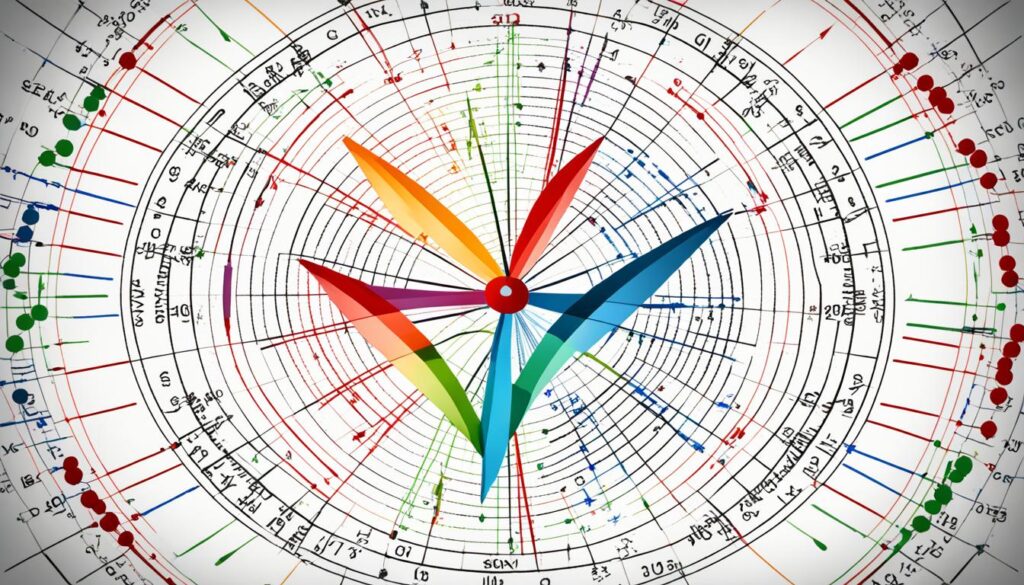
Overall, Gann Indicators offer traders a comprehensive framework for analyzing financial markets. By utilizing geometric angles, patterns, support and resistance levels, and major reversal signals, traders can enhance their technical analysis capabilities and increase the accuracy of their market predictions.
Gann Time Cycles Analysis
Gann Time Cycles analysis is a powerful tool in understanding market time factors and predicting future price movements. Developed by the legendary trader W.D. Gann, this methodology involves studying historical price data to identify recurring time intervals where significant market moves tend to occur.
By analyzing market cycles, traders can gain valuable insights into the timing of key highs and lows, allowing them to make informed decisions on market entry and exit points. Gann believed that price movements in financial markets follow specific patterns and cycles, influenced by both natural and mathematical principles.
One of the key aspects of Gann Time Cycles analysis is the identification of relevant cycle periods based on historical price data and market volatility. Traders need to monitor these key time intervals for potential market turning points. Gann’s time analysis techniques include identifying specific time cycles, such as daily, weekly, monthly, and even yearly cycles.
Confirmation signals beyond Gann time cycles are crucial to validate potential trading opportunities. By integrating time and price analysis, traders can increase their chances of success and improve their forecasting accuracy. Gann emphasized the importance of price analysis, using geometric patterns and ratios to identify big stock moves.
Proper risk management is essential when using Gann time cycles for stock trading strategies. Traders should implement risk management techniques such as stop-loss orders and position sizing to protect their capital and minimize potential losses.
Gann’s trading philosophy includes developing different strategies for each market phase, whether it’s a bull market, bull to bear market, bear market, or bear to bull market. Understanding the psychology of market participants and anticipating shifts in sentiment are crucial elements of Gann Time Cycles analysis.
Some significant days in the solar year, such as Dec. 22, March 21, June 22, and Sep 21/23, also have implications on the market, which traders can consider in their analysis.
Key Time Cycles and Days for Trend Changes
Various time cycles play a significant role in Gann Time Cycles analysis. Traders can observe trend changes at key count of days, including 30, 45, 60, 90, 135, 150, 180, 210, 225, 315, 330, and 360. These cycles provide insights into potential turning points in the market.
Important Cycles and Angles in Gann Analysis
Gann identified various important cycles, including the 7-week death zone, 6-month, 12-month, and 144-month periods. Traders can analyze these cycles to better understand market trends and potential opportunities.
In addition, Gann used specific angles on price charts, such as 45, 90, 120, 135, 180, 225, 240, 270, 315, and 360 degrees, to identify certain price movements. These angles are based on geometric patterns and ratios, providing further insights into market dynamics.
Utilizing Gann Time Cycles for Analysis
To utilize Gann Time Cycles analysis effectively, traders should combine it with other technical and fundamental analysis tools. While Gann time cycles provide valuable insights into market timing, it’s crucial to validate potential trading opportunities through confirmation signals.
By integrating Gann Time Cycles analysis into their trading strategies and combining it with proper risk management techniques, traders can gain a competitive edge in the market and improve their chances of success.
| Gann Time Cycles Analysis Benefits | Market Insights |
|---|---|
| Identify recurring time intervals for significant market moves | Gain valuable insights into market timing |
| Predict future price movements | Improve forecasting accuracy |
| Assist in market entry and exit decisions | Minimize potential losses |
| Understand market psychology and anticipate sentiment shifts | Enhance trading strategies |
Gann Square of Nine
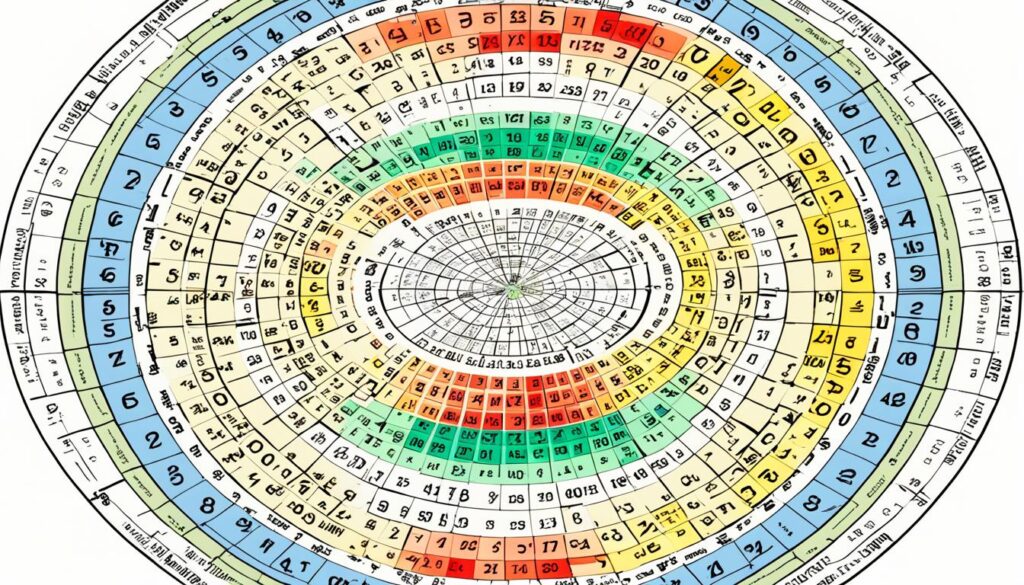
The Gann Square of Nine is a unique and powerful method that combines geometry, astrology, and ancient mathematical techniques to forecast market movements. Developed by W.D. Gann, this approach is open to interpretation and has become a cornerstone of many traders’ strategies.
While the Gann Square of Nine may seem complex, it offers traders valuable insights into support and resistance levels and potential reversal points. By squaring both price and time, starting from the center value of « 1 » and spiraling in a clockwise direction, this method helps identify important time and price alignments to forecast future prices.
One of the key features of the Gann Square of Nine is the presence of cardinal and ordinal cross numbers. These numbers represent crucial support and resistance levels and provide traders with key reference points for making trading decisions.
Each degree on the Gann Square of Nine chart represents time, with significant numbers occurring every 45 degrees. By drawing circles around the squares in the Gann Square, traders can introduce angles measured by degrees. These angles point to potential support and resistance levels, providing valuable insights for making trading decisions.
Traders can use the Gann Square of Nine to identify key support and resistance levels where they can buy or sell assets. This method takes into account planetary movements and the degree of price movement based on the circle within the square, adding a unique perspective to market analysis.
It’s important to note that while Gann’s forecasting techniques have shown historical accuracy, they may differ from actual trading outcomes. Therefore, it’s essential to interpret fluctuations accurately and adapt trading strategies accordingly.
For those seeking a deeper understanding of Gann’s teachings, wdgann.com provides access to the original writings and materials purchased from Gann’s business partner in the 1970s.
The Gann Square of Nine has practical applications across multiple markets, including stock indexes, stocks, commodities, and options. The numbers within the square of nine help determine price levels of support and resistance, as well as time units for counting minutes, hours, market days, calendar days, weeks, months, and years.
The construction of the square of nine involves a spiral of numbers starting from one in the center, with a clockwise spiral that extends to infinity. This spiral, combined with the angles and cycles within the square, allows traders to predict market trends and timing for highs and lows.
Real-world examples and historical data have shown the accuracy of the square of nine in predicting market movements, including significant events such as the crash of October 19, 1987. Key angles and cycle lengths identified by the square of nine provided crucial insights into these market events.
By utilizing cardinal squares (0-90-180-270 angles) and fixed squares (45-135-225-315 angles), traders can gain further insights into market movements and potential trading opportunities.
Predicting future market trends with the square of nine involves analyzing cycles and angles to identify potential support and resistance levels. Its historical accuracy in predicting market highs and lows showcases its potential as a valuable tool for market analysis and forecasting.
The Gann Square of Nine has stood the test of time and continues to intrigue traders seeking to understand market movements. W.D. Gann’s impact in the financial world remains significant, even years after his passing, as his methodology integrates mathematics and mysticism to effectively forecast market movements.
Gann Fan Tool Usage
The Gann Fan tool is a powerful technique that traders use to identify key support and resistance levels, predict price movements, and make informed trading decisions. By drawing angled lines on a price chart, the Gann Fan visually represents potential areas of interest based on specific angles and price points.
The Gann Fan consists of nine diagonal lines that radiate from a single point in different directions. The most essential angle is the main Gann Angle set at 45 degrees. Traders typically draw lines at other angles like 1×1, 1×2, and 2×1 depending on their preferences or the market being analyzed.
When using the Gann Fan tool, it is crucial to consider the concepts of support and resistance levels. These are key price levels where market sentiment often changes, leading to potential buying or selling opportunities. The Gann Fan helps identify dynamic support and resistance levels as price approaches these lines, allowing traders to anticipate potential market turning points.
Chart analysis plays a critical role in effectively using the Gann Fan tool. Traders analyze historical price patterns, trends, and chart formations to determine when and where to draw the Gann Fan lines. It is important to identify price trends before utilizing the Gann Fan to ensure accurate placement of the lines on the chart.
Traders can also incorporate time analysis when using the Gann Fan. By combining price and time, traders can predict when price movements are likely to occur, further enhancing their trading strategies.
Backtesting strategies involving the Gann Fan tool is highly recommended. Traders can evaluate the historical performance of their trading strategies by applying the Gann Fan to past price data. This process helps traders gain insights into the effectiveness of their strategies and make any necessary adjustments.
As with any trading tool, risk management is essential when using the Gann Fan. Traders should employ risk management techniques such as implementing stop-loss orders, sizing positions appropriately, and maintaining risk-reward ratios.
In conclusion, the Gann Fan tool is a valuable resource for traders seeking to predict future price movements, identify support and resistance levels, and enhance their chart analysis. By gaining an understanding of the various angles and applying proper risk management, traders can enhance their trading strategies and potentially improve their trading results.
Gann Swing Trading Strategies
Gann swing trading strategies are designed to capitalize on short- to medium-term price movements in the stock market. These strategies analyze price swings, patterns, and trends to identify profitable trading opportunities. By combining technical indicators with Gann’s principles, traders can make well-informed decisions based on observed market behavior.
One of the key elements of Gann swing trading strategies is the recognition of price movement swings. Traders utilize Gann Angles, which aid in identifying crucial support and resistance levels on price charts. These angles provide valuable insights into market dynamics, helping traders forecast future price levels with greater accuracy.
The Gann Swing Trading Strategy also leverages the Gann Square of Nine, a powerful tool for forecasting price and time goals. By analyzing the geometric correlations within this square, traders can anticipate turning points and price levels. This enables them to make timely entry and exit decisions, maximizing profit potential.
Successful implementation of Gann Swing Trading Strategies relies on historical data analysis. By studying past price action, traders can identify recurrent patterns and cycles that influence future market behavior. This historical perspective allows for more precise predictions and better risk management.
Additionally, Gann swing trading strategies can be enhanced by integrating other technical analysis tools such as moving averages, Fibonacci retracements, and momentum indicators. These tools provide supplementary insights and confirmation, strengthening the overall trading strategy.
It’s important to emphasize that risk management practices should always accompany Gann trading strategies. By incorporating proper risk management techniques, traders can strengthen trade signals and improve their decision-making processes. This ensures a disciplined approach to trading and helps mitigate potential losses.
| Gann Swing Trading Strategies | Key Components |
|---|---|
| Gann Angles | Identifying support and resistance levels |
| Gann Square of Nine | Forecasting price and time goals |
| Historical Data Analysis | Identifying recurrent patterns and cycles |
| Additional Technical Analysis Tools | Moving averages, Fibonacci retracements, and momentum indicators |
| Risk Management Practices | Strengthening trade signals and improving decision-making processes |
By employing Gann swing trading strategies, traders can increase their chances of profiting from short- to medium-term price movements in the stock market. These strategies provide a structured framework for analyzing price swings, patterns, and trends. By combining technical indicators with Gann’s principles, traders can make well-informed decisions and navigate the market with greater confidence.
Gann Fibonacci Relationships
Gann Fibonacci relationships play a crucial role in technical analysis by providing a systematic approach to identifying important price levels within the market structure. By integrating the principles of Fibonacci retracement with Gann’s time and price analysis techniques, traders can gain valuable insights into potential support and resistance levels, as well as trend reversals.
First introduced by the Italian mathematician Leonardo Fibonacci, the Fibonacci sequence is a series of numbers in which each number is the sum of the two preceding ones. These numbers, along with the Golden Ratio (approximately 1.61803398875), are widely used in various fields, including finance and trading. In trading, Fibonacci ratios are used to draw Gann angles on a chart, which then help identify potential levels of support and resistance.
Gann angles, such as the 1×1, 1×2, and other common angles, provide valuable insights into the market’s price movements. These angles can be used to confirm Fibonacci retracement levels and predict future price movements based on geometric angles. However, it’s important to note that Gann angles can be subjective, and they may not always provide accurate signals. Therefore, it’s advisable to use multiple technical analysis tools for confirmation.
Traders who incorporate Gann Fibonacci relationships into their analysis gain a systematic approach to identifying critical price levels. This enables them to make informed decisions regarding support, resistance, and trend reversal. The combination of Fibonacci ratios, Gann angles, and other technical analysis tools provides traders with a comprehensive toolkit to enhance their forecasting and trading strategies.
To illustrate the significance of Gann Fibonacci relationships, let’s explore an example. Consider a trader who uses Gann Square Analysis to determine critical price levels accurately. By integrating Fibonacci retracement tools, Gann angles, and mathematical divisions, this trader can pinpoint significant price levels indicating potential areas of support and resistance.
Furthermore, the strategic correlation of major market trends with support and resistance points assists traders in forecasting future price movements accurately. By integrating time analysis with price analysis using Gann’s time cycles methodology, traders can anticipate market turning points and make timely trading decisions.
Traders who master Gann Fibonacci relationships gain a competitive edge in understanding market dynamics and identifying critical price levels. By combining these relationships with other technical analysis tools, traders can enhance their trading strategies and improve overall profitability.
Using Fundamental and Technical Analysis Together
When it comes to investing in the stock market, understanding the different methods of analysis is crucial for making informed decisions. Two popular approaches are fundamental analysis and technical analysis. While these methods have their own strengths and weaknesses, combining them can provide a holistic view of a stock’s potential and lead to more effective stock selection and entry points.
Fundamental analysis focuses on evaluating the intrinsic value and financial health of a company. It considers factors such as earnings, dividends, growth prospects, and overall industry conditions. By analyzing these fundamental factors, investors can determine whether a stock is undervalued or overvalued, aiding in long-term investment decisions.
Technical analysis, on the other hand, is all about studying price trends, chart patterns, and historical data. It seeks to identify patterns and trends that can help predict future price movements. Tools like moving averages, price patterns, and volume analysis are commonly used in technical analysis to assist in finding optimal entry or exit points.
Combining fundamental and technical analysis allows investors to integrate financial health with market sentiment. While fundamental analysis provides insights into a company’s intrinsic value, technical analysis can help identify short-term trends and entry points. By considering both methods, investors can gain a more comprehensive understanding of a stock’s potential and make more well-rounded investment decisions.
One benefit of combining analyses is the ability to predict short-term movements and long-term value. Day traders can leverage technical analysis to capture short-term trends, while value investors can use fundamental analysis to identify undervalued stocks for long-term growth. Combining these approaches provides a more balanced investment strategy.
However, it’s important to note that combining fundamental and technical analysis comes with its own set of challenges. The sheer volume of data, conflicting signals, and the need for in-depth analysis can be overwhelming. It requires a higher level of commitment and can be time-consuming.
To effectively combine fundamental and technical analysis, investors can start with a broad fundamental analysis to assess the overall health of a company and its industry. This includes analyzing financial statements, earnings reports, and industry trends. After establishing a broad perspective, narrowing down the focus to technical analysis helps identify specific entry or exit points.
Having the right tools and platforms is essential for combining both analyses. Integrated dashboards, customizable filters, and real-time data are valuable for analyzing both fundamental and technical factors in a streamlined manner. These tools help investors save time and provide the necessary insights for making calculated investment decisions efficiently.
In conclusion, while fundamental and technical analysis have their own strengths and weaknesses, integrating both approaches can enhance investment decisions. By combining financial health with market sentiment, investors can gain a clearer understanding of a stock’s potential. However, it’s crucial to overcome the challenges of data overflow and conflicting signals. With the right tools and a well-rounded approach, investors can maximize their opportunities in the stock market.
Schwab Equity Ratings and Stock Screening
When it comes to making informed investment decisions, stock screening plays a crucial role. By using tools like Schwab Equity Ratings, investors can effectively narrow down their options and identify potential winners.
Schwab Equity Ratings is a comprehensive rating system that evaluates stocks based on fundamental factors such as revenue growth, earnings growth, dividend yield, and more. This powerful tool enables investors to sift through thousands of stocks and focus on the ones with the highest potential.
The process begins by considering stocks rated as « A » or « B » by Schwab Equity Ratings as « buy » candidates. This initial screening narrows down the pool from approximately 2800 candidates to around 824.
For those looking for growth stocks, a further selection based on fundamental analysis factors such as strong revenue growth, projected revenue growth, and projected earnings reduces the choices to just six candidates. These stocks are well-positioned for long-term growth and capital appreciation.
On the other hand, for investors interested in value stocks, a different set of criteria is applied. Selections are made based on above-average dividend yield, low price-to-earnings ratio, and a price below the company’s book value. This careful screening process results in a shortlist of five value stocks.
It’s important to note that stock screening is not limited to fundamental analysis alone. Technical analysis also plays a crucial role in stock selection. This involves activities such as screening charts, scanning for potential trades, and identifying trade setups.
To ensure liquidity, technical traders typically consider stocks that trade a minimum of 200,000 shares per day. This ensures ease of buying and selling positions without significant price impact.
When it comes to entry strategies, traders may look for breakouts in the direction of the trend (new highs or lows) or pullbacks. These strategies help investors capitalize on favorable market conditions and maximize returns.
One popular tool used in technical analysis is the stochastic oscillator. This tool helps evaluate potential price reversals by identifying overbought or oversold conditions in the market.
Schwab Equity Ratings provides investors with roughly 300 A-rated stocks, with approximately 10% of each economic sector rated « A » and 20% rated « B ». This balanced and diversified selection offers investors a wide range of options across various sectors.
When it comes to portfolio construction, it is advisable to build a portfolio of 20-30 highly rated stocks rather than randomly selecting 50 or more stocks. This approach helps reduce firm-specific risk and increases the probability of achieving long-term investment goals.
While Schwab Equity Ratings provide valuable insights, it’s important to remember that no rating system is 100% accurate. Even A and B-rated stocks may experience declines relative to the overall market. Therefore, monitoring portfolio performance and making adjustments accordingly is crucial.
To evaluate the success of an investment strategy, benchmarking against a relevant index is essential. The Russell 3000 Index is often recommended as a benchmark for diversified stock portfolios.
It is recommended to evaluate portfolio performance at least annually, with a focus on long-term capital growth rather than short-term gains. This approach helps investors stay aligned with their investment objectives and make informed decisions.
The Schwab Equity Ratings quantitative model is designed to provide reliable and unbiased ratings. It utilizes raw data from three independent third-party financial information providers to compute 24 fixed-weight factors for each security in a defined universe of over 3,000 stocks.
These factors are then used to rank stocks into categories A, B, C, D, or F based on a fixed distribution pattern. The model is run weekly, providing ratings for each stock based on their expected relative total performance over the next 12 months.
Schwab Equity Ratings are primarily provided to select clients through the Schwab website. The model is powered by a team of quantitative analysts based in Chicago, who have access to a non-production facsimile of the model for back-testing and educational purposes.
To ensure accuracy and prevent manipulation, the model’s production process is automated and executed by a separate team of computer technicians in San Francisco. Quality assurance controls are in place to safeguard the integrity of the ratings.
Decisions related to the model’s factors and formula are overseen by the Schwab Equity Ratings Policy Committee, which includes senior research personnel, Schwab Compliance representatives, and legal counsel. This governance structure ensures transparency and accountability.
Quantitative analysts are closely monitored for their personal trading activities to ensure compliance with regulatory restrictions. Enhanced monitoring and surveillance measures are in place to maintain the highest standards of integrity.
In conclusion, Schwab Equity Ratings and stock screening provide investors with valuable tools to navigate the stock market. By leveraging fundamental and technical analysis, investors can identify high-potential growth stocks or undervalued value stocks. However, it’s important to remember that no rating system or analysis technique can guarantee success. Monitoring performance, diversifying portfolios, and benchmarking against relevant indices are crucial components of a well-rounded investment strategy.
Technical Stock Screening and Entry Strategies
When it comes to successful stock trading, technical analysis plays a vital role. By examining historical data and utilizing various tools and techniques, traders can identify trends, predict price movements, and make well-informed decisions. One essential aspect of technical analysis is stock screening, which involves narrowing down the vast universe of stocks to a select few that meet specific criteria.
Technical stock screening allows traders to filter stocks based on parameters such as price, market capitalization, sectors, and industries. This process helps traders focus on stocks that fit their desired trading strategy, whether it’s day trading, swing trading, or long-term investing. By using stock screening tools and platforms, traders can save time and effort by automatically generating a list of potential candidates that meet their predefined criteria.
Once the initial stock screening process is complete, traders can move on to the next step: identifying potential entry points for trades. This is where chart scanning becomes invaluable. Chart scanning involves analyzing price patterns, moving averages, and momentum indicators to identify favorable entry and exit points.
Traders utilizing technical analysis can benefit from various entry strategies depending on their trading style and risk tolerance. For example, day traders may focus on simple trendlines and volume indicators to identify short-term trading opportunities. On the other hand, swing traders may prefer to analyze chart patterns and technical indicators to spot potential entry points for longer-term trades.
A popular and widely used entry strategy is the moving average crossover strategy. This strategy involves tracking the 50-day and 200-day moving averages and entering trades when these moving averages cross over each other. The moving average crossover strategy helps traders identify trend reversals and potential entry or exit points. However, it’s important to note that not all securities fit this strategy, as it works best for highly liquid and volatile stocks.
Momentum indicators are also crucial in determining entry points. These indicators, such as the Relative Strength Index (RSI) and the Moving Average Convergence Divergence (MACD), help traders assess the strength and momentum of a stock’s price movements. By using these indicators alongside other technical analysis tools, traders can find optimal entry points and time their trades effectively.
| Technical Analysis Tools | Description |
|---|---|
| Moving Averages | Used to anticipate changes in market sentiment |
| Momentum Indicators (e.g., RSI, MACD) | Help assess the strength and momentum of price movements |
It’s important for traders to remember that technical analysis is not foolproof and comes with its own limitations. It’s crucial to backtest trading strategies, practice in demo accounts, and have a thorough understanding of its strengths and weaknesses. Additionally, novice technical analysts often focus on indicators like moving averages, RSI, and MACD as they become familiar with the field.
Becoming proficient in technical analysis requires continuous learning. Traders can enhance their skills through books, online courses, and practice trading in paper accounts before venturing into real-money trading. While technical analysis can be a profitable approach to stock trading, it requires expertise, self-control, and sufficient starting capital to withstand potential losses.
« Technical Analysis of Stock Trends » by Edwards and Magee is a seminal book that formalized technical analysis theories back in 1948.
By incorporating technical stock screening and entry strategies into their trading plan, traders can optimize their decision-making process and increase their chances of success. Technical analysis provides traders with greater insight into market price movements, more accurate predictions of future price movements, and increased trading opportunities. Furthermore, it aids in identifying trends quicker and easier, allowing traders to spot trading opportunities they might have otherwise missed.
Summary:
- Technical stock screening involves narrowing down a list of potential stocks using specific criteria such as price, market capitalization, and sectors.
- Chart scanning, using price patterns and technical indicators, helps traders identify entry and exit points for trades.
- Moving average crossover strategy and momentum indicators are commonly used entry strategies in technical analysis.
- Technical analysis requires backtesting, practice, and awareness of its limitations.
- Novice technical analysts often focus on indicators like moving averages, RSI, and MACD.
- Continuous learning through books, courses, and simulated trading accounts is essential for mastering technical analysis.
Conclusion
Mastering stock market analysis techniques is essential for making informed decisions in the dynamic world of investing. By combining fundamental analysis and technical analysis, investors can gain a comprehensive understanding of a company’s financial health, industry trends, and potential market movements.
Fundamental analysis provides valuable insights into a company’s current financial position and future growth prospects. Key ratios such as the current ratio and quick ratio help investors assess a company’s ability to meet short-term liabilities with available assets. Additionally, the debt ratio indicates the level of leverage and financial risk associated with a company. Operating profit margin allows investors to compare the financial health of competing companies within the same industry.
On the other hand, technical analysis focuses on analyzing price patterns, volume, and supply and demand factors to predict future price movements. Charting techniques help identify support and resistance levels, indicating potential bullish or bearish trends. Technical analysis examines historical market data to identify trends and patterns that can guide investment decisions in the short term.
Combining fundamental and technical analysis techniques allows investors to assess both the intrinsic value and the market sentiment of a stock. By considering factors such as competitive advantage, industry trends, and stock price history, investors can make more well-rounded investment decisions that take into account both the qualitative and quantitative aspects of a company’s performance.