
Many investors look at stocks based on things like revenue and industry trends. But, these factors don’t always show up in the stock price. Technical analysis looks at past data to predict price changes. It uses things like statistical analysis to bridge the gap between what a stock is worth and its market price.
This method helps traders make better choices by using past information. Most people use both technical and fundamental analysis to decide on investments.
Key Takeaways
- Technical analysis uses historical price and volume data to identify trends and predict future market movements.
- Fundamental analysis evaluates a company’s financial health and industry position to determine its intrinsic value.
- Combining technical and fundamental analysis can provide a more comprehensive view of a stock’s prospects.
- Effective risk management and portfolio diversification are crucial for successful long-term investing.
- Backtesting and paper trading can help investors refine their strategies and develop trading discipline.
Understanding Technical Analysis
Many investors look at stocks based on their basics. Technical analysis offers a different way to guess price changes. It uses past data, like price and volume, to spot patterns and trends. These can help traders and investors know the difference between a stock’s true value and its market price.
This method uses stats and behavioral economics to learn about market feelings and possible trading chances. It’s great for spotting changes in momentum, trend shifts, and other signs not seen in financial reports.
The Foundations of Technical Analysis
Technical analysis believes market behavior repeats over time. By looking at past prices and volumes, analysts try to find patterns and signs for making investment choices. They look at chart patterns, trendlines, and moving averages to see a security’s speed and where it might go next.
One big plus of technical analysis is its focus on market data. It gives a clear, fact-based view of market trends. Unlike looking at a company’s finances, technical analysis looks at how the market acts. This gives insights that can add to a traditional stock picking method.
« Technical analysis is a method of evaluating securities by analyzing the statistics generated by market activity, such as past prices and volume. Technical analysts do not attempt to measure a security’s intrinsic value, but instead use charts and other tools to identify patterns that can suggest future activity. »
Learning about technical analysis helps investors make stronger, more complete plans for dealing with the stock market’s ups and downs.
Choosing the Right Technical Analysis Approach
There are two main ways to do technical analysis: top-down and bottom-up. Each has its own benefits and suits different traders and investors.
The Top-Down Approach
The top-down method looks at the big picture first, then zooms in on details. It starts with the economy and moves to specific stocks. This approach is great for those looking for quick profits. It gives a wide view of market trends and feelings.
The Bottom-Up Approach
On the other hand, the bottom-up method focuses on individual stocks first. Traders look at technical signs and patterns of certain companies. This is best for investors who think long-term and want to find good deals on specific stocks.
| Top-Down Technical Analysis | Bottom-Up Technical Analysis |
|---|---|
| Starts with the overall economy and then focuses on individual securities | Starts with individual stocks or securities and then considers the broader market context |
| Favored by traders seeking short-term gains | Preferred by investors with a long-term mindset |
| Provides a broader perspective on market trends and sentiment | Allows for the identification of potential value opportunities at the individual stock level |
Choosing between top-down and bottom-up technical analysis depends on your goals and how much risk you can take. Knowing the differences helps traders and investors make better choices. This can lead to success in the fast-paced stock market.
Developing a Trading System or Strategy
Creating a good trading system or strategy is key for investors wanting to do well in the stock market. It doesn’t matter if you’re new or have been trading for years. Having a solid plan can greatly improve your investment success over time.
A trading system is all about using a specific strategy or set of rules to make investment choices. For example, you might watch the 50-day and 200-day moving averages of a stock’s price. If the 50-day average goes above the 200-day average, it could mean the stock is going up, so you might buy it. The opposite would mean it’s time to sell.
Creating a winning trading system or strategy involves several steps:
- Backtesting: Looking at past data to see how well your trading plan works. This lets you tweak your strategy and find ways to get better.
- Paper trading: Trying out your strategy in a fake market before using real money. This helps you feel sure about your plan and spot any problems.
- Continuous Refinement: Changing your trading system or strategy as the market changes, as you learn more, and as your risk level changes.
Building a trading system development or trading strategy design takes time, patience, discipline, and a willingness to try new things. By using technical and fundamental analysis, along with strong risk management, you can aim for steady, profitable trading in the stock market.
« The key to successful trading is developing a well-defined strategy that you can consistently apply, while continuously learning and adapting to market conditions. »
There’s no single best way to trade. Your risk level, investment goals, and market knowledge will help shape the best trading system or strategy for you. By testing and practicing your ideas, you can boost your chances of doing well in the ever-changing stock market.
Identifying Suitable Securities
Choosing the right stocks is key in the stock market. It’s important for investors and traders to pick stocks that match their strategy. This means using tools like fundamental and technical analysis, and thorough security screening.
Stock screening is a big part of this. It’s about looking at financial details to find good investments. Things like liquidity, volatility, and the price-to-earnings ratio matter a lot.
For traders who like technical analysis, liquid and volatile stocks are often the best. They offer chances for quick price changes and profits. But, value investors might look for companies that are priced low but have strong finances and growth potential.
| Metric | Fundamental Analysis | Technical Analysis |
|---|---|---|
| Liquidity | Important for trading execution and portfolio management | Crucial for identifying short-term price patterns and volatility |
| Volatility | Considered a risk factor, may impact investment decision | Necessary for generating trading signals and potential profits |
| Price-to-Earnings (P/E) Ratio | Helps determine if a stock is undervalued or overvalued | Not a primary factor, but can provide context for price movements |
| Earnings Growth | Key indicator of a company’s financial health and future prospects | May influence price trends and momentum, but not a direct input |
| Dividend Yield | Provides a steady income stream and can signal financial stability | Typically not a primary focus, but could impact overall return |
By picking securities that fit your strategy, you can boost your chances of doing well in the market. This careful selection helps manage your portfolio better and can lead to better returns.
Finding the Right Brokerage
Choosing the right brokerage is key in the stock market. It should offer the right trading account features and platform capabilities for your strategy. It should also be secure and affordable for your trades.
When picking a brokerage, consider the types of accounts they have. Look for options like standard taxable accounts, ESAs, and retirement accounts like Roth or traditional IRAs. This lets you match your trading with your financial goals.
Also, check the brokerage’s fees. Know the costs for different accounts and trades. These fees can affect your profits. Many online brokers now charge $0 per trade for equity trades, which is great for those watching their costs.
| Brokerage | Equity Trade Fees | Account Minimum | Promotions |
|---|---|---|---|
| Brokerage A | $0 per trade | $0 | 1 Free Stock after linking bank account |
| Brokerage B | $0 per trade | $0 | $100 Cash Bonus for new accounts |
| Brokerage C | $4.95 per trade | $500 | No current promotions |
Security is also important. Choose brokerages with two-factor authentication and SIPC insurance coverage of at least $500,000. This protects your account in case of a broker failure.
Finally, check out what other customers say. Sites like NerdWallet offer insights into customer experiences. This helps you find brokerages that focus on safety and customer care.

By looking at trading account features, platform capabilities, and broker selection, you can pick the best brokerage. Your investment success often depends on the support of your chosen brokerage.
Tracking and Monitoring Trades
In the trading world, having the right tools is key. Traders need different levels of access and features based on their strategies. For instance, day traders might want real-time data and order flow visibility. On the other hand, long-term investors might just need a basic platform.
Trade Tracking and Monitoring Essentials
Understanding trade performance is vital for traders. They use various tools and techniques to track and monitor their trades. This includes:
- Trade journals for recording details like entry points and market conditions
- Spreadsheet software for tracking profit and loss over time
- Specialized platforms for advanced analytics and performance reporting
- Built-in tools on brokerage platforms for tracking performance
- Algorithmic trading platforms for backtesting and analyzing performance
- Risk management tools for assessing and managing risk
- Performance analytics websites for visualizing trades and trends
These tools and platforms help traders keep track of their trades and make informed decisions. They improve trading strategies and risk management.
Mobile Trading and Alerts
Today’s trading demands quick access to market data and the ability to monitor trades anywhere. Mobile trading apps like TradeBench offer this flexibility.
Brokerage and trading platforms also provide mobile alerts. These alerts notify traders about market events, price changes, or trade executions. This keeps traders informed and responsive, even away from their desks.
Using trade tracking tools and mobile trading capabilities gives traders valuable insights. It helps them make better decisions and improve their trading performance.
Using Additional Software or Tools
In the stock market, the right software and tools are key to success. Fundamental analysis looks at a company’s finances and trends. Technical analysis uses data to spot trading chances. Investors and traders use many software and tools to improve their analysis and make better decisions.
Over the last 15 years, technical analysis tools have become more accessible and faster. This helps traders better understand trading data. Trading Central offers tools that automatically analyze price action to spot chart patterns and important conditions. Many top online brokerages, like Ally Invest, Charles Schwab, E*TRADE, Fidelity Investments, Interactive Brokers, Lightspeed, TradeStation, and Tradier, have these tools on their platforms.
Interactive Brokers has over 100 indicators and real-time data. Lightspeed Trader lets you search and filter stocks with over 100 criteria. TradeStation offers advanced charting, automated analysis, and lets you test trading systems.
There are also trading software providers like MetaStock, eSignal, Market Gear, and NinjaTrader for technical traders. These platforms have many analysis studies, indicators, and backtesting tools. They help investors improve their strategies and make better decisions.
For traders looking for specialized tools, Market Gear connects to brokers like E*TRADE, ChoiceTrade, and Ally Invest. It supports custom indicators and trading based on technical data. MetaStock has over 150 indicators and lets you build and test strategies. NinjaTrader is free and lets users test trading systems for different markets before live trading.
The choice of trading software and tools depends on your trading style, risk level, and what you prefer. Using the latest in automated trading systems and mobile trading apps can give traders an edge in the fast-paced stock market.
stock market analysis strategies
Key Technical Analysis Strategies for Navigating the Market
Being a smart investor means knowing how to use technical analysis to move through the stock market. Key strategies like moving averages, the relative strength index (RSI), and the MACD indicator are very useful.
Moving averages smooth out price changes to show trends and possible price changes. They help traders see if a stock is going up, down, or staying the same. The RSI measures how fast and how much prices are moving. It helps spot when prices might change direction.
The MACD indicator looks at two moving averages to find momentum and trend shifts. It also shows when prices might change direction. This can help traders know when to buy or sell.
Using these technical analysis strategies together helps investors understand the market better. This can lead to better trading choices. Whether you’re experienced or new, learning these methods can really help your investment success.
« The key to successful investing is not predicting the future, but rather understanding the present. » – Peter Lynch
Learning Technical Analysis
Learning technical analysis is key for anyone wanting to trade stocks or invest wisely. There are many ways to learn this skill, like books, online courses, and practicing with paper trading.
Books on Technical Analysis
Books are a great way to start learning technical analysis. Classics like « Technical Analysis of Stock Trends » by Robert D. Edwards and John Magee are excellent for beginners. More recent books, such as « Trend Following » by Michael W. Covel, focus on specific strategies and indicators.
Online Courses in Technical Analysis
Online courses are perfect for those who like to learn interactively. Sites like Udemy, Bullish Bears, and The Chart Guys offer top-rated courses. These courses teach about chart patterns, oscillators, and how to manage risks. They help students gain the skills and confidence to trade in the markets.
Practicing with Paper Trading
Paper trading is a great way to improve your skills in technical analysis. It lets you practice trading without using real money. This way, traders can try out strategies, learn new techniques, and get experience before trading for real. Many brokerages and financial platforms offer paper trading, making it a safe way to learn.
Using books, online courses, and paper trading together can help you learn technical analysis well. This combination can greatly improve your chances of success in the stock market.
« The best way to learn technical analysis is to start practicing it. Paper trading is an excellent way to test your strategies and fine-tune your skills before risking real money. »
Combining Fundamental and Technical Analysis
Investors often choose between fundamental and technical analysis to evaluate stocks. Fundamental analysis looks at a company’s finances and trends in its industry. Technical analysis studies price and volume patterns. Using both methods together gives a fuller picture of a stock’s future.
Fundamental analysis is key for long-term investing. It helps figure out a stock’s true value by looking at financial statements, management, and the company’s position in the market. Technical analysis, on the other hand, uses past price and volume data. It helps spot good times to buy or sell stocks using tools like moving averages and the relative strength index.
A study by Fidelity Investments showed that mixing fundamental and technical analysis can lead to better returns than just buying and holding. This mix can be powerful. Technical analysis helps with timing market moves, while fundamental analysis gives insights into a company’s future growth.
Technical analysis is great for catching short-term price changes, like big volume spikes. Analysts use moving averages to spot these changes. Fundamental analysis is essential for looking at a company’s finances and trends in its industry. This helps understand its long-term growth potential.
But, both methods have their limits. Technical analysis can’t predict future financial data and might overemphasize past trends. Fundamental analysis might not capture the current market mood. By using both, investors get a fuller view of a stock’s value and potential.
In conclusion, combining fundamental and technical analysis can lead to smarter investment choices. By looking at both the business behind the stock and its market behavior, investors can craft a well-rounded strategy. This approach can help them succeed in the complex stock market.
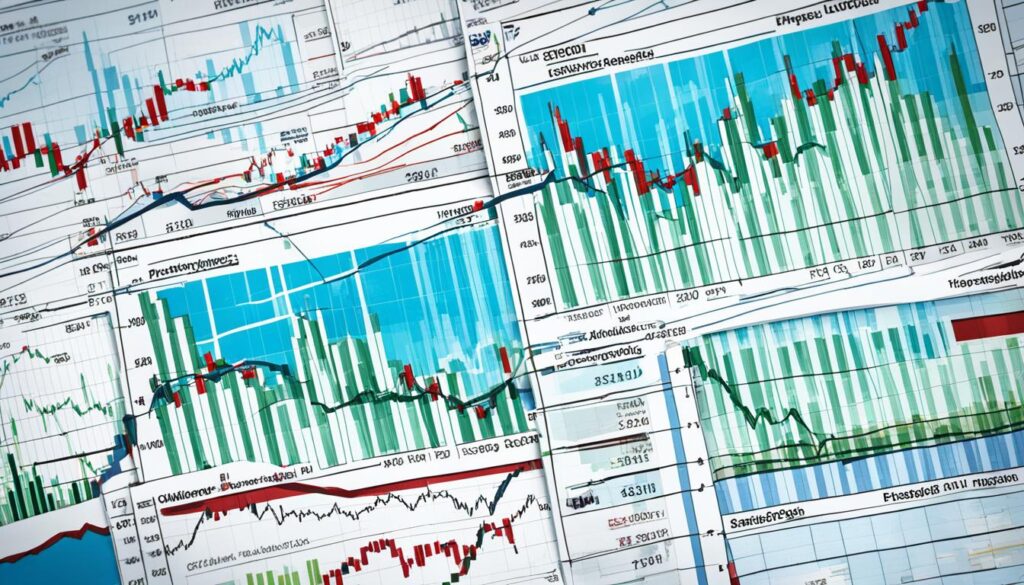
« Successful day traders are reported to find great live trading success by incorporating fundamental analysis with technical analysis techniques. »
Screening for Fundamental Factors
Stock screening tools help investors pick stocks that look good for growth or value. They look at stocks rated A or B by services like Schwab Equity Ratings. They also check revenue growth, earnings growth, and the price-to-earnings (P/E) ratio. This helps find stocks worth looking into more closely.
When screening stocks, we look at financial ratios, growth, and valuation metrics. These help us see a company’s financial health and its potential for investment. Key factors to think about include:
- Financial Ratios: Price-to-earnings (P/E) ratio, earnings per share (EPS), return on equity (ROE), and debt-to-equity (D/E) ratio.
- Growth Metrics: Revenue growth, earnings growth, and market share expansion.
- Valuation Metrics: Price-to-book (P/B) ratio, price-to-sales (P/S) ratio, and enterprise value-to-EBITDA (EV/EBITDA) ratio.
Looking at a company’s financial statements and industry trends helps us find stocks that are undervalued but have strong growth potential. This method looks at the factors that will affect a company’s future, not just its current price.
| Fundamental Factor | Description | Importance in Screening |
|---|---|---|
| Price-to-Earnings (P/E) Ratio | Measures a company’s current share price relative to its earnings per share. | Helps identify undervalued or overvalued stocks based on their earnings potential. |
| Revenue Growth | Measures the year-over-year change in a company’s total sales. | Indicates a company’s ability to expand its customer base and generate more income. |
| Debt-to-Equity (D/E) Ratio | Compares a company’s total debt to its total equity, providing insight into its financial leverage. | Helps assess a company’s financial stability and ability to withstand economic downturns. |
Using both fundamental and technical analysis helps investors understand a stock’s potential better. This way, they can make smarter investment choices.
Screening for Technical Factors
Technical traders use a step-by-step process to pick stocks for their portfolios. This process includes stock screening, chart scanning, and trade setup. In the stock screening phase, they look at technical factors to find good trading chances.
They focus on price and market capitalization as key technical factors. They might look for stocks in certain price ranges or with specific market caps. For instance, they might choose small-cap or mid-cap stocks. These stocks often show strong momentum indicators and are more volatile than large-cap stocks.
Technical traders also check the sector or industry of a stock. They might pick stocks in strong or weak sectors, based on their trading style. This helps them understand market trends and spot sectors ready for big moves.
They also look at momentum indicators like moving averages, RSI, and MACD. These tools show if stocks are overbought or oversold. This can signal a price change or a trend continuation.
By screening for these technical factors, traders can make a list of stocks that fit their strategy. This increases their chances of finding profitable trades in the market.
| Technical Factor | Description | Example |
|---|---|---|
| Price and Market Cap | Traders may focus on stocks within specific price ranges or market capitalization thresholds. | Small-cap or mid-cap stocks often exhibit stronger momentum and volatility compared to large-cap stocks. |
| Sector/Industry Analysis | Traders analyze the performance of a stock’s sector or industry to identify potential breakouts or reversals. | A trader may focus on stocks within a strong or weak sector, depending on their trading approach. |
| Momentum Indicators | Technical indicators like moving averages, RSI, and MACD can help identify overbought or oversold stocks. | A trader may use the MACD indicator to identify stocks with strong momentum or potential price reversals. |
« Successful technical analysis requires a combination of data analysis, chart interpretation, and a deep understanding of market psychology and behavior. »
Risk Management and Psychology
Stock market investing is complex, going beyond just chart patterns and indicators. It includes behavioral economics and risk management. These are key for getting the most out of your investments over time. They help traders and investors deal with the ups and downs of the markets.
Overcoming Cognitive and Emotional Biases
Cognitive biases, like confirmation bias and loss aversion, can affect trading decisions. They can lead to poor outcomes. Emotional biases, such as fear of loss and overconfidence, also shape how people react to market changes.
To beat these biases, traders need to learn, look at different views, and follow strict trading rules. Knowing yourself, setting clear stop-loss and take-profit points, and spreading out investments are key to a good risk management plan.
Developing a Risk Management Framework
- Follow the one-percent rule, risking no more than 1% of your capital on one trade.
- Use technical indicators like moving averages to set stop-loss and take-profit points.
- Spread your investments across different sectors and regions to reduce risk.
- Try strategies like protective put options to protect against losses.
By using risk management strategies and understanding what affects trading, investors can trade with more confidence. This can lead to better long-term, risk-adjusted returns.
« Successful trading is about managing risk, not maximizing returns. If you focus on managing your risk, the returns will take care of themselves. »
| Risk Management Technique | Benefit |
|---|---|
| Stop-Loss Orders | Limit potential losses and protect capital |
| Position Sizing | Manage risk exposure based on individual risk tolerance |
| Diversification | Mitigate risks across different asset classes and sectors |
| Hedging Strategies | Offset potential downside risks with protective options |
Backtesting and Paper Trading
Traders working on automated trading systems use backtesting to see how rules would have done with past data. Backtesting checks if a trading plan works by looking at past data. If it does well, it means the plan could make money in real life.
Complex trading plans need backtesting a lot. Automated systems use plans that are hard to understand without backtesting. Traders might need a skilled programmer to turn their ideas into something they can test.
Traders who trade on their own might want to try paper trading. This lets them practice with a demo account to see how they’d do over time. They can track their trades to see if their strategies work well. This is called forward performance testing, where they simulate trading without real money.
| Metric | Description |
|---|---|
| Profitability | Looks at the money-making ability of the trading plan. |
| Risk-Adjusted Returns | Checks how the strategy’s returns match its risks, giving a full view of its quality. |
| Win Rate | Finds out how often trades make money, showing how steady the strategy is. |
| Drawdowns | Looks at the biggest drop in the strategy’s value, showing its risk and volatility. |
Backtesting and paper trading are key for traders to check if their strategies work. They help spot what’s good and bad about the strategies. By testing with past data and simulated trades, traders can feel sure about their plans before trading for real.
The goal of backtesting is to see how a strategy does, find its good and bad points, and improve it with past data. Traders should make a detailed plan that fits their trading style, goals, risk level, money, and how they manage risks. It’s important to have clear goals for trading.
Good backtesting and paper trading mean having a strong plan with clear goals, using technical indicators, managing risks, and looking at results to get better. With these tools, traders can boost their chances of doing well in the stock market over time.
Conclusion
In the fast-paced stock market, successful investors use both fundamental and technical analysis. Fundamental analysis looks into a company’s true value. Technical analysis uses data to predict price changes and spot trading chances.
To get good at stock market analysis, it’s key to know both methods well. This means learning about technical indicators, chart patterns, and time series models. It also means understanding how to manage risks and stay mentally strong.
By using both numbers and insights, investors can grow their money over time. With hard work, practice, and a love for learning, people can get better at stock market analysis, technical analysis, fundamental analysis, trading strategies, risk management, and investment education. This can help them reach their financial dreams.