
Morocco is a key spot for investors looking for growth and diverse opportunities. Its location, trade deals, and growing sectors draw in investors from the US, Europe, and more. Knowing how to invest in Morocco is key for those wanting to tap into its potential.
This article dives deep into Morocco’s investment scene. It offers insights and points out the best sectors for investors. You’ll learn about real estate, renewable energy, startups, and venture capital in Morocco. It’s a must-read for anyone interested in the Moroccan market.
Key Takeaways
- Morocco’s strategic location and infrastructure make it an attractive investment destination in emerging market economies.
- The US-Morocco Free Trade Agreement has driven significant growth in bilateral trade and investment.
- Sectors such as real estate, renewable energy, and startups are presenting lucrative opportunities for investors.
- Navigating the regulatory and legal framework is crucial for successful investments in Morocco.
- Morocco’s position as a gateway to the African market and its Sharia-compliant investment options offer unique advantages.
Morocco’s Investment Landscape: An Overview
Morocco’s economy has shown strong growth and potential in recent years. It’s expected to grow by 3.2% by 2024. The government is working hard to diversify the economy, moving away from old sectors like farming and phosphates.
A big part of this change is thanks to free trade agreements. The US-Morocco FTA is a key example. It has helped Morocco grow its economy.
Economic Growth and Diversification Efforts
The economy has been getting back on track, growing by 3% in the first half of 2023. This followed a slow year in 2022 due to various issues. The government has launched programs like the Mohamed VI investment fund to help the private sector grow.
Manufacturing has seen a lot of growth, pulling in most foreign investment. Sectors like cars, planes, and green energy are booming. This is thanks to Morocco’s good location, skilled workers, and business-friendly environment.
Impact of Free Trade Agreements
Free trade deals, like the US-Morocco FTA, have been key to Morocco’s growth. They’ve helped increase trade and investment between countries. This has let Moroccan companies move into new areas like high-tech manufacturing.
In 2021, Morocco got the ninth-most foreign investment in Africa, with a 52% increase to $2.2 billion. France, the UAE, and Spain are the top investors in Morocco. The most investment goes into manufacturing, followed by real estate and more.
Morocco is attractive for investment because of its good location, stable money, and strong financial buffers. It has over 1,000 agreements with more than 40 countries. This makes it a key place for international trade and investment.
The US-Morocco Free Trade Agreement: A Game Changer
The US-Morocco Free Trade Agreement (FTA) started in 2006. It has been a key factor in Morocco’s economic growth and investment. By removing tariffs and lowering trade barriers, the agreement has helped increase trade between the two countries. Now, their trade is almost $7 billion a year.
Increased Bilateral Trade and Investment
The FTA has boosted trade and brought more foreign investment. It has made US and EU investors feel more confident. This has led to a lot of money coming into sectors like manufacturing, tourism, and renewable energy.
Emergence of High-Tech Manufacturing Sectors
The US-Morocco FTA has helped high-tech manufacturing grow in Morocco. It has made industries like automotive and aeronautics parts thrive. Now, Morocco is a big producer of vehicles for Europe, with the automotive industry making up 22% of its GDP and exporting $14 billion.
It has also made Morocco a place for onshoring electric vehicle production. The country’s stability and location near Europe attract automakers. The US and Europe want to increase EV production at home, which could be good or bad for Morocco’s car industry.
| Key Statistics | Value |
|---|---|
| Annual Bilateral Trade Between US and Morocco | Nearly $7 billion |
| Automotive Industry’s Contribution to Morocco’s GDP | 22% |
| Automotive Exports from Morocco | $14 billion |
| Automotive Industry Employment in Morocco | 220,000 people |
| Integration Rate in Morocco’s Automotive Sector | Over 65% |
The US-Morocco FTA has changed the game for Morocco’s economy. It has helped create high-tech manufacturing sectors. These sectors are set to grow and attract more investment in the future.
morocco investment strategies
Real Estate: A Promising Sector
The Moroccan real estate market is now a top choice for investors worldwide. It’s driven by the country’s strong economy and efforts to diversify. This makes it a key spot for those looking to invest in real estate investing morocco.
Morocco’s great location, stability, and supportive policies draw investors. The government offers government incentives like tax breaks, infrastructure growth, and affordable housing. These efforts make the moroccan real estate market more appealing.
Government Policies and Incentives
The Moroccan government is actively shaping a favorable climate for property investment. Key initiatives include:
- Tax incentives for real estate developers and buyers
- Investment in transportation and urban infrastructure to enhance connectivity
- Affordable housing programs to cater to the growing middle-class population
- Streamlining of bureaucratic processes to facilitate easy market entry
- Continued efforts to diversify the economy and attract foreign direct investment
Thanks to these government actions, Morocco is becoming a top pick for real estate investors. Its strategic spot, stable politics, and expanding middle-class offer chances for sustainable growth and solid returns.
« Morocco’s real estate market presents a unique opportunity for investors looking to capitalize on the country’s economic expansion and growing middle-class population. The government’s pro-business policies and targeted incentives make it an increasingly attractive destination for those seeking reliable and lucrative investment options. »
As the Moroccan real estate market grows, smart investors will see many chances to profit from its promising future. They can secure good returns on their investments.
Key Cities for Real Estate Investments
Rabat: The Capital’s Allure
Rabat, Morocco’s capital, is a top spot for real estate investing. Its strong economy, stable politics, and great location draw in investors. The city is growing, with new infrastructure and plans for better living spaces.
This makes Rabat a key place for investing in property. Property sales have gone up, thanks to a good mix of renters and owners. You can earn 4% to 8% a year from renting out properties here.
The cost of living in Rabat starts at about $1,000 per square meter outside the city center. In popular areas, prices can go up to several thousand dollars per square meter.
The government is working to make Rabat better and more affordable. With more expats moving in and a steady need for rentals, it’s a great time for investors. They can look forward to steady growth and good returns.
| Metric | Rabat |
|---|---|
| Average Property Price (per sq. m.) | $1,000 – $3,000 |
| Rental Yields | 4% – 8% annually |
| Holding Period | 5 – 10 years |
| Rental Demand | Consistently High |
Investors find many options in Rabat, from modern flats to historic riads. With its ongoing growth and international interest, Rabat is a strong choice for real estate investing morocco.
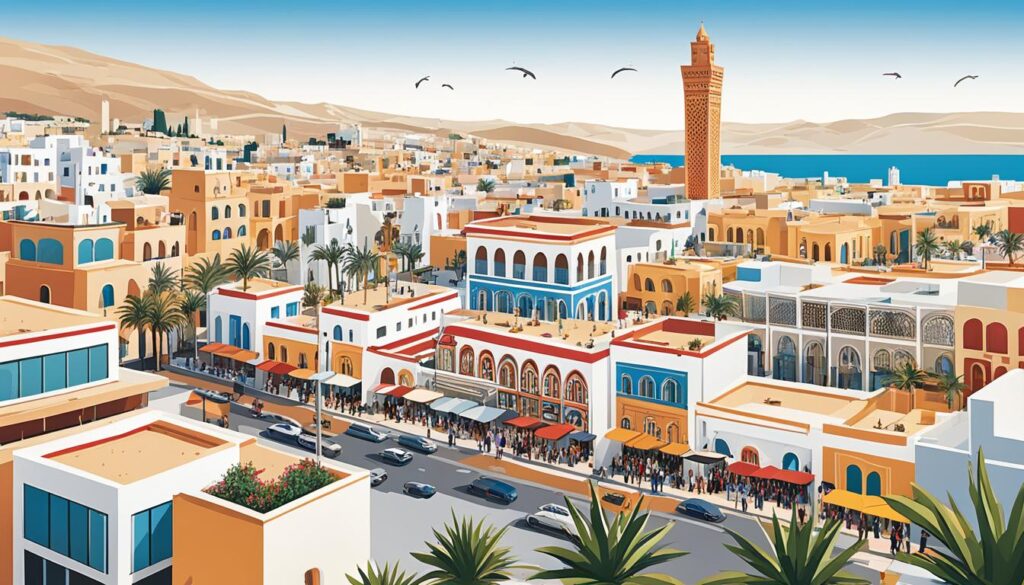
« Rabat’s strategic location, combined with its growing economy and government support, make it a standout destination for real estate investors in Morocco. »
Marrakech: A Vibrant Market for Luxury Properties
Marrakech is a magical city in Morocco that’s becoming a top spot for luxury property investments. It’s known for its rich culture, booming tourism, and stunning architecture. These factors draw in investors from around the world who see the city’s growing wealth and charm.
The city’s unique architecture, like the traditional Riads, and modern developments make it a key place for luxury investments. More and more buyers from outside Morocco are investing in Marrakech’s properties. This shows how much interest there is in the city’s real estate market.
In Marrakech, you can find everything from luxury villas to modern flats and historic Riads. Prices for homes range from $1,000 to $3,000 per square meter, depending on the location and features. Rental income can be 5-10% a year, making it a good choice for investors looking at the tourist market.
The city’s popularity with tourists boosts its property market, especially for short-term rentals. But, selling property in Marrakech can be affected by market changes, political stability, and the economy. This can change how long it takes to sell and the price you get.
The Medina of Marrakech, near places like Jemaa el-Fna square and the Koutoubia Mosque, is a hotspot for real estate. Property values here have steadily gone up over time, with no big drops in value.
Government plans like Vision 2030 aim to boost the economy, which could lead to more real estate investment in Marrakech. The city draws both local and international buyers looking for luxury properties and Riads. This interest is driven by market trends, economic conditions, tourism, foreign investment, and government policies.
Investing in Moroccan Startups and Venture Capital
Morocco’s startup scene is booming, offering great chances for investors. The government backs startups with tax breaks, incubators, and funding access. This has sparked a lively venture capital scene, drawing in investors worldwide. They’re interested in areas like fintech, e-commerce, and renewable energy.
The Venture Capital Forum was a big event that brought together investors, government officials, and startup founders. They talked about Morocco’s startup world and had meetings between startups and investors. This showed how ready Morocco is for investment.
The Innov Invest Fund is a key government effort, with $70 million for startups. It supports early-stage companies, funding 230 projects so far. The fund works with 16 incubators and accelerators to find and fund promising projects.
The Mohammed VI Investment Fund is a big deal, worth $4.1 billion. It aims to make Morocco a top tech spot in Africa. It got 47 applications, with 33 from international managers. The chosen teams will invest in startups, focusing on growth and responsible practices.
Despite its growth, Morocco’s startup scene has hurdles. It lacks traditional investment, has tough bankruptcy laws, and needs better partnerships. Overcoming these issues is key to fully tapping into Moroccan startups and venture capital in emerging markets of Africa.
Opportunities in Renewable Energy and Green Technologies
Morocco is leading the way in renewable energy, aiming to get 52% of its electricity from green sources by 2030. It’s investing heavily in projects like the Noor Ouarzazate Solar Complex, one of the biggest solar power plants globally. This focus on green tech offers great chances for investors to join Morocco’s drive towards a sustainable future.
Morocco’s Ambitious Renewable Energy Goals
Morocco plans to boost its renewable energy to 52% of its electricity by 2030, up from 4.6 gigawatts now. It’s already seen MAD 30 billion (about $3 billion) in solar energy investments. And, it’s set to invest another MAD 23 billion (around $2.3 billion) in green energy from 2023 to 2027.
Private companies are playing a big role too, with over half of wind energy projects in Morocco led by them. The Tarfaya Wind Farm and the Noor Ouarzazate Solar Complex show Morocco’s big plans for renewable energy.
The government is pushing for partnerships with the private sector and other countries to grow renewable energy and green tech. They’re offering tax breaks and subsidies to draw in foreign investment.
Morocco’s location and natural resources make it perfect for renewable energy projects. The country is focusing on innovation and tech, making it a key spot for sustainable solutions.
So, Morocco offers a wide range of chances in renewable energy and green tech. It’s a prime spot for investors looking to be part of a sustainable future.
Navigating Regulatory and Legal Frameworks
Investing in Morocco means understanding its laws and rules. The government has made things easier for businesses by simplifying rules and building important infrastructure. But, knowing about property rights, taxes, and labor laws is key for success.
Morocco’s laws mix civil law with Muslim traditions, influenced by France and Roman law. It has 72 investment treaties and 62 economic agreements to protect and boost investments. This network helps make it easier for foreign investors.
Setting up a business in Morocco takes a few steps, like registering the company name and opening a bank account. You also need to prepare documents and register with different authorities. It’s important to follow the rules, like filing papers and updating company info, to do well in Morocco.
It’s also important to know about property, taxes, and labor laws in Morocco. For example, Law 62-19 lets companies with foreign owners buy land for farming without extra permission. The ONHYM needs a 25% share in oil and gas projects. Knowing these laws helps avoid problems and make investments last.
Understanding Morocco’s laws and rules is key to investing well. By getting to know the legal side, investors can make the most of Morocco’s opportunities.
| Regulatory Aspect | Key Highlights |
|---|---|
| Investment Agreements | Morocco has 72 investment treaties and 62 economic agreements aimed at protecting and promoting investments. |
| Business Incorporation | The incorporation process in Morocco involves steps like company name registration, bank account opening, document preparation, and registration with various administrative bodies. |
| Property Rights | Law 62-19 allows joint stock companies with foreign shareholders to purchase agricultural land without a previous certificate of non-agricultural vocation. |
| Oil and Gas Sector | The ONHYM retains a mandatory 25% share of any exploration or development permit in the oil and gas sector. |
| Legal System | The Moroccan legal system is a blend of civil law and Muslim traditions, with elements inherited from the French protectorate and inspired by Roman law. |
« Morocco has created a favourable environment for investors, aiming to achieve 52% of its total installed capacity from renewables by 2030. »
Navigating the Legal Landscape
Investors in Morocco don’t face special approval steps. The country offers different business types, like SARL, SA, and SAS, each with its own capital needs.
Following Moroccan laws is a must for investors. This means filing papers and sharing changes in company info. Knowing and following these laws helps avoid risks and ensures success in Morocco.
Emerging Markets and Sharia-Compliant Investments
Morocco is a key spot for investors looking at new chances. Its location and role as a gateway to Africa make it stand out. Being close to Europe and part of the AfCFTA boosts its investment and trade appeal. Morocco’s growing Islamic finance sector also offers chances for sharia-compliant investments.
Morocco’s Position in the african market
Morocco has over 36 million people and a changing economy. Its good location, strong infrastructure, and stable politics make it a top choice for investors. The country’s emerging markets offer growth chances in real estate, renewable energy, tech, and more.
Investors looking for Islamic finance find Morocco appealing. The country has a strong Islamic banking sector and Sharia boards. This makes it a key spot for those wanting ethical and faith-based investments in Africa.
| Statistic | Value |
|---|---|
| Nearly 25% of the world population is Muslim, yet less than 1% of global financial assets are Sharia-compliant. | – |
| Sharia-compliant funds exhibited better performance during international lockdowns due to limited exposure to severely affected industries. | – |
| New Islamic asset classes gaining prominence include asset leasing, real estate, commodities trading, and sukuk (Islamic fixed-income securities). | – |
Investors looking to diversify are eyeing Morocco. Its role as a gateway to Africa and its Islamic finance growth make it attractive. Morocco’s focus on a business-friendly environment and sustainable development adds to its appeal.
Challenges and Risk Mitigation Strategies
Morocco offers many investment chances but also faces challenges. Investors need to watch out for market ups and downs and economic ups and downs. This is especially true for real estate and startups. Knowing the investment scene well and using smart risk management is key.
Market Volatility and Economic Uncertainties
Morocco’s economy has been strong lately, with a smaller current account deficit in 2023. Car exports even jumped by 27.4%. Yet, the country has seen big drops in phosphate and derivative exports. Investors should keep an eye on market trends and economic signs.
Foreign direct investment (FDI) in Morocco has seen ups and downs, rising by 60% from 2020 to 2022, then dropping to 0.7% of GDP in 2023. This shows why doing deep research and having backup plans is crucial.
Regulatory and Legal Considerations
Dealing with Morocco’s rules is a big challenge for investors. It takes about 14 months to get a judgment. Even so, foreign judgments are recognized in commercial courts. Knowing about insolvency, grace periods, and conciliation can lower legal risks.
There are also regional differences in Morocco that affect investment and rules. Investors should study local conditions to make sure their projects fit with regional goals and plans.
Disaster Risk and Resilience
Morocco is at risk from natural disasters like the big earthquake in 2023. But, the country is working hard on disaster risk reduction. Over 230 projects were done from 2016 to 2024, helping millions of people.
Investors should learn about Morocco’s disaster risk management and think about insurance for their assets. By understanding the challenges and using smart risk management, investors can be more confident in Morocco’s market.
Business Opportunities for Expats and Foreign Investors
Morocco is a great place for expats and foreign investors looking to grow their money. It offers chances in real estate, renewable energy, startups, and high-tech manufacturing. The country’s good location, modern infrastructure, and stable politics make it a top choice for investors.
The United Nations Conference on Trade and Development’s World Investment Report 2021 says Morocco got $1.7 billion in foreign direct investment (FDI) in 2020. This was less than the $3.6 billion in 2018. Morocco has investment treaties with 62 countries, including the United States and most EU nations.
Morocco is the only African country with a Free Trade Agreement (FTA) with the United States. This has led to a big increase in trade with the U.S. The U.S. invested $457 million in foreign direct investment (FDI) in Morocco in 2020.
There are many chances for expat investing and foreign investors in Morocco. These include the booming real estate market, renewable energy, and the growing startup scene. The government’s focus on business opportunities and investment-friendly policies make Morocco a great place for foreign direct investment.
| Country | GDP Growth Forecast |
|---|---|
| Egypt | 5.20% in 2023 |
| Morocco | 3.2% in upcoming years |
| South Africa | 1.3% to 1.8% in the next two years |
| Rwanda | 6.9% in 2023 |
| Botswana | 4% and 4.20% in the next two years |
| Ghana | 5% in 2023 |
| Mauritius | 1.5% increase in GDP |
| Côte d’Ivoire | Stable economic expansion for the past decade |
Morocco is a key spot for expat investing and foreign direct investment in Africa. Its good location and stable politics make it a top choice. With its wide range of business opportunities, Morocco is set to become a big player for investors looking at Africa’s growth.
Leveraging Morocco’s Strategic Location and Infrastructure
Morocco sits at the crossroads of Africa, Europe, and the Middle East. This spot has boosted its economy and made it a top spot for investors. The country has built up its moroccan infrastructure, like ports and airports, to help with international trade and logistics. This makes Morocco a key spot for companies wanting to tap into the African market and more.
The Mohammed VI Fund for Investment (M6FI) started in 2020 with £1.2 billion. It aims to use £3.6 billion from investors for projects in infrastructure, industry, SMEs, agriculture, tourism, and innovation. The fund focuses on projects that are good for the climate and follow ESG principles.
Morocco wants to grow its economy by 6% a year. It plans to make medium- and high-tech industries add half of the industrial value. By 2035, the goal is to double the GDP per person to $16,000. The digital sector aims to make up 5% of the GDP.
The « Morocco Offer » sets aside 300,000 hectares for green hydrogen projects at first. Morocco plans to use 1 million hectares for these projects. This move makes Morocco a leader in green hydrogen, helping the world move towards a zero-carbon future.
Thanks to its strategic location and infrastructure, Morocco is becoming a major logistics hub for international trade. It gives businesses a big advantage in reaching African and European markets. Morocco’s push for sustainable development, like in renewable energy and green hydrogen, makes it a great place for companies looking to invest.
« The ‘Morocco Offer’ is expected to play a key role in global energy markets, particularly in Europe, contributing significantly to the global energy transition. »
| Metric | Target |
|---|---|
| Annual GDP growth rate | 6% average |
| GDP per capita | $16,000 by 2035 |
| Formal employment | 80% of total employment |
| Women’s activity rate | 45% |
| Renewable energy share | 40% of total energy consumption |
| Digital sector contribution to GDP | 5% |
Conclusion
Morocco’s investment scene has changed a lot in recent years. It’s grown thanks to strong economic growth, efforts to diversify, and free trade deals. The country offers great chances for U.S. and international investors in real estate, renewable energy, and startups. But, investors need to be careful with the rules and how to reduce risks.
Investors can use Morocco’s good location, modern infrastructure, and stable politics to their advantage. This can help them make the most of the country’s growing market and aim for long-term success. As Morocco gets better at competing and connecting with the world, the next ten years could be very good for investors.
Morocco is working hard to spread out where it gets its investments from. This move helps reduce its reliance on Europe and builds stronger links with places like Asia-Pacific and Latin America. This makes the Moroccan economy stronger and gives Moroccan businesses a chance to grow in new, fast-growing markets.