
The e-learning market has grown a lot in recent years. It was worth USD 399.3 billion in 2022 and is expected to grow by 14% from 2023 to 2032. Technology advancements and changes in education have made e-learning popular. Now, people can learn at their own pace, anytime, anywhere.
Key Takeaways
- E-learning offers a flexible and convenient way to learn, allowing individuals to access educational content anytime, anywhere.
- Advancements in technology have driven the growth of the e-learning market, which is projected to reach $374 billion by 2026.
- E-learning can help businesses improve revenue, employee engagement, and competitive edge by keeping up with changing technologies.
- Online courses can be completed up to 60% faster than traditional in-person lessons, while promoting self-discipline and time management skills.
- The United States and Europe account for a significant portion of the global e-learning market revenue.
E-Learning Market Overview
The global e-learning market has seen big growth in recent years. This is thanks to more people wanting flexible and easy-to-access learning options. By 2022, the market hit a huge USD 399.3 billion and is expected to grow by 14% from 2023 to 2032.
Growth of E-Learning Market
Several factors have led to the e-learning market’s fast growth. These include the need for new skills in the workplace, the move to online learning because of COVID-19, and the use of new tech like cloud computing and AI in schools.
Regional Market Trends
The e-learning market is doing well in many parts of the world. The Asia Pacific region is a big part of this, making over USD 60 billion in 2022. This is thanks to better internet access and government efforts to improve digital learning, especially in China and India.
In Europe, e-learning has grown a lot thanks to a strong education system and government support for learning and vocational programs. The business world is also pushing for more e-learning, aiming to upskill workers and solve the shortage of skilled people.
| Metric | Value |
|---|---|
| Global E-learning Market Size (2022) | USD 399.3 billion |
| CAGR (2023-2032) | 14% |
| Asia Pacific E-learning Market Revenue (2022) | USD 60 billion |
| India’s Higher Education E-learning Market Size (2025 Projection) | USD 35.03 billion |
| Corporate E-learning Market CAGR (2023-2032) | Over 15% |
The e-learning market is set to keep growing. This is because people want more flexible and tailored learning, tech is getting better, and there’s a big need for new skills in many fields.
Popular Online Courses
The online learning world is always changing, and so is the demand for great courses. Class Central has been tracking online courses since 2012. They’ve made a list of the 250 most popular courses ever, based on how many people signed up.
Class Central’s Course Rankings
These top 250 courses have gotten over 117,000 reviews and more than 152 million sign-ups. On average, each course got about 608,000 sign-ups. Some courses even got over 1 million people to join in.
Most of these popular courses are in English, showing how global they are. But, there are also courses in Spanish, showing the growing need for online learning in different languages.
Most Popular Online Courses
These courses come from big names like Coursera, edX, FutureLearn, and Swayam. The « Learning How to Learn » course on Coursera got the most reviews. And Harvard University’s « CS50’s Introduction to Computer Science » got a perfect five stars from 169 people.
Data Science is the most popular subject with 1,110 courses. Business is second with 921 courses, followed by Computer Science with 817 courses, and Information Technology with 524 courses. This shows how much people want to learn digital skills for their jobs.
| Top Subjects | Number of Courses |
|---|---|
| Data Science | 1,110 |
| Business | 921 |
| Computer Science | 817 |
| Information Technology | 524 |
These popular courses show how online learning is changing. People all over the world want to learn new skills, move up in their careers, and reach their goals through online learning.
Factors Driving E-Learning Adoption
The e-learning market has grown a lot, reaching USD 399.3 billion in 2022. It’s expected to grow even more, at a 14% CAGR from 2023 to 2032. This growth is thanks to the rising need for immersive learning and practical training in fields like healthcare.
Market Size and Projection
The e-learning market has seen huge growth. The COVID-19 pandemic was a big reason for this. When schools closed, over 90% of students worldwide had to turn to digital learning tools.
UNESCO said more than 1.6 billion kids couldn’t go to school or college during the pandemic. This made e-learning platforms more necessary than ever.
Influence of Technology
Technology has also pushed e-learning forward. Tools like Zoom, Microsoft Teams, Google Meet, and Google Classroom made online learning easier. Learning Management Systems (LMS) are now key for schools, businesses, and those wanting to keep learning.
Studies show online learning is better than traditional methods. It improves quality and performance in institutions.
The e-learning market is set to keep growing. The pandemic and tech advancements will keep shaping education and training. Embracing these changes is key for those wanting to get the most out of e-learning.
Impact of E-Learning
The e-learning market has grown a lot, making online learning a big part of education. Now, people can learn at their own pace and anytime they want. This change is making education more flexible and accessible.
Studies have looked into how e-learning affects students in colleges, especially during the COVID-19 pandemic. Researchers found both good and bad things about e-learning. They showed it can make students happier and more motivated to learn.
In Algeria, colleges are getting more into e-learning to improve education. Studies there talk about how e-learning affects students, focusing on their motivation and how well they do.
Many things affect how well e-learning works. This includes the technology used, how well students know how to use it, and how much they value online learning. These factors are important to consider.
The ARCS model by Keller (2010) helps make students more motivated in e-learning. But, figuring out how e-learning affects motivation and results is still a big question. More research is needed on this topic.
The e-learning impact on education is big, making learning more accessible and flexible. As more people use e-learning, education is changing for the better. The future of learning looks bright with new digital tools.
| Criteria | Effectiveness Rating |
|---|---|
| Instructional Delivery | Highly Effective |
| Knowledge Acquisition | Effective |
| Motivation | Moderately Effective |
| User Satisfaction | Highly Effective |
| Overall Effectiveness | Effective |

« E-Learning was highlighted as an efficient tool to enhance instructional delivery and foster knowledge acquisition skills. »
Advantages of E-Learning
E-learning has opened up new doors for those wanting to learn more. It fits the needs of different learners and is good for the planet. This new way of learning is changing education for the better.
Accommodates Everyone
E-learning meets the needs of all kinds of learners. People from everywhere can learn at their own speed, anytime. This accessible e-learning makes learning fair for everyone.
Access to Up-To-Date Content
Today, e-learning lets learners get the newest info easily. Teachers can quickly update lessons with the latest trends and tech. This keeps students ready for today’s world.
Lectures Accessible at Any Time
With e-learning, students can learn whenever they want. They can review lessons during breaks or at night. This flexibility lets learners fit school into their life easily.
Efficiency
E-learning makes learning faster and more effective. Studies show students learn 60% faster online than in class. They remember more and score better on tests. This way, everyone saves time and gets more from learning.
Reduced Environmental Impact
E-learning is also good for the planet. It cuts down on paper and travel, lowering education’s carbon footprint. This makes learning more sustainable in our eco-friendly world.
« E-learning has the potential to revolutionize the way we approach education, offering learners greater flexibility, accessibility, and a more efficient and eco-friendly learning experience. »
E-Learning Statistics
E-learning has changed how we learn, making knowledge and skills available anytime, anywhere. It shows how fast and far-reaching this new way of learning has become.
The global e-learning market is expected to hit $374 billion by 2026. This shows how fast and widely online learning is growing. In the workplace, 42% of companies say e-learning has boosted their revenue. Also, companies see about 18% more employee engagement through e-learning.
E-learning has many benefits. It usually needs 40-60% less time than traditional classes. And learners can cover almost 5 times more material without spending more time training. This makes e-learning a top choice for many.
| E-Learning Statistics | Figures |
|---|---|
| Worldwide, students who have completed some form of online learning | 49% |
| Growth of online learning since 2000 | Over 900% |
| Students who believe online learning is better than traditional classroom learning | 70% |
| Number of online learners expected by 2027 | 57 million |
| Businesses offering online learning or training solutions | 80% |
These numbers show the big impact of e-learning statistics, online learning statistics, and e-learning adoption statistics. They’re changing education and how we share knowledge.
« Online learning can increase student and employee retention by up to 50%. »
Fast Results
Online education has changed the game with its fast results. Studies show online courses finish nearly 60% faster than traditional classes. This speed comes from e-learning‘s self-paced nature, letting students learn at their own speed.
Online course completion time is a big plus of e-learning efficiency. Students can move at their own pace. They spend more time on tough topics and less on easy ones. This way, they reach their goals quicker, making e-learning a top choice for quick skill development.
| Online Course Completion Time | Traditional In-Person Lessons |
|---|---|
| 60% Faster | Longer |
E-learning also means you can learn anytime, anywhere. This lets students fit their studies into their busy lives. It makes their learning experience more effective and productive.
The need for flexible education is growing. E-learning stands out with its quick completion times and flexible learning. Thanks to technology, online courses now offer fast and efficient ways to reach goals.
E-Learning in the U.S. and Europe
The U.S. and Europe lead the global e-learning market, making up about 70% of its revenue. This shows how big a part these regions play in e-learning around the world.
The e-learning market in Europe was worth $79.8 billion in 2022. It’s expected to grow by 8.60% each year from 2024 to 2032. By 2032, it will hit $167.6 billion. More people using smartphones and better internet access have made mobile learning more popular, especially with the young and tech-savvy.
| Region | Market Size (2023) | Market Forecast (2032) | CAGR (2024-2032) |
|---|---|---|---|
| Europe | $76.3 Billion | $194.9 Billion | 10.7% |
| United States | $93.2 Billion | $159.7 Billion | 6.2% |
In the United States, e-learning is growing fast. This is because people need new skills to keep up with the changing job market. The U.S. e-learning market is set to grow by 6.2% annually from 2024 to 2032. It’s expected to reach $159.7 billion by 2032.
Even with growth, there are still hurdles. In Europe, only 20-25% of teachers feel confident using technology. And 43% of Europeans lack basic digital skills. To fix this, the European Union has started programs like the Digital Education Action Plan. This aims to improve technology use and digital skills in schools.
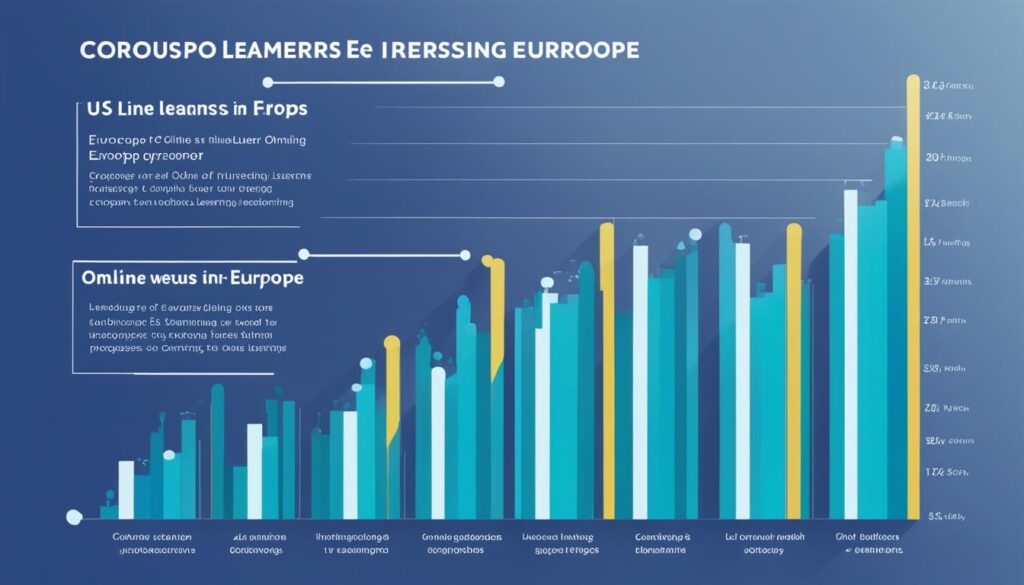
The U.S. and Europe’s strong presence in the e-learning market share shows their key role in pushing e-learning forward globally.
Strengths of E-Learning
E-learning has changed education a lot. It offers many benefits for students and teachers. You can learn anytime, anywhere and at your own pace. It also gives you access to lots of resources, changing how we learn.
Flexibility and Accessibility
E-learning lets you learn flexibly. You can check out course materials and join virtual classes when it fits your schedule. This self-paced learning means you learn how you like, making education more about you.
Synergy and High-Quality Dialogue
Online learning brings students and teachers together in new ways. Through forums and video chats, you can have deep talks with others. This creates a lively online classroom where everyone shares ideas and grows together.
Inclusive and Equitable Learning
E-learning helps everyone, no matter where you live or your background. It gives you access to many educational resources. This means you can learn about different topics and views, making learning fair for all.
Innovative Teaching Approaches
E-learning lets teachers try new ways of teaching. They use technology to make learning fun and personal. This way, you take an active part in your learning, helping you understand and remember more.
In short, e-learning is changing education for the better. It offers anytime, anywhere learning, self-paced study, and synergistic interactions. With innovative teaching methods, it’s opening up new ways to learn and helping everyone.
Weaknesses of E-Learning
E-learning has many benefits, but it also has some weaknesses. One big challenge is the technology side of online learning. This includes issues with fairness and access, needing to know how to use computers, and tech limits.
Some students struggle because they don’t have good internet or the right devices. This is a big problem for those who are less well-off. Also, knowing how to use computers is a must to get around e-learning sites and tools. This can be hard for some students.
Technology Challenges in E-Learning
- Equity and accessibility issues due to the need for reliable internet and devices
- Requirement of computer literacy skills to navigate e-learning platforms
- Limitations of technology, such as the inability to fully replicate hands-on experiences
Student Challenges in E-Learning
Students face special challenges with e-learning. It requires a lot of self-control, being organized, and managing time well. Not being able to talk face-to-face can make students feel alone and lower their motivation. This is true for those who prefer a traditional classroom.
- Developing self-discipline and time management skills
- Overcoming feelings of isolation and maintaining motivation
- Adapting to a learning environment with limited hands-on experiences
It’s important to fix these issues for e-learning to work well. Tools like Cincopa help by offering customizable video players, making things easier to access, and giving detailed stats. These features improve the e-learning experience for both students and teachers.
« Online learning has been especially beneficial for adult learners seeking further education as it provides a flexible solution for those with conflicting work, family, and other obligations. »
e-learning
E-learning, also known as online learning or virtual learning, is changing education. It lets people learn from anywhere, anytime. This digital shift has made learning easier and more accessible.
Many people want flexible learning options, which is why e-learning is growing. A survey by McKinsey & Company found that 65% of students want to keep some online learning after the pandemic. This shows how much people value the ease and flexibility of e-learning.
Platforms like Anthology for Business, Canvas, Moodle, Sakai, and Schoology offer many tools for learning. They have courses, presentations, exams, and tools to track student progress. These systems are especially useful in businesses for training employees and customers.
MOOCs and platforms like Coursera, edX, Udemy, and Skillshare make high-quality learning available worldwide at low cost. They offer courses on many topics, from tech to marketing. This helps both individuals and companies grow.
E-learning is not just convenient; it’s also cheaper and better for the planet. It cuts down on paper waste and helps learners learn at their own pace. This can boost performance and productivity.
The e-learning market is set to hit $1 trillion by 2028. This shows that the future of education is digital. By using e-learning, people and companies can grow, learn, and develop in new ways.
| E-Learning Platform | Key Features |
|---|---|
| Anthology for Business | Courses, presentation capabilities, online examinations, student performance data analysis |
| Canvas | Courses, presentation capabilities, online examinations, student performance data analysis |
| Moodle | Courses, presentation capabilities, online examinations, student performance data analysis |
| Sakai | Courses, presentation capabilities, online examinations, student performance data analysis |
| Schoology | Courses, presentation capabilities, online examinations, student performance data analysis |
In conclusion, e-learning, online learning, virtual learning, and distance education have changed education. They offer a flexible way to learn that’s different from traditional classrooms. By using technology, everyone can grow, learn, and improve in new ways.
Conclusion
The e-learning market has grown a lot, thanks to new tech and changes in education. As we look ahead, we’ll see more new ways to learn online. This will make e-learning even more popular and successful.
Online learning has its ups and downs. Some students find it hard to stay focused or prefer a traditional classroom setting. Yet, e-learning’s flexibility, reach, and affordability make it a top choice for many, especially adults. With ongoing tech advancements, e-learning will keep growing in importance.
It will offer more personalized, engaging, and collaborative learning experiences. These will meet the varied needs of students.
Educational institutions and learners can use e-learning’s strengths to overcome its weaknesses. This will lead to better results, improved digital skills, and more equal access to education. As e-learning changes education, being able to adapt and innovate will be key to its success.