
China says it’s the first to test a high-speed train using vacuum technology, or ‘vactrain’. Researchers tested the train on a 2-kilometre track in Shanxi, northern China. It hit speeds of up to 128 km/h inside a vacuum tube.
The team aims to build a 59-kilometre test track. There, the train could go as fast as 1,000 km/h. This would be the fastest way to travel on land.
China’s big plans for a « flying train » show China’s push for new transport tech. This maglev system uses the latest tech to change how we move people and goods.
Key Takeaways
- China is testing a vacuum-powered « flying train » that can reach speeds of up to 1,000 km/h (621 mph).
- The goal is to build a 59-kilometer test track for the high-speed maglev system.
- This technology represents a significant advancement in China’s transportation innovation and infrastructure development.
- The « flying train » project aims to integrate advanced technologies to provide faster and more efficient transportation solutions.
- China’s high-speed rail network and investment in transportation infrastructure are laying the groundwork for future innovations.
China’s Ambitious Endeavor: The 1,000 km/h « Flying Train »
China is leading the charge in high-speed transport with a new « flying train » that can hit speeds of up to 1,000 km/h. This project, called « T-Flight, » is being driven by the China Aerospace Science and Industry Corporation Limited (CASIC). They are a top name in China’s aerospace sector.
China’s Aerospace Industry Spearheading the Project
CASIC has set up a superconducting maglev test line in Datong City, Shanxi Province. They’ve run detailed tests on the whole system. These tests proved the design’s scientific soundness, opening doors for more progress in this new transport tech.
Integrating Cutting-Edge Technologies for High-Speed Travel
The « T-Flight » project combines the latest tech for safe, fast travel of people and goods. It plans to up the train’s speed, starting with 1,000 km/h for regional trips. The goal is to hit 2,000 km/h and 4,000 km/h for major city connections, supporting the Belt and Road trade initiative.
This big project shows China’s strong push for infrastructure development, economic growth, and technological innovation. With ongoing investments in high-speed rail and transportation technology, the « flying train » project highlights China’s vision for a future of green and efficient travel.
« The ‘T-Flight’ project represents China’s ambitious pursuit of cutting-edge transportation solutions that will redefine the future of travel and connectivity. »
The Science Behind the Vacuum Maglev Train
The « flying train » project in China is a big step forward in transportation technology, innovation, and sustainability. It’s all about the vacuum maglev train, a new way to travel fast that could change the future of trains.
This train doesn’t use traditional rails. It floats on a cushion of air and moves really fast because it’s in a vacuum. This lets it go up to 1,000 km/h, which is super fast.
The idea behind it is similar to the Hyperloop, which Elon Musk talked about in 2013. The Hyperloop aims to be as fast as a plane but for shorter distances. It could change how we travel for trips that are not too long.
The vacuum maglev train has some cool tech features:
- Magnetic levitation: It floats on the track without wheels, which means less friction and smoother ride.
- Vacuum environment: Flying in a vacuum means less air resistance, so it can go even faster.
- Superconducting technology: This tech makes the magnets strong and efficient, saving energy.
This new transportation technology and innovation could change how we move people and things. It promises to be faster, more efficient, and sustainable.
China is leading the way in high-speed rail with the vacuum maglev train. It’s a big step towards a future where we can travel fast and protect the environment. This tech could make connecting cities easier and help us live in a more sustainable world.
China’s High-Speed Rail Network: Paving the Way for Innovation
China’s high-speed rail network has changed how the country moves people and goods. It’s made getting from one major city to another faster. Now, China wants to go even faster and make travel more efficient.
China’s Existing Bullet Train Infrastructure
China started its high-speed rail in 2008 with a line from Beijing to Tianjin. Since then, the network has grown a lot, reaching over 42,000 kilometers by 2022. It’s part of a huge 155,000-kilometer railway network.
China Railway Group (CREC) has worked on big projects around the world too. They’ve built the China-Laos Railway and the Jakarta-Bandung High-speed Railway, among others. These projects show China’s skill in building fast and efficient railways.
The Need for Faster and More Efficient Transportation
The « flying train » project aims for speeds of 1,000 km/h. This is a big step in making travel faster. The goal is to cut down travel times and boost economic growth in China.
« Foreign envoys praised China’s railway technology progress and accomplishments, highlighting their impressions of the innovation, technology, and talent employed in major railway projects. »
At a Foreign Ministry event, 100 foreign envoys from 70 countries met. They were impressed by China’s work in transportation technology. They saw the innovation, technology, and talent in big railway projects.
China economy,Beijing,Transfer,The flying train,Technology,Train railway
China is working on a « flying train » that could go as fast as 1,000 km/h. This is part of a big plan to change its transport system and boost economic links. China leads the world in high-speed rail, with over 40,000 kilometers of tracks. This network has cut travel times between cities and helped the economy grow.
China’s high-speed rail has made a big difference in the economy. A 2019 study showed it brought back 8% of the economy in 2015. Another study in 2020 found it added about $378 billion to the economy, with a 6.5% return on investment each year.
| Key Statistic | Value |
|---|---|
| Total High-Speed Rail Mileage in China | Over 40,000 kilometers |
| High-Speed Rail Coverage | 95% of cities with a population over 500,000 |
| Beijing to Shanghai Travel Time | 4.5 hours |
| Beijing to Shenzhen Travel Time | 8 to 10.5 hours |
| Shanghai to Shenzhen Travel Time | About 6.5 hours |
China’s high-speed rail does more than just make travel easier. Cities on these lines see faster GDP growth than those without them. This shows how the rail system boosts the economy. It also creates jobs, helping the country grow economically.
China’s « flying train » project is pushing transport tech forward. Adding this new tech to the high-speed rail network will make things even better. It will help connect more places and grow the economy, fitting with China’s modernization plans and the Belt and Road Initiative.
The Technological Challenges of Achieving 1,000 km/h
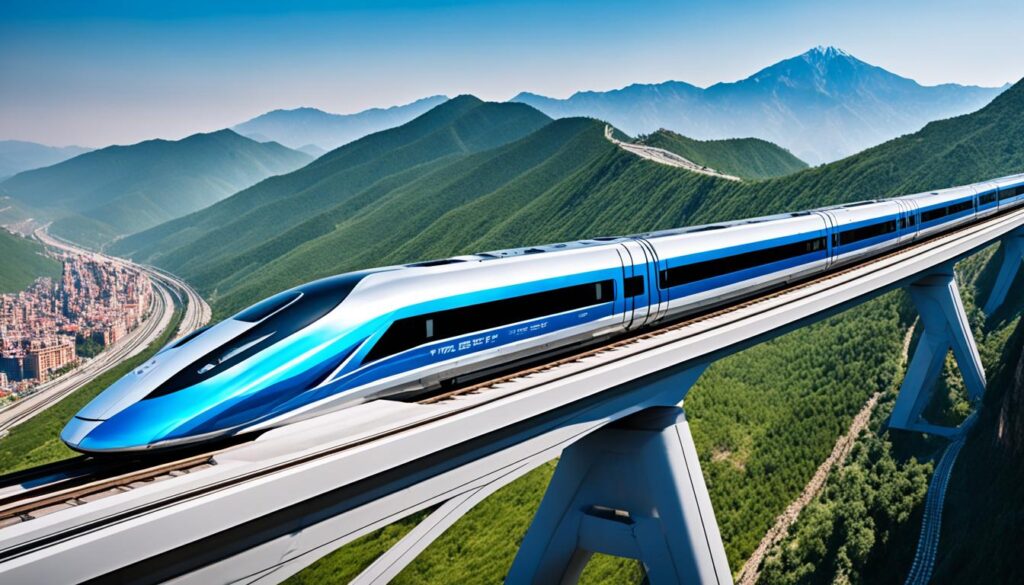
Creating a way to travel on land at speeds up to 1,000 km/h is a big challenge. Experts worry about how our bodies can handle the forces of speeding up and slowing down. They also question if the project will be worth the huge cost to build and keep up the needed tracks and systems.
Engineering Feats and Breakthroughs Required
To hit the 1,000 km/h mark, many experiments and big discoveries are needed. China plans to boost bullet train speeds to 600 to 1,000 km/h using magnetic levitation. A new network in China could make trains go from 600 km/h to 1,000 km/h on special tracks. This could cut a 2,200-km trip from Wuhan to Guangzhou down to about two hours.
China is racing with other countries in technology, innovation, and sustainability to lead in transportation. They’ve already shown they can do high-speed trains, with the CR400 « Fuxing » trains going up to 350 kph and testing at 420 kph.
| Country | High-Speed Rail Speeds |
|---|---|
| China | CR400 « Fuxing » trains: Commercial max. 350 kph (217 mph), Test max. 420 kph (260 mph) |
| Germany | ICE3 trains: Normal 300 kph (186 mph), Max. 330 kph (205 mph) |
| France | TGV trains: Up to 320 kph (200 mph), Speed record 574.8 kph (357 mph) |
| Spain | AVE trains: Commercial max. 310 kph (193 mph), Record 404 kph (251 mph) |
| Japan | E5 « Bullet Trains »: Up to 320 kph (200 mph) |
Reaching speeds of 1,000 km/h is a big goal that will need big advances in engineering, materials, and making things more energy-efficient. This push will challenge and change the limits of transportation technology, innovation, and sustainability.
Potential Impact on Connectivity and Economic Growth
If the « flying train » is developed, it could change transportation in China and beyond. It would cut travel times between cities, making it easier to move people and goods. This could boost the economy by connecting cities better.
China’s high-speed rail is already making a big difference in the economy. A study found it helps cities grow economically. This is because it creates jobs, raises incomes, and encourages spending.
High-speed rail also makes it easier to move things like workers and money around. This helps make the economy more productive and connected. China plans to add more high-speed rail by 2025, reaching more cities and provinces.
« The development of high-speed rail has been a key driver of China’s economic growth, and the ‘flying train’ project has the potential to take this to the next level. By drastically reducing travel times, it could unlock new possibilities for business, trade, and cultural exchange across the country. »
But, China still faces a big issue with income differences between cities and rural areas. The gap has grown over the years. We need more research on how high-speed rail affects everyone’s income and how it moves people and resources.
| Key Statistic | Value |
|---|---|
| Sample size of cities studied | 276 prefecture-level cities from 2007 to 2019 |
| Expected total length of China’s high-speed rail network by 2025 | 38,000 km |
| Percentage of total social passenger traffic accounted for by high-speed rail in 2020 | 25.2% |
| Percentage of total freight traffic accounted for by high-speed rail in 2020 | 9.6% |
Sustainability Considerations for High-Speed Rail
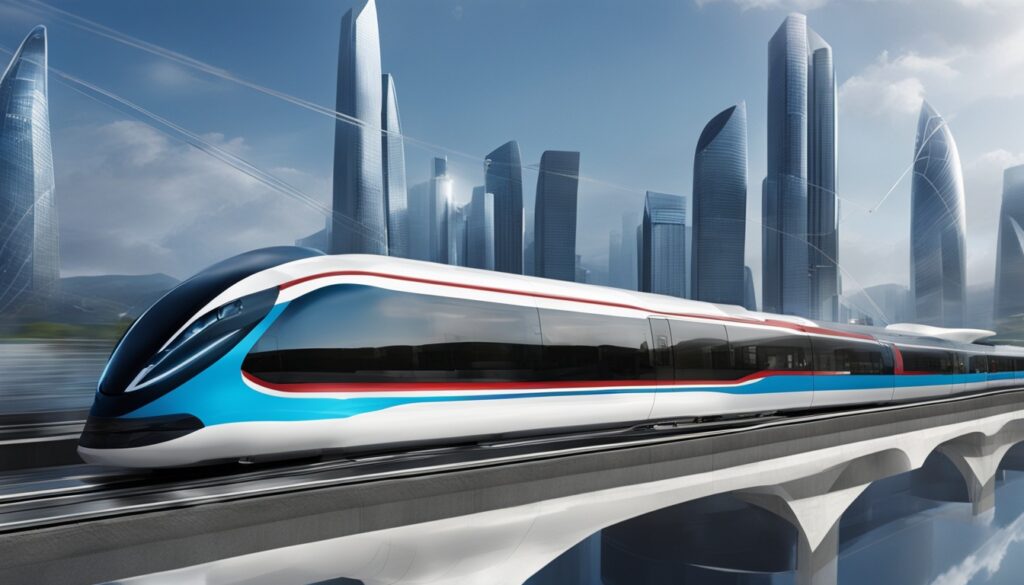
China is working on a « flying train » that could go up to 1,000 km/h. This project is exciting because it could make travel faster and connect places better. But, we must think about how it affects the environment.
Environmental Implications and Mitigation Strategies
High-speed trains use a lot of energy and produce greenhouse gases. The transport sector is responsible for 25% of global carbon emissions. China’s transport is growing fast, making it a big user of energy. We need to look at how these projects affect the environment and find ways to lessen the harm.
Here are some ways to make high-speed rail better for the planet:
- Using renewable energy like solar or wind to power the trains can cut down on fossil fuel use.
- Putting in place strong measures to protect nature, like reducing noise and saving habitats, helps ecosystems.
- Improving energy efficiency with new technology and design can make trains use less energy.
- Connecting high-speed rail with other green transport options makes a better, more eco-friendly way to travel.
By focusing on sustainability, China can make sure its « flying train » helps the environment. This will help meet goals for protecting the environment and reducing carbon emissions.
« Achieving sustainability is not just about technological innovations, but also about integrating these advancements into a comprehensive, eco-friendly transportation network that serves the long-term well-being of our communities and the planet. »
Global Competition in Hyperloop and Vacuum Train Technologies
China is leading the charge with its « flying train » project, aiming for the world’s fastest ground transport. In the US, Hyperloop One and Hyperloop Transportation Technologies are also pushing the limits. They aim to make Hyperloop technology go over 1,000 km/h (621 mph).
This global race shows the huge demand for faster, greener ways to move people and goods. China’s « flying train » is part of a big push to change how we travel in the future. It’s all about making transportation faster, more efficient, and sustainable.
The first Hyperloop line will connect Shanghai and Hangzhou, stretching 150 km (93 miles). It’s set to open by 2035. With speeds up to 1,000 km/h, it will cut travel time from an hour by high-speed rail to just 15 minutes.
China’s experience with high-speed rail will help with Hyperloop development. But, the project faces legal hurdles and safety tests. It needs to prove it’s safe and accepted by the public.
The race in Hyperloop and vacuum train tech shows how big a change transportation innovation can bring. As countries like China push these technologies, we’re seeing a fast-changing future of travel.
Public Perception and Skepticism Surrounding the Project
China’s plan to make a « flying train » that goes up to 1,000 km/h has raised eyebrows. Experts and the public are unsure about its chances of success. They worry about if it’s even possible and if it makes sense financially.
Addressing Concerns and Feasibility Doubts
Experts wonder if our bodies can handle the speed. They also question if spending so much on this project is worth it. The technical hurdles, like keeping it stable and safe at such speeds, are big concerns.
- Concerns over the ability of the human body to tolerate the intense forces and stresses of 1,000 km/h travel
- Doubts about the economic feasibility of such a costly and complex undertaking
- Technical challenges in ensuring stability, safety, and reliability at these extreme speeds
The team behind the « flying train » must prove it’s possible with thorough testing and steady progress. They need public support to make this new way of traveling a reality.
« The true test of the ‘flying train’ will be whether it can overcome the skepticism and deliver on its promises of faster, more efficient, and safer transportation. »
The Future of Transportation: China’s Vision for Modernization
China is leading the way in transportation technology with the « flying train » project. This technology aims for speeds of up to 1,000 km/h. It could change how we travel between cities, making trips much faster.
This project is part of China’s big plan, the Belt and Road Initiative. It aims to improve connections between countries. By using this new tech, China wants to be a leader in making travel and trade easier.
Revolutionizing Transportation: The « Flying Train » and the Belt and Road Initiative
China’s high-speed rail has grown a lot in the last 20 years. It now covers over 37,900 kilometers, the most in the world. By 2035, it plans to double that. Adding the « flying train » will make China a pioneer in fast and efficient travel.
By adding the « flying train » to the Belt and Road Initiative, China will strengthen its ties with other countries. This project aims to create a vast network of roads and trade routes. The « flying train » will make this network work better, boosting trade and cultural exchange.
| Metric | China | Global Comparison |
|---|---|---|
| High-speed rail network length | 37,900 km | Spain: 2,000+ miles, UK: 107 km, US: 1 high-speed route |
| High-speed train operational speed | Up to 350 kph (217 mph) | – |
| High-speed train daily operations | Over 9,600 trains per day | – |
| Fares for high-speed rail journeys | Starting from $13 | – |
China’s « flying train » project is a big step towards modernization. It’s part of the Belt and Road Initiative. With its high-speed rail and new tech, China is changing how we travel. This will start a new era of fast, green, and connected travel worldwide.
Conclusion
China is taking a big step forward with its « flying train » project. This project combines new technologies like maglev and vacuum tube trains. It aims to make the world’s fastest ground transport system, reaching speeds over 1,000 km/h.
This project is part of China’s plan to update its transport network. It will improve economic connections and make China a global leader in innovation.
China already has the longest and most used high-speed rail network in the world. It has greatly helped the economy by connecting regions, creating jobs, and boosting industries.
The « flying train » could change how we travel and move goods between cities. It would strengthen economic ties and help develop regions along the route.
However, the « flying train » is still in the planning stages. Its technical and economic success is yet to be proven. But China’s big plans show its dedication to leading in transportation technology.
As the demand for high-speed rail grows worldwide, China is well-positioned to lead. Its strong infrastructure and tech advancements will help it grab a big part of this growing market. This will make China a key player in the future of transport.