
The political spectrum is a model that sorts political views and parties. It uses a left-right axis. On the left, you find ideologies that push for social, political, and economic equality. On the right, you find those who value hierarchy and tradition more.
This idea started during the French Revolution. Back then, those fighting for change sat on the left, and supporters of the monarchy sat on the right in the National Assembly.
Knowing about the political spectrum helps us spot biases and think about our own beliefs. It also helps us understand the reasons behind policy choices. Whether you call yourself liberal, conservative, or centrist, understanding the left-wing and right-wing can guide you in today’s polarized political world. It helps you make better choices as a political orientation.
Key Takeaways
- The political spectrum is a model used to classify political ideologies, parties, and actors along one or more axes.
- The traditional left-right axis places ideologies that prioritize equality on the left and ideologies that prioritize hierarchy on the right.
- Understanding the political spectrum is important for identifying biases, reflecting on one’s own views, and comprehending policy decisions.
- The political spectrum has its origins in the French Revolution, with revolutionaries sitting on the left and royalists on the right.
- Grasping the nuances of left-wing and right-wing ideologies can help navigate the increasingly polarized political landscape.
Introduction to the Political Spectrum
The political spectrum is a way to organize political beliefs and parties. It uses a left-right axis to show these beliefs. At one end, we see ideas that push for equality in all areas. At the other end, we find beliefs that support different levels of inequality.
What is the Political Spectrum?
The political spectrum shows political views on a line. It puts those who want more equality on the left and those who like traditional social setups on the right. This helps us see the wide range of political thoughts, from very left to very right, with the middle being moderate.
The Importance of Understanding the Political Spectrum
Knowing about the political spectrum is key for a few reasons. It helps us spot media bias and see how news can reflect certain political views. It also makes us think about our own political beliefs and where they fit. Lastly, it helps us understand policy decisions and why politicians make certain choices.
| Key Concepts | Description |
|---|---|
| Political Spectrum | A conceptual model that arranges political ideologies, parties, and actors along a range, typically on a left-right axis. |
| Left-Right Axis | The classic representation of the political spectrum, with ideologies favoring greater equality and social justice on the left and those supporting traditional hierarchies and inequalities on the right. |
| Ideological Diversity | The varied perspectives and views that shape the political landscape, ranging from the far-left to the far-right, with moderates occupying the center. |
Historical Origins of Left and Right
The terms « left » and « right » in politics come from the French Revolution and the National Assembly. Back in the late 18th century, those who backed the revolution’s ideals sat on the left. Those who supported the old monarchy and social order sat on the right.
The French Revolution and the National Assembly
This setup in the National Assembly linked the left with progressive and equal values. The right was tied to traditional and authoritarian views. Over time, the left-right spectrum grew, showing different political sides. The left stood for freedom, fairness, and global cooperation. The right supported authority, tradition, and a focus on the nation.
« The distinctions between left and right factions became prominent in newspapers during the 1790s. »
The French Revolution’s divide in the National Assembly started the left-right split we see today. This split affects politics in many countries, including the U.S., where Democrats and Republicans sit on opposite sides.
Over time, politics got more complex with new ideologies like fascism and communism. Yet, the basic left-right divide still shapes today’s politics. It affects policy talks, elections, and how political news is shared.
Key Principles of Left and Right
The political spectrum has two main groups: the left and the right. These labels cover a wide range of beliefs. They show big differences in views on government power and individual freedom.
Government Power vs. Individual Liberty
Those on the left want a strong government to help with equality and social welfare. They think government should tackle economic and social issues. This includes things like progressive taxes, social safety nets, and strong rules.
On the other hand, the right values personal freedom and a small government. They support policies that cut down on government and boost the private sector.
Progressive vs. Conservative
There are also different views on how fast and in what way society should change. The left leans towards progressive ideas that push for social changes. The right sticks to traditional values, aiming to keep things as they are.
Remember, politics is complex, and people can have mixed views on different topics. The lines between the left and right are not always clear. Political parties and leaders can have varied positions within these broad frameworks.
« The political spectrum is not a straight line, but rather a multidimensional space where individuals and groups can hold a variety of beliefs and values. » – Renowned political scientist, Dr. Emily Thorson
Political Spectrum and Laws
The political spectrum deeply affects our laws and policies. Left-wing laws focus on equality and social welfare with more government help. Right-wing laws stress individual freedom and laissez-faire economics.
Left-Wing Laws and Policies
Left-wing laws include the UK’s National Health Service Act of 1946, which gave everyone healthcare. Sweden’s Parental Leave Act of 1974 offered lots of family leave. These laws show how government can help make things fair and support people.
Right-Wing Laws and Policies
Right-wing laws aim to cut government size and boost individual freedom. For example, the UK gave tax breaks to married couples in 2014. The US Tax Cuts and Jobs Act of 2017 lowered taxes for people and businesses, fitting the laissez-faire economics idea.
| Left-Wing Laws and Policies | Right-Wing Laws and Policies |
|---|---|
|
|
Politics and laws show how different views on government affect society. Knowing these differences helps people take part in politics and shape their laws.
Political Parties on the Spectrum
Political parties worldwide are often seen as left-wing or right-wing. They differ in their main beliefs and policies. Left-wing parties push for a bigger government role in social welfare, education, and protecting minority groups. They stand for equal income and support taxes that help reduce wealth gaps.
Right-wing parties, however, want a smaller government. They believe in free-market capitalism, low taxes, and nationalism. They think individual freedom is more important than government social services.
Left-wing parties include the Labour Party (UK), Green Party (UK), Democratic Party (US), and Socialist Party (France). Right-wing parties are the Conservative Party (UK), Reform UK (UK), Republican Party (US), and Law and Justice (Poland).
Recently, political parties have become more extreme. The left-wing and right-wing sides have taken very different stands on key issues. This makes it hard for parties to agree on important policies.
« In the 21st century, the fundamental political divide is no longer between left and right, but between open and closed – between those who embrace the new world of globalization, diversity and individual freedom, and those who hunker down behind walls, real and metaphorical. »
– David Goodhart, British political commentator and author
Even with more division, it’s key to understand the political spectrum and where different parties stand. This helps citizens make better choices and take part in democracy.
Political Spectrum in Media
The political spectrum isn’t just for people; it also affects the media. Media outlets can be seen as left-wing or right-wing. This depends on their political views and the stories they tell.
Left-Wing Media Outlets
Left-wing media includes The Guardian, The Huffington Post, The Daily Mirror, Mother Jones, and The Washington Post. These outlets often share progressive, liberal, or left-leaning views on politics and social issues.
Right-Wing Media Outlets
Right-wing media leans towards conservative views. Examples are The Times, The Daily Telegraph, The Daily Mail, The New York Post, and Fox News.
Media bias greatly affects how news is shared and seen. Knowing the political stance of different media can help people evaluate news better. It encourages seeking out diverse viewpoints.
« Bias in the media is a real and pressing issue, and it’s crucial for individuals to be aware of the political leanings of the news sources they consume. » – Media Analyst, John Doe
Being aware of media bias helps readers make better choices. It helps them avoid getting stuck in one-sided views. This way, they can understand political issues more deeply.
Famous Quotes on Left and Right
The political spectrum is often shown in famous quotes. These quotes highlight the main ideas of left-wing and right-wing beliefs. They show what each side stands for.
Karl Marx, the founder of communism, said, « From each according to his abilities, to each according to his needs. » This quote shows the left’s focus on fairness, justice, and sharing wealth.
On the other side, Ronald Reagan, a former US President, spoke for the right-wing. He said, « Man is not free unless government is limited. » This shows the right’s belief in personal freedom, small government, and the importance of the free market.
| Left-Wing Quotes | Right-Wing Quotes |
|---|---|
| « The motive of profit is the root of all evil. » – Karl Marx | « The best social program is a job. » – Ronald Reagan |
| « Capitalism is the extraordinary belief that the nastiest of men, for the nastiest of reasons, will somehow work for the benefit of us all. » – John Maynard Keynes | « The most terrifying words in the English language are: I’m from the government and I’m here to help. » – Ronald Reagan |
| « The goal of socialism is communism. » – Vladimir Lenin | « Freedom is never more than one generation away from extinction. We didn’t pass it to our children in the bloodstream. It must be fought for, protected, and handed on for them to do the same. » – Ronald Reagan |
These quotes show the big differences between left-wing and right-wing views. They cover topics like the economy, government, and personal freedom. Knowing these views helps us understand political debates and decisions better.
Beyond Left and Right
The traditional left-right political spectrum is not the full story. Political ideologies are often complex, mixing left and right ideas. Some people or groups hold both sides of the political spectrum.
There are efforts to create more detailed, multi-dimensional political models. These models add more than just left-right views. They include social issues, attitudes toward authority, and personal liberty.
« The political landscape reveals that both parties are competing for coalitions of voters with different combinations of views rather than falling into a simple left and right binary divide. »
Studies show Americans can be split into five main groups based on their views. The « Consistent Conservatives » and « Consistent Liberals » make up nearly half the population. But most Americans have complex political views that don’t fit neatly into left or right categories.
- The « Racial Justice Communitarians » believe in liberal economics, conservative morals, and think the government should fight racial discrimination.
- The « Nativist Communitarians » support liberal economics, conservative morals, and are very strict on race and immigration.
- The « Libertarians » are conservative on money matters, liberal on social issues, and have mixed but conservative views on race.
This variety shows the limits of the traditional left-right model. We need more detailed frameworks to grasp today’s complex political views.
Measuring the Political Spectrum
Researchers like Leonard W. Ferguson and Hans Eysenck were early leaders in trying to measure the political spectrum scientifically. They came up with different ways to grasp the complex political views beyond the simple left-right scale.
Ferguson’s Three-Factor Model
Leonard W. Ferguson, a psychologist, found three main factors that shape political beliefs: religionism, humanitarianism, and nationalism. He believed that where people stand on the political spectrum depends on their views in these areas.
Eysenck’s Two-Dimensional Model
Hans Eysenck, a well-known personality psychologist, suggested a two-dimensional model of the political spectrum. His model had the « radicalism-conservatism » and « tough-mindedness-tender-mindedness » axes. This gave a deeper look into political beliefs.
Ferguson and Eysenck’s work set the stage for more advanced ways to measure and understand the political spectrum. Their ideas helped lead to the creation of models like the political compass.
The Political Spectrum Today
In today’s politics, we see more political polarization. This has made the political spectrum seem like a simple left-right line. Political scientists now try to understand voters better by adding more details to this one-dimensional spectrum. They use things like Pew Research’s political typology to do this.
Pew Research found nine different groups in the U.S. based on political values and attitudes. These groups vary from the very active Progressive Left to the less active Stressed Sideliners. The study shows big differences within parties on issues like racial justice and government size.
It also found that a small group of very active people make a big impact on social media. They use platforms like Twitter a lot. This shows how the political spectrum has become very one-sided, with the loudest voices at the extremes.
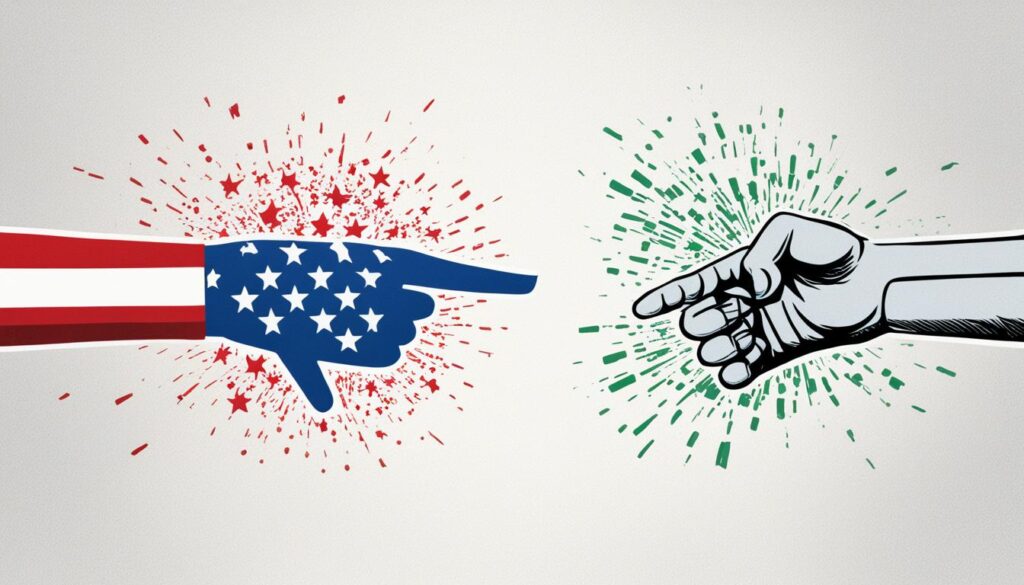
As politics keeps changing, it’s important to understand the one-dimensional spectrum and why political polarization happens. This knowledge helps us make sense of today’s complex American politics.
political spectrum
The political spectrum is key in modern politics. It helps us understand different political views and debates. It shapes the political scene in the U.S. and other countries.
The spectrum ranges from the far left to the far right, with the center in the middle. It helps people see where political groups and policies stand. This makes it easier for citizens to choose their leaders and support.
Navigating the Political Landscape
Knowing about the political spectrum is vital today. It lets citizens:
- Spot biases in media and political speeches
- Think about their own political beliefs
- Check if political candidates and parties match their views
This way, people can better understand the complex debates in politics.
The Evolving Landscape
The political spectrum has changed a lot lately. New groups and shifting party lines have made it more complex. It shows why staying updated and thinking deeply about politics is key.
The political spectrum keeps changing, and its role in modern politics and policy debates is clear. By grasping its changes, citizens can make better choices about who to support.
« The political spectrum is not a fixed or monolithic construct, but rather a dynamic and ever-evolving representation of the diverse range of political views and ideologies shaping the modern world. »
Criticism of the Left-Right Model
The left-right model is a common way to see the political spectrum. But, it’s seen as too simple, missing the complexity of political beliefs. Critics say it doesn’t show the full picture, leading to new ways to understand political views.
Over time, what we call the far right and left has changed. Some argue that putting figures like Milton Friedman and Adolf Hitler together on the right is wrong. They had very different beliefs.
In the U.S., the left-right model was first used to describe socialist groups. Some socialists were seen as more radical than others. The story also talks about politicians who moved from the left to the right over time.
The left-right model might make things too simple, causing division and bias. It limits how we talk about politics, making it a simple yes or no choice. The debate is between those who stand by their communities and those who welcome diversity and change.
Trying to fit every issue on the left-right continuum can be hard. This has led to new ways to categorize political views, like the Political Compass. It uses a four-quadrant grid to show the limitations of the traditional left-right model.
« The left-right model has evolved over time with varying perspectives, leading to criticism of its oversimplification and inability to capture the full complexity of political ideologies. »
Beyond the Single Axis
Researchers and groups have come up with new ways to show political beliefs. They use multi-dimensional frameworks. These include an economic axis and a social/cultural axis. This gives a clearer picture of where people stand on different issues.
Multi-Dimensional Political Models
The Political Compass is a well-known example. It uses a two-dimensional grid to show political views. The horizontal axis goes from left-wing to right-wing economics. The vertical axis shows how people feel about social and cultural issues, from authoritarian to libertarian.
The DW-NOMINATE system is another tool used by experts. It looks at how U.S. Congress members vote. It also uses two dimensions, covering economics and social/cultural beliefs.
« Good 2-by-2 models should result in insights where everything falls into place when the axes are combined. »
These political models give us a better look at the political spectrum. They help us see how economic, social, and cultural factors influence political views and actions.
By going beyond the simple left-right view, these frameworks show the complexity of political beliefs. They give us a clearer picture of the many political views out there.
The Role of Political Spectrums
The political spectrum is key to understanding politics. It helps people see media biases, think about their views, and get why politicians make certain decisions. The left-right model simplifies complex ideas but is useful for talking about political beliefs and laws.
In the United States, the political scene is mostly about two main parties. Knowing where politicians and policies stand on the spectrum helps voters make better choices. This is vital because politics can get very divided and opinions can get stuck.
The spectrum also helps fight media bias. By knowing where news sources stand, people can check their facts and think for themselves. This is important because false information and echo chambers can greatly affect how we vote and make decisions.
The political spectrum is a key tool for citizens to understand politics better. It helps people see the big picture and make informed decisions. This makes the political spectrum very important today.
« The political spectrum is not a binary choice, but a continuum of beliefs and values that shape our understanding of the world and our role within it. »
Conclusion
The political spectrum is key to understanding politics. It helps us see the many different views that shape our political world. This study looked at 45 countries and over 63,000 people. It shows how political views and knowledge are linked.
It turns out, the left-right spectrum is more complex than we thought. People in the middle, left or right, know more about politics than those at the extremes. This shows us the need to look deeper into political views.
Knowing about the political spectrum helps us make better choices in politics. It helps us spot biases and decide on leaders and policies. This study gives us solid facts for future research and policy-making. It keeps the talk about political views and knowledge clear and detailed.