
The United States is a top economic and military power. It also has the oldest written constitution and is one of the oldest democracies. Since the 18th century, American politics has fascinated those who study it. It’s known for its lively elections, strong judiciary, and independent legislature.
It also has meaningful federalism, racial diversity, and lots of immigration. When you study American politics, you look at many things. This includes the presidency, Congress, the bureaucracy, and the courts. You also explore state and local politics, public law, public opinion, voting, and democratic theory.
Key Takeaways
- American politics is a complex and multifaceted field of study, encompassing a range of institutions, behaviors, and theoretical perspectives.
- The United States is a longstanding democracy with a unique system of government, marked by the separation of powers and federalism.
- The study of American politics examines the presidency, Congress, the judiciary, public opinion, and the role of political parties and ideologies.
- Researchers in this field utilize a variety of methodological approaches, including quantitative, qualitative, and comparative analysis.
- Understanding American politics is crucial for making sense of the country’s past, present, and future, as well as its global influence and impact.
The Profound Disillusionment with American Politics
Americans are now very negative about politics and those in office. A Pew Research Center survey found people calling politics « disgusting, » « divisive, » and « broken. » They used words like « corrupt » and « crazy » to describe it.
The survey talked to 8,480 adults in July 2023 and 5,115 in June 2023. Most people said they were tired and angry with politics. Only 10% felt hopeful.
Americans’ Harsh Views on the State of Politics
Most Americans think lobbyists and special interests have too much power. They also believe presidential elections are too long and expensive. Plus, many think both parties focus more on fighting each other than solving problems.
Just 16% trust the federal government to do the right thing. Republicans trust it the least.
Deep Distrust in Government and Political Institutions
- Only 4% of Americans think the political system works well. 23% say it works somewhat well.
- About 63% don’t have much or any confidence in the U.S. political system’s future.
- Only 16% trust the federal government always or most of the time, which is a record low.
Many Americans feel let down and disconnected from politics. This deep distrust is a big problem. It makes people feel cynical and apart from the political process.
The Driving Forces Behind Voter Turnout
Despite feeling let down by the American political system, more people are voting than in decades. A Pew Research Center survey found that fear and anger are key reasons. These feelings affect everyone, no matter their age, race, sex, education, or political views.
Many people, on both sides of politics, fear the worst if the other side wins. This fear drives more people to get involved in politics and vote.
Fear and Anger as Motivators for Political Engagement
In the 2020 presidential election, 77 percent of registered voters turned out, which is 48.5 percent of the U.S. population. But, fewer people were actually registered to vote in 2020 compared to 2012. This shows a drop in voter turnout.
Young people aged 18 to 25 are less likely to vote, while those 65 to 74 are more likely. Older voters might feel more fear and anger. They think elections could greatly affect their lives and the country’s future.
| Voter Turnout Rates by Age Group | Registered Voters | Actual Voters |
|---|---|---|
| 18 to 24 years old | 51% | 39% |
| 65 to 74 years old | 75% | 68% |
The data shows how fear and anger really push people to vote. Older voters are especially motivated to take part in elections.
Constitutional Structures as a Strength of the System
Many Americans are unhappy with U.S. politics, but a big group sees the strength in the country’s constitutional setup. A Pew survey found 12% of people who knew a strength in politics pointed to the constitution and its independent branches.
The U.S. system of checks and balances keeps the country stable, even in hard times. It has the presidency, Congress, and the judiciary working together but separately. The first Supreme Court was set up in 1789 with six justices. Now, it has a Chief Justice and eight others.
The Marbury v. Madison case in 1803 made it clear the Supreme Court can check if laws are right or wrong. This power helps protect people’s rights and keeps the government in check.
Experts have debated the best way to govern, focusing on keeping democracy stable and growing the economy. They’ve looked into how different voting systems work in divided societies and the issues with presidential systems.
« The Supreme Court ensures that the limits of power for each branch of government are recognized, protecting civil rights and liberties and setting limits on democratic government. »
The U.S. political system has big challenges like gridlock and special interests. But, many Americans see the lasting value in their constitutional setup. As politics change, the ideas of checks and balances and protecting freedoms stay key to how America is governed.
| Key Statistic | Value |
|---|---|
| Supreme Court Justices | 1 Chief Justice and 8 Associate Justices |
| Cases Heard by Supreme Court | 100-150 out of over 7,000 presented annually |
| Percentage of respondents citing constitutional structures as a strength | 12% |
Declining Confidence in the Supreme Court
As the new term of the Supreme Court starts, the public’s confidence in it is low. Only 41% approve of its job, and 49% trust and believe in the institution.
The Pew Research Center survey shows that most Americans (54%) now see the Supreme Court unfavorably. This shows a big loss of trust in this respected institution. It’s a big drop in how people see the Supreme Court, which was once seen as above criticism.
| Key Findings | Percentage |
|---|---|
| Americans with a favorable opinion of the Supreme Court | 44% |
| Americans with an unfavorable opinion of the Supreme Court | 54% |
| Democrats and Democratic-leaning independents with a favorable view of the Supreme Court | 24% |
| Republicans with a positive opinion of the Supreme Court | 68% |
| Americans who believe the Supreme Court is conservative | 50% |
| Democrats who view the Supreme Court as conservative | 71% |
| Republicans who view the Supreme Court as conservative | 32% |
There’s a growing partisan divide in how people see the Supreme Court. Democrats have much less confidence and think the court is too conservative. Republicans, however, still have a good view of it.
« Confidence in the Supreme Court is down by double digits among both Democrats and independents this year, with the Democratic figure at its lowest historically at 13%, while independents’ confidence rating is the lowest recorded historically at 25%. »
These trends show a big erosion of public trust in this key institution. This could greatly affect the court’s legitimacy and its role in our government.
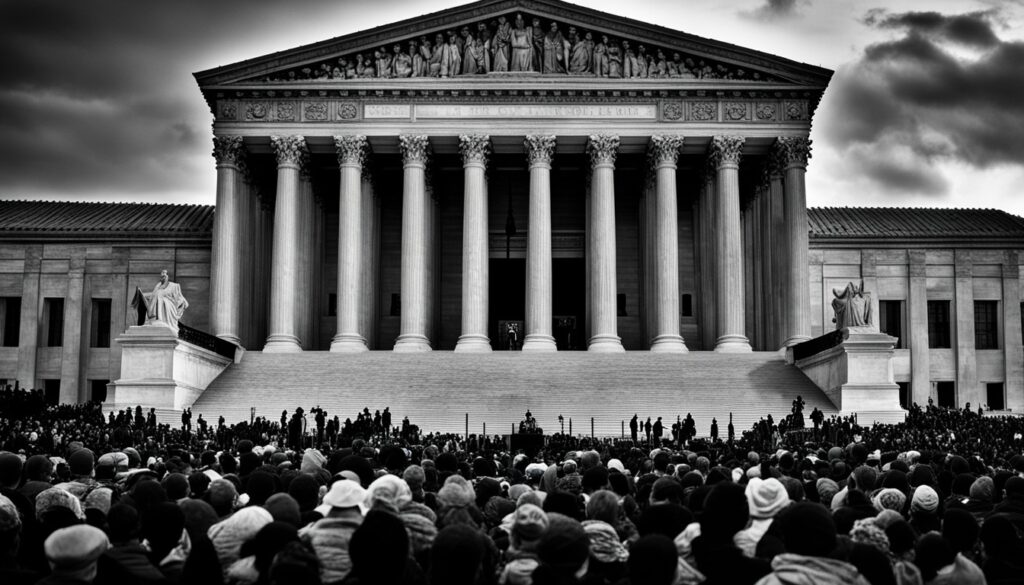
Unfavorable Views of Both Major Political Parties
The political landscape in the United States has become more divided. Both major parties now face more public doubt. A recent survey by the Pew Research Center shows a big jump in Americans who don’t like the Republican and Democratic parties. Now, 61% see the Republicans unfavorably, and 60% feel the same about the Democrats.
There’s a big divide between Republicans and Democrats, the survey shows. Most Republicans, 72%, think Democrats are more immoral. And most Democrats, 63%, see Republicans the same way. Many also think the other party is dishonest, with 72% of Republicans and 64% of Democrats believing this.
Also, many think the other party is more closed-minded. For example, 83% of Democrats and 69% of Republicans feel this way. This shows a deep distrust between the two sides.
Independents are also unhappy with the two-party system. 39% wish there were more parties to choose from. Younger Americans, aged 18 to 49, are especially looking for more options, with 47% wanting more choices. This drops to 35% for those aged 50 to 64 and 23% for those 65 and older.
| Metric | Democrats | Republicans |
|---|---|---|
| Unfavorable view of the other party | 74% | 78% |
| Belief that the opposing party is more immoral | 63% | 72% |
| Belief that the opposing party is more dishonest | 64% | 72% |
| Belief that the opposing party is more closed-minded | 83% | 69% |
| Wish for more political parties | 39% | 39% |
These findings show a deep divide and growing distrust in the two-party system. As things keep getting more polarized, it’s important for both parties to work on winning back trust from the public.
The Exhaustion of Highly Politically Engaged Americans
In the U.S., a worrying trend has appeared: those deeply involved in politics feel the most drained. Studies show that 72% of highly engaged adults often feel exhausted when thinking about politics. This shows how deep the political divide has become.
Feeling exhausted isn’t just about government or politicians. It affects daily life too. 61% of Americans find it stressful and frustrating to talk politics with those who disagree with them. This ongoing stress has left many feeling worn out and disconnected from democracy.
This political exhaustion has big effects. As people step back from politics, the risk of democracy weakening grows. To fix this, we need a broad plan. This should focus on restoring trust, fostering respectful dialogue, and reinvigorating a sense of shared purpose among Americans.
« Only 10% of Americans always or often feel hopeful and 4% feel excited about politics frequently. »
Fixing this won’t be simple, but it’s vital for a strong democracy. By tackling the causes of political exhaustion and frustration, we can help people get back into politics. This will also help rebuild trust in our system.
We must work together to find solutions for political exhaustion and stress. By doing so, we can help Americans regain their interest in democracy. This will make them active, engaged citizens once more.
Popular Ideas for Reforming the Political System
A recent survey by the Pew Research Center showed many Americans want big changes in politics. They suggest ideas like setting term limits, age limits, and changing how we elect the president. These changes could make politics better.
Term Limits and Age Limits for Elected Officials
Most Americans, 87%, think it’s a good idea to limit how long Congress members can stay in office. 79% of adults also want age limits for elected officials in Washington, D.C. And 74% think there should be a top age for Supreme Court justices.
Eliminating the Electoral College
Many people are talking about getting rid of the Electoral College to make presidential elections more direct. 65% of Americans like the idea of the candidate with the most votes winning. Democrats are even more supportive, with 82% in favor, while 47% Republicans agree.
The survey shows Americans are ready for big changes in politics. They want more transparency, term limits, and a direct link between votes and election results.
Politics on Social Media Platforms
Social media platforms are key places for political talks and actions in the U.S. X (formerly Twitter) is a standout for political content and discussions. A recent Pew Research Center survey found 59% of X users use it to stay updated on politics. This is much higher than on TikTok (36%), Facebook (26%), and Instagram (26%).
The survey also showed most X users (74%) see political content there. This is more than on Facebook (52%), TikTok (45%), and Instagram (36%). But, only 14% of X users post or share political content. Facebook, TikTok, and Instagram have even lower numbers, around 10% each.
X (formerly Twitter) as a Hub for Political Content
X has become a key spot for political content. Users are more likely to engage with such information there. This is important because X plays a big role in U.S. politics and can shape public opinion and engagement.
| Platform | Users Who Cite Politics as a Reason for Use | Users Who Report Seeing Political Content | Users Who Post or Share Political Content |
|---|---|---|---|
| X (formerly Twitter) | 59% | 74% | 14% |
| TikTok | 36% | 45% | 10% |
| 26% | 52% | 10% | |
| 26% | 36% | 10% |
The role of social media, especially X, in shaping political talks and actions is under debate. As the 2024 U.S. presidential election nears, these platforms’ impact will be closely watched. Researchers, policymakers, and the public are all keeping a close eye.
Perceptions of Political Bias on Social Media
The debate about political bias on social media is getting more heated. Some people don’t see a clear political side in what they see online. But others have different views based on the platform they use.
Recent studies show that Instagram, Facebook, and TikTok users often think the content leans liberal. On the other hand, users of the social network X (formerly Twitter) are almost evenly split. They see either a liberal or conservative bias.
There are also party differences. Republicans on Facebook tend to believe the content is mostly liberal. But on X, Democrats think the same thing.
These beliefs about bias matter a lot. 75% of U.S. adults think social media sites might censor views they don’t like. This feeling is stronger among conservative Republicans. About 70% of them believe social media sites censor certain political views.
The debate over social media bias, political ideology, and partisanship shows how complex these platforms are. As social media grows, we need to understand and fix these bias issues. This is key to keeping trust in our political institutions.
The Relationship Between Social Media and Democracy
Social media and democracy have a complex relationship. Platforms like X (formerly Twitter) are key places for political talks. But, there are worries about how these digital spaces affect democracy. A Pew Research survey showed big differences in how people see social media’s role in democracy.
Divergent Views Across Party Lines
About four-in-ten X users think the platform is good for democracy. But, opinions vary a lot by party. Republican X users are much more likely than Democratic users to think so (53% vs. 26%). On the other hand, Democratic X users are three times more likely than GOP users to see it as bad for democracy (39% vs. 13%).
This shows how divided people are on social media’s effect on democracy. The debate is complex and often split. Issues like election misinformation and how to moderate content are big concerns. People have very different views on how these affect democracy.
« Social media has become a battleground for competing visions of democracy, with users across the political spectrum holding starkly different views on its role and impact. »
The future of social media and democracy is still up in the air. There are ongoing debates about free speech, misinformation, and how these platforms shape politics and participation.
Consumption and Sharing of Political Content
Social media has changed how Americans see and share political content. A Pew Research survey shows us this change. It tells us most social media users see political content but few share it.
According to the survey, 74% of social media users see political content. Yet, only 10-14% share political content themselves. This shows a big gap between seeing and sharing political views online.
| Platform | Users Seeing Political Content | Users Posting/Sharing Political Content |
|---|---|---|
| X (formerly Twitter) | 74% | 14% |
| 72% | 10% | |
| 72% | 11% |
It seems that while social media users see a lot of political content, they don’t share much. They prefer to just consume the information. This shows how complex the relationship between social media and political views is.
The Pew Research survey reveals how social media users interact with political content. As social media changes politics, knowing how people use and share political content is key. It helps us understand the link between tech, communication, and democracy.
Reasons for Using Social Media Platforms
Social media’s impact is growing fast. It’s key to know why people use these platforms. The survey shows the many reasons Americans use social media.
Entertainment, Friends, and Family as Primary Motivators
Most X users use the platform to keep up with politics. But, this isn’t the case on TikTok, Facebook, and Instagram. Here, people are more into entertainment and staying in touch with friends and family.
- The survey shows that many use social media for entertainment.
- Keeping up with friends and family is a big reason people use TikTok, Facebook, and Instagram.
- Politics isn’t a top reason for most users on these platforms, except for X.
Social media is a big source of political info and engagement. But, for many, it’s about entertainment and keeping relationships strong. Knowing this helps us understand social media’s role in our lives and its effect on politics.
« Social media has become a big part of our lives. People use it for more than politics. It’s about staying connected with loved ones and finding fun content for their daily lives. »
The Study of American Politics and Institutions
The study of American Politics looks at many theories and ways to study it. It dives into how the country’s political system works. It looks at the Institutions that help make decisions, like the Presidency, Congress, the Bureaucracy, and the Courts. It also looks at how people and groups act in politics, including Public Opinion, Voting, and Democratic Theory.
Institutions: Presidency, Congress, Bureaucracy, and Courts
Studying American political Institutions helps us understand how the country is governed. Researchers look at the Presidency, the Congress, the Bureaucracy, and the Courts. They study how these groups make decisions, their power, and how they affect policies.
Behavior: Public Opinion, Voting, and Democratic Theory
Along with looking at institutions, studying Behavior in American Politics looks at what shapes public opinion and voting. Researchers explore what drives people to vote and how the democratic system works. They look at the mental, social, and cultural factors that affect Voting. They also study the ideas behind Democratic Theory.
| Research Areas in American Politics | Key Focus |
|---|---|
| Institutions | Presidency, Congress, Bureaucracy, Courts |
| Behavior | Public Opinion, Voting, Democratic Theory |
The study of American Politics and its Institutions and Behavior is a lively and complex field. It gives us deep insights into the nation’s political system.
Conclusion
The survey on American politics shows a complex view. Many people feel let down and don’t trust the system much. Yet, many still care about politics and want real changes. Understanding what makes people vote, how social media affects things, and the role of key groups is key to moving forward.
To fix American Politics, we need a plan that makes things more open, accountable, and responsive. People want changes like term limits and ending the Electoral College. They want a system that better represents everyone.
The survey also shows that people are still active in politics, even when they’re unhappy. This activity, through social media and other means, brings both good and bad for American democracy’s future. Finding ways to use this energy for good while fixing the big issues is vital.