
Ethnicity and racial identity shape how we see ourselves and how others see us. They are about being part of a group that shares customs, language, religion, or where they come from. Race is about physical traits that people see as different. These identities help form our sense of self, especially for minority groups who might feel out of place between their culture and the main culture.
Looking into ethnicity and race helps us understand how we and others see identity. This article looks at how these identities shape our personal and social lives. By getting to know the complex sides of identity, we can see the wide range of human experiences. This helps us build a society that includes everyone.
Key Takeaways
- Ethnicity means being part of a group that shares things like language, religion, or where they’re from.
- Racial identity is made up of physical traits and is different from ethnicity.
- Ethnic and racial identities help shape how we see ourselves and how others see us.
- Studying ethnicity and race helps us see the diversity of human life and supports inclusivity.
- Minority groups often struggle to blend their culture with the main culture.
The Concept of Ethnic and Racial Identity
Ethnicity and race are important ideas that help shape who we are and where we belong. Ethnicity is about being part of a cultural group. It includes things like shared history, traditions, language, and values. Race, on the other hand, is about physical traits that society uses to group people. These groups can get more or less privilege.
Our ethnic and racial identities play a big role in how we see ourselves and others. They affect our thoughts, actions, and even our life chances. These identities grow and change over time, shaped by our families, communities, and the world around us.
Ethnicity vs. Race
Ethnicity and race are not the same thing. Ethnicity is about cultural ties and shared history. Race is based on physical looks and is a social idea. Racial identity comes from how society sees us, leading to unequal chances for different groups.
Components of Ethnic Identity
Ethnic identity has four main parts:
- Ethnic Awareness: Knowing about your own ethnic group and others.
- Ethnic Self-Identification: The label you use to say who you are.
- Ethnic Attitudes: Your feelings, good or bad, towards your ethnic group and others.
- Ethnic Behaviors: The actions and customs typical of your ethnic group.
These elements are key to forming your ethnic identity and connecting with your cultural roots.
« Ethnicity is not something fixed or static, but rather a dynamic and complex aspect of human identity and experience. »
Stages of Ethnic Identity Development
Ethnic identity development goes through three main stages, as shown by psychologist Jean S. Phinney. These stages help us see how people from ethnic minority backgrounds explore and commit to their culture.
Unexamined (or Diffused) Ethnic Identity
At first, people don’t really think about what their ethnic identity means to them. This is especially true if they’re part of the main culture. They just accept the culture of the majority without much thought.
Moratorium
Then, they start to look into what their ethnicity means to them. They might study their ethnic group’s history, learn their language, and join in cultural events. This important step often happens after a big event related to their ethnicity.
Achieved
Finally, they feel sure and proud of their ethnic identity. It becomes a big part of who they are, affecting their values and beliefs. They strongly commit to their ethnic heritage.
Phinney’s model gives us a detailed look at how people from different backgrounds find and connect with their cultural roots. It helps us understand the process better. This way, we can support young people from various ethnic groups in exploring and committing to their identities.
Racial Identity Statuses
Racial identity development is complex and happens during adolescence. The classic model by psychologist William Cross talks about four racial identity statuses. These are the stages people may go through at any time in their lives.
Pre-encounter
In the pre-encounter stage, people might not think much about their race or how it affects their life. They might have picked up the beliefs of the dominant culture. They see their racial identity as less important.
Encounter
The encounter stage comes when something makes people think more about their racial identity. For racial minorities, this is often a negative event, like facing racial discrimination for the first time.
Immersion
After the encounter, people enter an immersion phase. They start to learn more about their racial identity. They do this by talking to peers who share the same racial background. This helps them deal with being a racial minority in a dominant culture.
Internalization and Commitment
In the final stage, people have a strong sense of their racial identity. They feel secure in their identity and socialize with people from their racial group and others. Their racial identity is a big part of who they are.
Knowing about these racial identity stages helps us understand the unique challenges racial minority teens face during their growth.
The Role of ethnicity in Identity Development
Ethnic identity is key to who we are. It makes us feel part of a certain culture. This shapes our values and actions. For those in minority groups, it’s even more important as they balance their culture with the dominant one.
Research by Jean Phinney shows that being a teenager is a big time for figuring out one’s ethnic identity. This is because teens meet people from different backgrounds, making them think more about their own race and ethnicity. A study found that teaching about ethnic identity helped 9th graders feel better about themselves and do better in school.
Helping teens develop their ethnic identity has many benefits. These include:
- Higher self-esteem
- More positive academic outcomes
- Better social functioning
- Lower levels of depressive symptoms
- Fewer health risk behaviors
Encouraging teens to talk about their race and ethnicity can lead to these good things. Schools can help by offering groups where students can share their experiences. Even groups for White students can help them understand privilege and fight racism.
Exploring one’s ethnic identity can boost confidence in young people, no matter their background. For young people of color, it doesn’t mean they can’t get along with others. But identifying too strongly as White can lead to avoiding people of color. So, it’s key to explore identities in a way that respects everyone’s differences.
Feeling good about one’s race and ethnicity is important. But so is the process of figuring out who you are. This process is covered in models like Cross’s Racial Identity Development Model and Helms’s White Racial Identity Development Model.
| Racial Identity Development Model Stages | Description |
|---|---|
| Pre-Encounter | Individuals may not fully recognize the significance of their racial identity and may internalize dominant cultural values. |
| Encounter | Individuals experience a significant racial event that challenges their views and increases awareness of racism and its effects on their lives. |
| Immersion/Emersion | Individuals seek to connect with their cultural heritage and may grapple with feelings of anger, guilt, or shame about their experiences as a minority. |
| Internalization | Individuals develop a more secure and positive racial identity, accepting and embracing their cultural heritage. |
| Internalization-Commitment | Individuals have a secure racial identity and a deep commitment to their racial group, challenging racism and promoting social justice. |
Looking into our ethnic identity and cultural values and beliefs is key to growing up. It’s especially important for teens and young adults. By understanding our ethnic group membership and ethnic identity salience, we can better know ourselves and our cultural roots.
Ethnic Identity as a Coping Resource
Ethnic identity is a strong way to cope with the bad effects of racial discrimination. Social identity theory says that having a strong ethnic identity gives a person a sense of belonging. This feeling helps protect against the hurt of being left out by others.
It also helps people understand why they face discrimination. They can see it’s not just about them, but about their group. This understanding helps keep their self-esteem up and helps them find better ways to deal with the mental health issues from discrimination.
Social Identity Theory
Social identity theory says our sense of self comes a lot from being part of groups, like our ethnic or racial group. When people face discrimination, they can find comfort in their ethnic group. This support helps lessen the bad effects of being treated unfairly.
Effective Coping Strategies
Studies show that those with a strong ethnic identity handle racial discrimination better. They use strategies like:
- Learning about their cultural background and traditions
- Feeling proud and positive about their ethnic group
- Finding support and approval within their ethnic community
- Taking action to solve the problems caused by discrimination
Using these strategies, people with a strong ethnic identity can protect their self-esteem. They can also lessen the mental health problems caused by discrimination.
« Ethnic identity can provide a sense of belonging and acceptance that can buffer the pain of rejection and exclusion from the majority group. »
Ethnic Identity as a Stress Exacerbator
Ethnic identity can be a strong support, but it can also make stress worse. The idea of identity-relevant stressors says that the more important an identity is to someone, the more stress they feel from threats to that identity. For those deeply connected to their ethnic background, racial discrimination can be seen as a big stress, causing more psychological distress.
A study looked into this with 2,047 Asian Americans aged 18 to 75. It found that ethnic identity affects how stress impacts mental health differently by age. For those born in the U.S. between 41 to 50, ethnic identity helped protect against the bad effects of discrimination on mental health. But for those aged 31 to 40 and 51 to 75, ethnic identity made the negative effects of discrimination worse.
This shows how complex the link is between ethnic identity, discrimination, and mental health. A strong ethnic identity can help in coping, but it can also make the stress of identity-relevant stressors like racial discrimination worse. Knowing this is key for creating support systems that meet the mental health needs of diverse ethnic groups.
Racial Discrimination and Mental Health
Many studies show a strong link between racial discrimination and mental health issues. These issues include negative feelings and depression. Racial discrimination is a big stress that can harm health, especially for minorities who face more stress from things like poverty or bad neighborhoods.
Research shows how racial discrimination affects mental health. Black adults are 20% more likely to feel serious mental distress than White adults. Those who identify as two or more races are most likely to have had mental illness in the past year. Native and Indigenous Americans have higher rates of stress disorders and alcohol use than other groups.
Racial bias in healthcare also worsens mental health differences. Doctors talk more and listen less to Black patients than White ones. Black people are more often diagnosed with schizophrenia and less with mood disorders than White people with similar symptoms.
| Racial/Ethnic Group | Mental Health Outcomes |
|---|---|
| Black Adults | 20% more likely to report serious psychological distress than adult Whites |
| Those Identifying as Two or More Races | 24.9% most likely to report any mental illness within the past year |
| Native and Indigenous Americans | Higher rates of post-traumatic stress disorder and alcohol dependence than any other ethnic/racial group |
| Black Patients vs. White Patients | Physicians were 23% more verbally dominant and engaged in 33% less patient-centered communication |
| Black People vs. White People with Same Symptoms | More frequently diagnosed with schizophrenia, less frequently diagnosed with mood disorders |
These mental health differences and care access gaps among minorities show we need to act fast. We must improve mental health services for all cultures and make sure everyone can get care. This is key to reducing these health gaps.
The Moderating Role of Racial/Ethnic Identity
Studies show that racial discrimination affects mental health in complex ways. This impact changes based on a person’s race or ethnicity. The way racial/ethnic identity helps or hurts varies across different groups.
Race/Ethnicity-Dependent Pattern
High racial/ethnic identity can protect some people from the mental health effects of discrimination. But, it can make things worse for others. For instance, a study with 417 teens found that peer stress hit harder for African American teens than White teens. Yet, a stronger ethnic identity helped both groups feel better about their lives.
Research also shows that a strong ethnic identity boosts self-esteem and lowers depression in many ethnic groups. These findings highlight how important ethnic identity is for keeping teens well, especially for minority groups.
Some studies reveal that a strong ethnic identity can lead to feeling more discriminated against and worse mental health in certain groups. This includes Whites and American Indians/Alaska Natives. This shows how the effect of racial/ethnic identity changes across different groups.
The impact of racial/ethnic identity is stronger for those born in the U.S. than for those born elsewhere. This points out that the relationship between discrimination, ethnic identity, and mental health is influenced by many factors.

« Ethnic identity plays a crucial role in protecting adolescents’ life satisfaction, particularly among African American adolescents. »
Exploring Your Ethnic Identity
Looking into your ethnic identity can be a deep and enlightening journey. By thinking about the different things that have shaped your view and feelings about your ethnic background, you can learn a lot. This journey is key to understanding who you are.
Reflection Questions
Think about these questions to understand your ethnic identity better:
- When has your ethnicity been most important in your life?
- How have family, friends, and society shaped your cultural background and identity?
- What personal stories have helped shape your cultural identity?
- How has your ethnic identity influenced your view of the world and daily life?
Cultural Short Story Activity
Writing a short story about your cultural experiences can help you understand your ethnic identity better. Think about the thoughts and feelings you have while writing. How do these insights show your ethnic identity development and personal stories?
This activity can make you more aware of yourself and help you share your cultural story with others. It can also make you appreciate the diversity of human experiences more.
Exploring your ethnic identity is a journey of self-discovery. It can improve your understanding of your cultural socialization, ethnic identity salience, and the stories that have shaped your cultural identity narrative. This journey also helps you understand your ethnic identity development and personal experiences.
Cross-Cultural Experiences and Discrimination
Dealing with different cultures can be tricky. People from various backgrounds often find it hard to adjust to new norms and ways of communicating. These challenges can make us think more about our own culture and identity.
Discrimination, whether it’s obvious or hidden, can deeply affect how we see ourselves and the world. Thinking about these experiences helps us understand how to handle cultural bias and prejudice.
It’s important to grasp the complexities of dealing with different cultures and discrimination. By reflecting on our own experiences, we can learn how to be more accepting and understanding. This helps us grow and build better relationships with others.
Embracing Cultural Differences
Even though it can be tough, interacting with different cultures can also be rewarding. Here are some ways to appreciate these differences:
- Be open and curious when you meet new cultures, ready to learn and understand.
- Talk respectfully to gain insight into other perspectives and experiences.
- Learn about the history, society, and politics that shape different cultures.
- Be empathetic and compassionate, knowing everyone has their own cultural story.
Navigating Discrimination
Discrimination can be very hurtful and affect us deeply. But, there are ways to deal with it:
- Keep a strong sense of self and cultural pride to protect yourself from discrimination’s harm.
- Surround yourself with supportive people who can help emotionally and practically.
- Take care of yourself with activities like meditation, exercise, or art.
- Work towards making things fairer and more welcoming for everyone.
Thinking about our experiences with different cultures and discrimination helps us understand ourselves and the world better. This leads to being more skilled in dealing with cultural differences, making our interactions with others smoother.
« The more I traveled the more I realized that fear makes strangers of people who should be friends. » – Shirley MacLaine
Ethnic Identity Self-Assessment
Exploring one’s ethnic identity is key to personal growth. The Multigroup Ethnic Identity Measure by Jean S. Phinney helps people check their ethnic identity exploration and ethnic identity commitment.
This tool lets people see how their ethnic identity fits into their overall self-view. It helps them understand their ethnic identity better, how it changes, and its impact on life.
Multigroup Ethnic Identity Measure
The Multigroup Ethnic Identity Measure has questions about an individual’s ethnic identity. It shows how much they explore and commit to their ethnic identity. This helps people see their journey of ethnic identity self-assessment.
It looks at how much someone feels they belong to their ethnic group and values their cultural practices. It also looks at how their ethnic heritage shapes their view of the world and how they see themselves. This gives people insights into their ethnic identity exploration and ethnic identity commitment.
The Multigroup Ethnic Identity Measure is a key tool for understanding ethnic identity. It helps people become more aware of themselves, feel more connected to their culture, and understand their identity better in society.
Behavioral Indicators of Ethnic Identity Development
The journey of ethnic identity development shows through certain behaviors. These behaviors show how much someone connects with their cultural roots. As people grow, they start to show signs of embracing their culture more.
Increased acceptance and confidence in expressing one’s ethnic identity is a big sign. People might dress differently, speak in a unique way, or celebrate cultural traditions more. This shows they’re proud of where they come from.
Learning more about one’s ethnic background is another sign. This could mean looking into family history, joining cultural events, or reading books about their heritage. It shows they’re interested in knowing more about who they are.
- Talking about race and ethnicity, even when it’s hard, shows a strong commitment to one’s identity. It means they’re ready to stand up for what they believe in.
- Joining groups or communities based on ethnicity is also a sign. It’s a way to meet others who share similar cultural experiences.
These signs show how ethnic identity development changes in our lives. As someone’s identity becomes a bigger part of who they are, these behaviors become more visible. They show the deep change happening inside them.
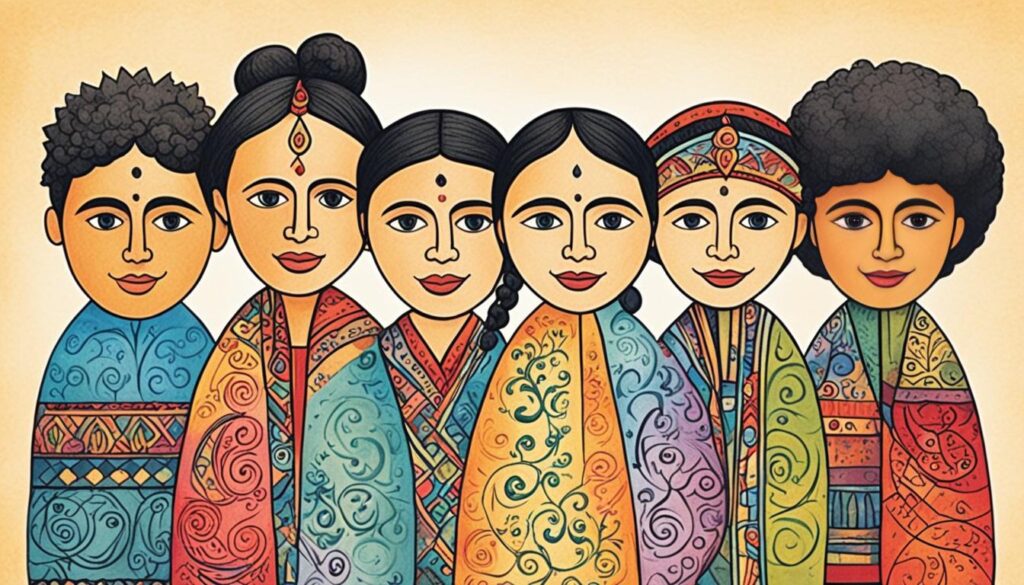
« The development of a strong, positive ethnic identity is a critical task for many adolescents and young adults, and can have significant implications for their overall well-being and adjustment. »
Intersectionality and the Cultural Self
Our cultural identity is more than just our ethnicity. It includes things like our social class, family roles, religious beliefs, gender, and sexual orientation. These different parts of our identity mix together, creating who we are and how we see the world.
Looking at how our ethnic identity meets other parts of our identity helps us understand ourselves better. Intersectionality is key in this. It shows how different social and cultural groups affect each other.
Seeing how our identity interacts helps us understand our cultural identities better. This way, we can see how they shape our views, experiences, and how we connect with others. It’s important for a full picture of who we are.
In mental health, knowing about a person’s cultural identity is crucial. Clinicians need to understand the unique challenges their clients face. Using an intersectional view helps them offer better support, meeting the specific needs of their clients.
By looking into how different cultural identities intersect, we learn more about ourselves and others. This leads to more empathy, inclusivity, and respect in our communities.
Conclusion
Throughout this article, we’ve seen how ethnicity and race deeply shape our identities. They influence our sense of self and how we see the world. The process of developing these identities is complex and ever-changing.
It can be a source of strength or stress, especially when facing racial discrimination. Understanding this process is key to living in today’s diverse society. Even though some schools have made changes to how they collect race and ethnicity data, more work is needed.
This includes addressing concerns from school staff. A planned state-level survey aims to shed light on laws and guidelines for collecting this data. It could lead to better ways to support and understand the diverse identities of people and communities.