
The global space industry is changing fast, thanks to more satellites in low Earth orbit (LEO). This growth could change how we use satellites in many areas, like communication and watching the Earth. But, it also brings new challenges and risks.
With more satellites coming, the lower orbits are getting crowded and filled with space junk. This raises big risks for satellites. The chance of hitting other objects in space and breaking into pieces is a major worry. It’s making it hard for companies to plan and insure their satellites.
It’s important to know the risks of collisions in low Earth orbits. Figuring out who is responsible for damage is key for the space industry. The more satellites and space junk are a big threat to space activities. We need good ways to manage space traffic and reduce risks.
Key Takeaways
- The growing number of satellite constellations in low Earth orbit is significantly increasing the risk of collisions and the generation of orbital debris.
- Collision risks associated with operational satellites are more critical than those from failed satellites, as the majority of the risk is concentrated in the active satellites.
- Existing large constellations may already face an annual collision probability exceeding 10% due to their maneuverability and low collision probability thresholds for triggering evasive actions.
- The private sector now dominates space activity, leading to a disruption in space traffic and usage patterns with the deployment of thousands of satellites in low Earth orbits.
- Comprehensive risk assessment and mitigation strategies are essential to ensure the long-term sustainability of the growing space ecosystem.
Introduction to Satellite Constellations
The space industry has changed a lot, moving from the old ways to the new. This change is thanks to the private sector getting more involved. Now, we see more satellite constellations in lower Earth orbit. They help with tasks like taking pictures of Earth, making global communications, and connecting the internet.
Definition and Historical Background
Satellite constellations are groups of satellites that work together for a common goal. This idea started in the late 1980s with the launch of smaller satellites. Early examples include the Iridium and Globalstar constellations, each with many satellites. NASA’s Global Positioning System (GPS) also had 24 satellites spread across six orbits.
Applications and Benefits of Satellite Constellations
- Improved global connectivity: These constellations make it easier to access the internet, talk, and send data, even in hard-to-reach places.
- Enhanced Earth observation: They let us watch over the Earth more often and in detail, helping with weather forecasts, disaster relief, and tracking the environment.
- Increased resilience: Spreading out the work among many satellites makes the system stronger, so losing one doesn’t bring everything down.
- Technological advancements: Building these constellations has led to new tech in making satellites smaller, moving them around, and talking to each other, making space tech better.
The private sector is leading the charge in the ‘new space’ era. Companies like SpaceX, Blue Origin, and OneWeb plan to launch thousands of satellites. This will improve global connectivity and other services. But, it also brings up big questions about space debris, collision risks, and rules.
Debris Impact of Constellations
Many satellite constellations in low Earth orbit (LEO) are causing trouble. Over 90% of objects in space are just debris. This debris increases the risk of debris collision with working satellites. With more satellites and less experienced teams, the chance of collisions goes up, adding to the space debris problem.
Collision Risk from Orbital Debris
In 2017, more than 312 small satellites under 500 kg were launched, making up most of the spacecraft that year. Big countries and companies plan to launch many more satellites, which could put over 20,000 satellites in space soon. This will make the orbital debris problem worse, putting active satellites at risk.
Contribution to Orbital Debris Environment
Planned constellations have different orbits and sizes. Some go as low as 380 km, while others go up to 1,400 km. This variety makes it hard to manage the constellation debris and keep space clean.
How well satellites are cleaned up after use is key to managing space debris. If most satellites are removed properly, debris levels can go back down. But if not, debris will keep growing, harming the space environment.
« The impact of large and small satellite constellations on the space debris environment can be minimized by shortening the off-orbit time after the mission and improving the PMD success rate. »
The Growing Space Population
The space industry is getting bigger, and so is the number of objects in space. In the last seven years, the number of objects in orbit has jumped by 19%. It went from about 16,000 in 2011 to 19,000 in 2018. This jump is mainly because of more satellites being launched and more space junk.
Big satellite constellations like SpaceX’s Starlink and OneWeb’s network are adding to the space crowd. The FCC has approved plans for constellations of around 100,000 satellites in low-Earth orbit. Even more satellites are set to launch in the next 15 years. This big increase makes managing space around Earth harder.
More satellites, especially those that can’t move, increase the risk of collisions and create more space junk. The ITU and regulatory filings say we could see 100,000 LEO satellites in the next decade. That’s a big jump from the 9,000 satellites launched in the last 70 years.
| Metric | Value |
|---|---|
| Cataloged orbital population growth (2011-2018) | 19% |
| Number of objects larger than 10 cm (mid-2022) | ~36,500 |
| Estimated number of centimetre-sized objects that could damage satellites | ~1,000,000 |
| Estimated increase in night sky radiance from satellites (before megaconstellations) | 10% of natural background level |
The growing number of satellites and space junk is a big challenge for space management. As the space industry grows, we need to find ways to deal with these issues. It’s important to have good strategies to handle the risks of having more objects in space.
« If space debris proliferates considerably, there is a high probability of a rapid rise in night sky radiance. »
satellite constellations risk assessment
More satellites are being launched into low Earth orbit, making it crucial to assess their risks. The large number of satellites and frequent close passes pose new challenges for safety.
Conjunction Assessment and Mitigation Strategies
Aerospace’s Reliability and Statistics Department has developed new methods like Constellation Risk Assessment (CRA). These methods predict how well satellite constellations will work over time. They use complex math to guess satellite lifetimes and the chances of successful launches.
The Generalized Availability Program (GAP), created in 1981, is a key tool. It shows when new satellites are needed to keep a constellation healthy. Aerospace is now improving this with the Generalized Availability and Performance Program (GAPP).
Residual Collision Risk Analysis
Even with safety plans, many satellites in low Earth orbit can still collide, posing a risk. Aerospace’s CRA uses knowledge from various fields to understand each constellation’s risks.
The MASTER model, developed over 30 years, is vital. It has a huge database of past events and objects in orbit since 1957. This helps analyze the risks and find ways to prevent collisions.
With thousands more satellites expected by 2030, we need strong conjunction assessment and safety plans. Aerospace’s knowledge is key to tackling these challenges and keeping satellites safe for the future.
Large Resident Debris Hazard
The number of satellites in Low Earth Orbit (LEO) is growing fast. SpaceX plans to add up to 41,000 satellites with its Starlink project. This means the risk from large debris pieces is getting bigger. These pieces, 10 cm or bigger, can be a big danger to satellites.
Tracking and Characterizing Large Debris
It’s important to track and understand the large debris in space. There are over 12,000 pieces we can track in LEO. Experts think there are about a million pieces over 1 cm in size.
This huge amount of debris makes it hard to avoid collisions. Satellites like Starlink and OneWeb will be very close together. This makes them more likely to hit small, hard-to-track pieces of debris.
| Metric | Value |
|---|---|
| Active and defunct satellites in LEO (as of March 2021) | Approximately 5,000 |
| Planned Starlink satellites | 11,000 (with potential for 30,000 more) |
| Trackable debris pieces in LEO | Over 12,000 |
| Estimated debris pieces larger than 1 cm | Approximately 1 million |
| Planned Starlink satellite mass | Over 3,000 tonnes |
It’s crucial to track and understand the large debris in space. This helps satellite operators deal with the large debris hazard. It ensures their satellites can work well for a long time.
Current Debris Collision Risk Management
The growing number of satellites in low Earth orbit (LEO) has made debris collision risk management more important. The 18th Space Control Squadron of the United States Space Force is key in this area. They alert spacecraft owners about potential conjunction data messages and risks to help with space situational awareness.
Most of the world depends on the U.S. Department of Defense for tracking objects in LEO. This is vital for the global space community. In 2021, NASA and SpaceX agreed to work together on avoiding collisions for ten years. This shows how important it is to work together on debris collision risk management.
Launches are now 10 times more common than a decade ago. To deal with this, space agencies like the European Space Agency (ESA) have strict rules. They require a 90% chance of safely disposing of space objects or reorbiting them. Also, ESA now limits new missions to just five years in protected orbits.
« The number of collision alerts received every week due to the growth of space activity and the increase in debris in orbit is also rising. »
ESA is also being proactive. It sent its Planck and Herschel satellites towards the Sun after they finished their missions. This prevents them from causing collisions or reentry hazards. ESA also moved its Integral spacecraft and a Cluster-2 satellite to ensure they safely enter Earth’s atmosphere in the next decade.
Working together to manage the debris collision risk is crucial for safe space operations. Groups like the Inter-Agency Debris Coordination Committee (IADC) and the Zero Debris Charter show the space sector’s commitment to being responsible and sustainable.
Legal Implications of Collisions
As more satellites are launched, the chance of them crashing into each other is getting bigger. This is a big worry for lawyers and space experts. The rules of international space law say that if a satellite crashes, the one to blame could face big money and legal problems.
International Space Law and Liability
International treaties like the Outer Space Treaty and the Liability Convention set the rules for space. They say that whoever causes a collision might have to pay for the damage. This is based on who was at fault.
Figuring out who was at fault in a crash is hard. It involves looking at what the operator did and how it led to the accident. Things like how well they avoided collisions, followed rules about space trash, and managed their satellites matter too.
| Collision Scenario | Legal Implications |
|---|---|
| Collision between two operational satellites | Potential liability for the operator(s) responsible for the collision, based on the assessment of fault or negligence. |
| Collision between a satellite and orbital debris | Liability may be more challenging to assign, as the source of the debris may be difficult to identify or may be from a historical launch. |
| Collision between a satellite and a space object of unknown origin | Liability may be ambiguous, as the responsible party may be difficult to determine. |
Domestic laws and licenses also affect who is liable for a satellite crash. Operators need to follow these rules to avoid legal trouble.
With more satellites up there, dealing with legal issues from crashes will get more important. Following space laws, having good plans to avoid collisions, and managing space trash well are key. This helps space operators handle legal problems and lower the risk of being liable.
Hypothetical Collision Scenario
A scary thought: a satellite crashes into a new satellite, causing $800 million in damage. This shows the dangers of having more satellites in space. We need to think carefully about who should pay when satellites collide.
The IRIDIUM satellite system has 66 satellites in space, plus six spares. They orbit at 780 km high and follow a path close to the Earth’s equator. Each satellite weighs about 667 kg. If two IRIDIUM satellites hit, they can create a lot of space debris that lasts for years.
By 2035, the chance of a satellite collision goes up if just one crash happens at 800 km high. This is a big worry as more satellites move through space. The model looks at objects from 200 to 2,000 km high because objects below 200 km don’t last long and there are fewer objects above 2,000 km.
This possible crash would lead to big legal and financial issues. The company affected would try to figure out who is responsible and get their money back. They would have to deal with complex laws from around the world.
« The collision frequency between two given populations depends on the local density of each population at a given time. This, combined with the growing number of satellites in low-Earth orbit, underscores the pressing need for proactive measures to mitigate the risks of collision scenarios. »
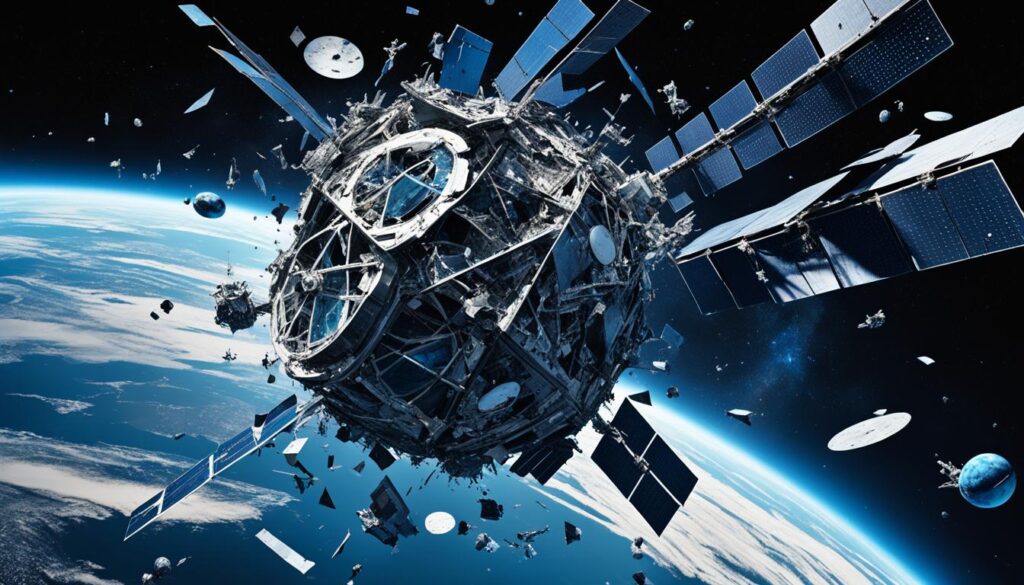
The space industry is changing fast, and so must the laws and rules. This thought experiment shows us what we need to think about for the future. It helps us see how to make sure satellites don’t crash into each other.
Assessing Liability: The International Track
In a possible crash scenario, the UAE-based operator looks into the international legal path to get back what they lost. They check if they can blame the US-based operator of the fallen satellite under space law. They need to show the US operator was at fault or careless.
The international liability rules say a country is responsible for damage from its space objects. The UAE must prove the US operator was at fault or careless with the satellite. This caused the crash and the damage.
- To prove fault-based liability, the UAE must show the US operator didn’t take enough care when getting rid of the satellite, leading to the crash.
- The UAE might have to show the US operator broke space law and didn’t follow best practices for getting rid of space junk.
- It’s important to link the US operator’s actions (or lack of action) to the damage caused. This link is key to a successful claim under international law.
The international legal path offers chances and hurdles for the UAE operator to get back what they lost from the crash. They must navigate the complex space law and prove the US operator was at fault or careless. This could help them get damages through this route.
Assessing Liability: The Domestic Track
The UAE-based satellite operator looks at both international and domestic laws. They also check their contracts with other operators. This helps them figure out how to deal with losses from a collision.
They focus on domestic liability under national space law. They look at rules about who pays for damages from space activities. They also study their contracts with other operators to understand contractual liability.
This careful look at laws and contracts helps the UAE operator find ways to cover costs from the collision. They want to make sure they protect their company and its people.
| Domestic Liability Considerations | Key Elements |
|---|---|
| National Space Law |
|
| Contractual Liability |
|
« By diligently assessing both the domestic legal landscape and the contractual obligations, the UAE-based operator seeks to identify potential avenues for recouping the financial and operational consequences of the collision. »
Insurance Challenges for Constellations
The growth of satellite constellations in low Earth orbit (LEO) has brought new challenges for insurance. Insurers must now offer financial protection for thousands of satellites. They also need to consider the higher chance of collisions in a crowded LEO space.
Adapting Insurance Products
Before, space insurance covered single satellites or small groups. But large constellations need new insurance models. Insurers are creating products that protect entire constellations, not just single satellites.
Quantifying Collision Risks
Insurers worry about the risk of satellites colliding in LEO. With so many satellites moving fast, the chance of hitting other spacecraft or debris is high. They use advanced tools and data to understand these risks and set fair prices for satellite insurance and constellation insurance.
Experts like Philip Chrystal, Dr. Darren McKnight, and Pamela L. Meredith have studied these risks. Their work helps insurers adjust their products and understand collision risks better.
| Key Factors | Implications |
|---|---|
| Increasing Satellite Population | Since 2011, the number of satellites in orbit has grown by 19%. By the end of this decade, there could be 20,000 to 100,000 satellites. This means big challenges for collision risk quantification. |
| Debris in Low Earth Orbit | LEO is full of space debris, including old satellites and pieces from military tests. This makes collisions more likely, which insurers must consider when adjusting their insurance products. |
| Monitoring and Analytics | Insurers use advanced data, like LeoLabs’ huge database and the MASTER program, to better understand collision risks. |
The space insurance industry is changing fast. Insurers must adapt to the needs of satellite constellations and accurately quantify collision risks. This is key to offering good satellite insurance and constellation insurance solutions.
Regulatory Considerations
The space industry is growing fast, with thousands of new satellites expected by 2030. Rules are key to making sure these satellites are safe and don’t harm the environment. Companies launching satellites must follow these rules closely.
They need to make sure their satellites don’t cause harm. This includes reducing space junk and following the law.
Licensing and Mitigation Requirements
Satellites need special licenses and must follow rules to avoid collisions and reduce space junk. In the U.S., the FCC sets these rules. They updated their rules in 2004 to address space junk.
Since September 2020, new rules have made satellite operators take more steps. They must have plans for disposing of satellites after use and reduce space junk. They also need to show they can avoid collisions and follow the best practices for space junk.
- Detailed plans for post-mission disposal of satellites
- Measures to limit the creation of debris during normal operations
- Assessments of the probability of successful disposal and collision avoidance
- Compliance with established standards and best practices for orbital debris mitigation
Following these rules shows that satellite operators care about the environment. It helps keep space safe for everyone.
| Regulatory Requirement | Description |
|---|---|
| Licensing | Satellite operators must get the right licenses from groups like the FCC to use their satellites. |
| Debris Mitigation | Operators need to take steps to create less space junk and dispose of satellites properly after use. |
| Collision Avoidance | Operators must figure out how to avoid collisions and show they can do it. |
| Compliance with Standards | Operators must follow the rules and best practices for reducing space junk, like the FCC’s new rules and the U.S. Government’s Orbital Debris Mitigation Standard Practices. |
By following these rules, satellite operators help keep space safe for the future. This lets us use space technology without harming the environment.
Future Outlook and Recommendations
The number of satellites in orbit is growing fast, thanks to new constellations. This brings new challenges for keeping space safe for the future. Companies like SpaceX and Amazon are leading this change, along with many startups. Big investments from the USA, China, and Europe show how serious they are about space.
One big worry is how satellites might affect astronomy. They could block our view of the stars and affect radio signals. Also, there’s no global rule for satellites, leading to a race for space. This makes it hard to keep control over communication networks.
To fix these issues, we need more science and industry work. France and Europe should focus on using satellites to make communication safer and more secure. We also need international help to manage satellite data and avoid collisions.
Learning from OneWeb’s bankruptcy and military satellite risks shows we must be careful. Operators should plan for financial and technical challenges. This means having backup plans, making satellites quickly, and using reliable launch services.
By tackling these problems and following good policies, we can keep space safe for the future. This way, satellite technology can grow without causing harm. We can also reduce the risks of collisions and space debris.
Key Recommendations:
- Increase scientific and industrial efforts by France and Europe to leverage satellite network advancements for communication resilience and security.
- Foster international cooperation on a centralized mechanism for data collection and conjunction analyses to promote collaboration on collision risk mitigation.
- Prioritize financial, technical, and operational resilience for satellite operators, including pre-negotiated capacity leases, redundancies, and rapid satellite replacement capabilities.
- Develop comprehensive policies and regulations to address the challenges posed by the growing number of satellite constellations, such as the impact on astronomy and the need for frequency and orbit allocation management.
| Metric | Current Trend | Proposed Recommendation |
|---|---|---|
| Satellite Congestion | Increasing due to the deployment of large constellations | Implement international cooperation and regulation to manage frequency and orbit allocation |
| Collision Risk | Rising due to the growing number of satellites and debris in orbit | Develop a centralized mechanism for data collection and conjunction analyses to mitigate collision risks |
| Astronomical Impact | Negative impact on visible, infrared, and radio astronomy | Invest in research and technology to minimize the impact of satellite constellations on astronomical observations |
| Communication Resilience | Increasing reliance on satellite networks, but with challenges in maintaining sovereignty | Strengthen European efforts in leveraging satellite network advancements for communication resilience and security |
By focusing on these areas, we can ensure the long-term safety of space. This will allow satellite technology to grow and improve. It will also reduce the risks of collisions and space debris.
Conclusion
The growth of satellite constellations in low Earth orbit is causing big problems for space. With more satellites up there, the risk of collisions and debris is getting worse. This threatens the safety of space missions and scientific research.
We need to tackle this issue from many angles. This means using technology, making strong rules, and working together. Improving how satellites are disposed of after use, reducing how long they stay in orbit, and better managing near-miss situations are key steps. These actions can help lessen the harm satellites cause in space.
It’s also vital to sort out legal and financial issues linked to satellite collisions. Everyone involved – satellite owners, insurers, and rule-makers – must find new ways to keep the space industry growing safely. They need to make sure the benefits of satellites don’t harm the future of space exploration.