
Space exploration is growing fast, making it more important to avoid satellite collisions. With more satellites in orbit, the risk of them crashing into each other is high. Satellite formation flying is a new way to help avoid these risks. It lets satellites move together safely and avoid collisions.
Spacecraft collision avoidance is all about making sure satellites don’t crash into each other. Researchers work on this by finding ways to prevent collisions, predicting where they might happen, and moving satellites out of the way. Since satellites move so fast, hitting one can cause a big problem, known as the « Kessler syndrome. »
Most satellites in space don’t work anymore, making it crucial to clean up space. The European Space Agency says over half of the satellites up there still work. This shows we need better ways for satellites to move on their own and avoid hitting things.
Key Takeaways
- Satellite formation flying is a promising approach for mitigating the risks of spacecraft collisions in Earth’s orbit.
- Effective collision avoidance strategies are crucial as the number of satellites and space debris continues to grow.
- Analytical methods for predicting potential collisions and autonomous spacecraft maneuvering capabilities are essential for enhancing space safety.
- Coordination and multi-satellite systems can improve the reliability and coverage of distributed space systems.
- Relative navigation algorithms and proximity operations are key technologies for enabling successful satellite formation flying.
Introduction to Spacecraft Collision Avoidance
The need for spacecraft collision avoidance comes from the danger of orbital crashes. At a speed of ~7.8 km/s, two spacecraft hitting each other would meet at ~12.2 km/s. This speed is too high for most materials to handle. The collision would instantly vaporize most of the satellite, sending pieces flying in all directions.
Necessity and Risks of Orbital Collisions
More spacecraft and satellites in orbit increase the risk of Kessler syndrome. This is when so much space debris is around that collisions could start a chain reaction. Each collision would create more debris, making more collisions likely. This threatens the work of satellites and the future of space exploration.
Estimated Quantity of Space Debris
NORAD says there are about 17,000 objects over 10 cm tracked around Earth. There are around 0.75 million objects over 1 cm, and hundreds of millions over 0.1 mm. Most, about 70%, of this space debris is in the low Earth orbit (LEO).
| Debris Size | Estimated Quantity |
|---|---|
| Objects over 10 cm | Approximately 17,000 |
| Objects over 1 cm | Approximately 0.75 million |
| Objects over 0.1 mm | Hundreds of millions |
There’s a huge amount of space debris in orbit. This makes it hard to keep spacecraft and satellites safe. We really need good ways to avoid collisions.
Risk-Mitigation Methods for Space Debris
The number of objects in space is growing fast. To deal with this, new ways are being found to reduce space debris risks. Suborbital trajectories and atmospheric reentry are key to quickly get rid of objects before they become debris.
Objects sent on suborbital paths, like for space debris mitigation tests or sounding rockets, fall back to Earth fast. Rocket booster stages also do this if they burn out before reaching orbit. They follow a path that ends with them burning up in the atmosphere.
Some launch vehicles, like the Space Shuttle’s external tank, are made to burn up quickly when they reenter the Earth’s atmosphere. After separating from the main spacecraft, the tank goes on a path that ends with it breaking apart from the heat.
« Various models have been developed to analyze the threat of space debris and predict the orbital environment, including ORDEM 3.0 by NASA, MASTER-8 by ESA, and SPDA by RSA. »
These new methods are vital for keeping space safe for future missions and activities.
Suborbital Trajectories and Reentry
Objects launched on suborbital paths, like for debris tests or sounding rockets, fall back to Earth quickly. Rocket booster stages also do this if they use up all their fuel before reaching orbit. They follow a path that ends with them burning up in the atmosphere.
Some launch vehicles, like the Space Shuttle’s external tank, are made to burn up fast when they reenter the Earth’s atmosphere. After separating from the main spacecraft, the tank goes on a path that ends with it breaking apart from the heat.
Managing Debris in Low Earth Orbit
Most artificial satellites and space stations orbit in low Earth orbit (LEO). These satellites are close to the atmosphere, making it easier for them to safely reenter Earth. They use their fuel to slow down and fall back to Earth, helping to control space debris.
There are now nearly 130 million pieces of space debris in orbit. This is a big problem because it can cause more collisions and make things worse. For example, the collision of Iridium 33 and Cosmos 2251 in 2009 doubled the space debris. The Fengyun-1C collision in 2007 added 25% more debris.
| Incident | Outcome |
|---|---|
| Iridium 33 and Cosmos 2251 satellite collision (2009) | More than doubled the amount of OSD |
| Fengyun-1C collision with ASAT kinetic-kill vehicle (2007) | Increased OSD by 25% |
| Progress 59 Cargo and Soyuz collision | Generated more than 500 OSD pieces upon disintegration |
| Cosmos-2421 disintegration (2008) | Created more than 500 pieces of OSD |
| Raduga-33 incident (1996) | Led to the generation of over 200 pieces of OSD |
These incidents show we need better ways to remove satellites from orbit and reduce debris. We must use strategies like satellite deorbiting and atmospheric drag to tackle the low Earth orbit debris problem.
Debris Avoidance in Medium and Higher Orbits
Spacecraft going beyond low Earth orbit face new challenges with space debris. Orbits like medium Earth orbit (MEO) and geosynchronous orbit are far from Earth. This makes it hard to get rid of satellites completely.
The 25-Year Rule for Satellite Deorbiting
Satellites in lower MEO can use the « 25-year rule » to slow down and fall back to Earth in 25 years. This rule helps prevent more space debris in these orbits.
Graveyard Orbits for Geostationary Satellites
Satellites in the crowded GEO region can’t use the 25-year rule because they’re too far from Earth. They move to graveyard orbits instead. These orbits keep them away from working satellites.
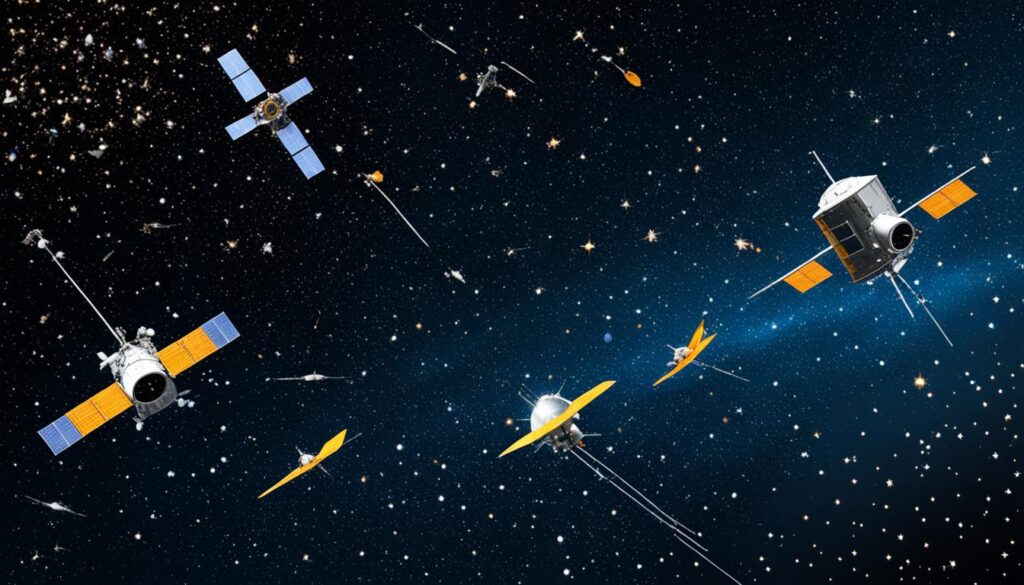
To avoid debris in higher orbits, we need a detailed plan. This includes monitoring, analysis, and taking action early. By doing this, the space industry can keep space safe for the future and reduce debris risks.
Dealing with Empty Rocket Stages
The space industry is growing fast, making the problem of orbital debris more serious. Spent rocket stages left in orbit after launch are a big part of this issue. These stages, without fuel, stay in orbit for years before they can reenter Earth.
Now, new designs are coming up to fix this problem. SpaceX’s Falcon 9 is a good example. Its first stage comes back to Earth quickly after launch. The second stage then burns fuel to go back to Earth and break apart in the atmosphere for Low Earth orbits. But, for orbits like Geostationary transfer orbits and Geostationary orbit, these stages can’t get back to Earth on their own.
| Orbit | Debris Mitigation Approach |
|---|---|
| Low Earth Orbit (LEO) | Falcon 9 first stage reenters within minutes, second stage performs de-orbit burn |
| Medium Earth Orbit (GTO, GEO) | Stages generally lack sufficient fuel to de-orbit themselves |
Spent rocket stages add to the growing orbital debris problem. This debris is a big risk to working satellites and spacecraft. With more launches happening, solving this issue is key for space operations to be sustainable.
« The issue of orbital debris has become increasingly pressing, with more than 100 million tiny particles of space debris exceeding one millimeter in size currently in Earth’s orbit. »
Collision Prediction Methods and Databases
Predicting collisions in space is key to keeping space safe. We use databases to track objects in orbit. These databases tell us where they are, how fast they’re moving, and more. The United States Department of Defense Space Surveillance Network (DoD SSN) keeps track of objects bigger than a softball.
The DoD SSN shares information about these objects. This lets us predict where they might go and if they could hit something else. Knowing where an object is going helps us avoid collisions and deal with space debris.
Groups like the European Space Agency (ESA) also have their own databases. They use different methods to predict risks. These include looking at how often objects move and using models of space debris.
Some satellites get more precise tracking, like ESA’s ERS-2 and Envisat. This means we can watch for potential collisions better. If a collision might happen, we can move out of the way.
With more objects in space, we need good collision prediction, satellite tracking, and space surveillance tools. These help protect our satellites and deal with space debris.
satellite formation flying for debris avoidance
Challenges of Maintaining Spacecraft Formations
The modern focus on satellite formation flying now includes keeping a group of spacecraft together. For example, the U.S. Air Force is looking into using a cluster of satellites to make a big radar dish in space. This idea avoids the big costs of building a huge radar dish.
Keeping a group of satellites in a spacecraft relative orbit formation is tricky. It’s much harder than just flying two or more spacecraft together. This is because small errors in relative orbit modeling can cause big problems.
Analytical Relative Orbit Solutions
Using simple assumptions can make a mission much more expensive. This is because the control system must constantly fix errors. Early research has found ways to use the Earth’s shape to help satellites stay together.
| Statistic | Value |
|---|---|
| Objects tracked in low earth orbit (LEO) by NORAD | Approximately 17,000 |
| Estimated objects over 1cm in LEO | 0.75 million |
| Percentage of space debris in LEO | Around 70% |
Researchers have worked on finding the best way for satellites to avoid space debris when flying together. Satellite formation missions are useful for many things like studying the Earth and understanding space technology. A new algorithm, called PSOGSA, was tested and showed it can quickly and efficiently help satellites avoid each other.
« The study discussed the problem of executing the Interferometric Synthetic Aperture Radar (SAR) Mission between two formation flying satellites, assuming equal size and weight. »
Designing orbits for flying satellites together means setting up a special kind of motion. The goal is to avoid hitting each other. This includes checking how close objects are and the chance of a collision based on their orbits.
Enabling Technologies for Formation Flying
The success of satellite formation flying depends on advanced technologies. These include precise communication between satellites, navigation, and complex sensors. These tools are vital for keeping satellites close together.
Inter-Satellite Links and Navigation
The inter-satellite link system is crucial for formation flying. It keeps the spacecraft updated on their distance from each other. Satellites use special navigation systems to know their exact positions.
Star trackers help satellites know which direction they’re facing. This gives them the awareness needed for control.
Vision-Based Sensor Systems
When satellites get closer than 250 meters, vision-based sensors take over. Vision-based sensor systems use cameras to track LED patterns on other satellites. This gives precise location data.
A Fine Lateral and Longitudinal Sensor uses a laser to measure distance with even more accuracy. This technology is key for close flying.
These technologies, like inter-satellite communication, relative navigation, and sensor systems, are essential for complex flying. They show how technology is advancing space exploration.
« Multi-spacecraft technology is identified as a supporting technology for spacecraft systems by NASA and the U.S. Department of Defense for the 21st century. »
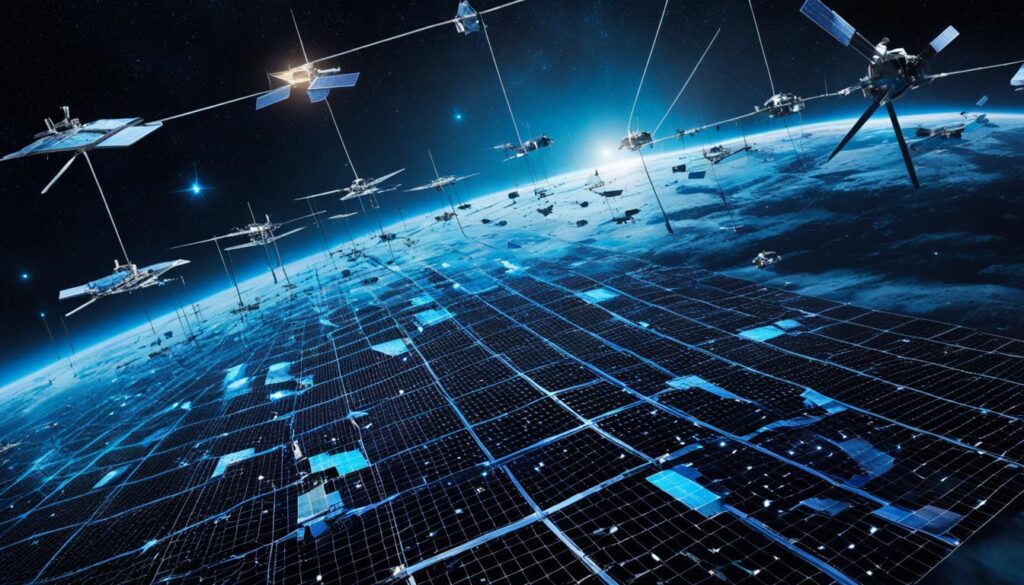
The Proba-3 Mission: A Formation Flying Demonstration
The Proba-3 mission is set to show off the amazing skills of satellite formation flying. It will have two satellites flying together, as close as 25 meters apart. They will make artificial solar eclipses by lining up with the Sun.
This will let scientists study the Sun’s outer atmosphere without getting blinded by its light. The satellites will use advanced sensors to stay in perfect position.
They will start with optical observations and then use laser metrology and shadow detection. This was tested in a cleanroom at Redwire in Belgium. Teams from Sener, ESA, and DTU Space worked together to try out the navigation systems.
Creating Artificial Solar Eclipses
The main goal of the Proba-3 mission is to make artificial solar eclipses. The satellites will be 150 meters apart. This lets scientists study the Sun’s outer atmosphere without being blinded.
Testing Proba-3’s Relative Navigation Systems
Keeping the Proba-3 satellites in their precise formation needs advanced navigation systems. The mission will use technologies like inter-satellite links and satellite navigation receivers. These will help keep the satellites in perfect position, down to the millimeter.
The Proba-3 mission is set to launch in the autumn on an Indian PSLV-XL launcher. It’s a big step forward for formation flying technology in space. This will open up new possibilities for scientific discoveries and space operations.
Future Applications of Spacecraft Formation Flying
Spacecraft formation flying is now more than just about avoiding collisions. It’s opening new doors in space exploration and Earth observation. The U.S. Air Force has a cool idea to use many satellites together to make a big radar dish in space. This way, they avoid the big challenges of making one huge dish. Instead, they use smaller satellites to make a virtual structure.
Looking ahead, advanced formation flying could be used for Earth observation, astronomy, and communications. When many satellites work together, they can do more than one big spacecraft could. These future formation flying applications make space missions cheaper and more efficient. They also show us what’s possible with advanced spacecraft.
| Application | Benefit |
|---|---|
| Sparse Aperture Radar Dish | Avoids the technical and financial challenges of a single large radar dish structure |
| Distributed Space Systems | Combines the capabilities of multiple satellites, exceeding what a single spacecraft could achieve |
The push for future formation flying applications and distributed space systems shows the space industry’s drive for new solutions. With the growth of the New Space economy, we’ll likely see more exciting uses of spacecraft formation flying soon.
« The coordination of multiple smaller satellites to create a virtual structure is a game-changer in the world of space exploration and Earth observation. »
International Regulations and Policies
Keeping space safe for the future is a big goal for the world. Satellite operators play a key role in this by following global rules for space debris. These rules include the « 25-year rule » for removing satellites from medium and higher orbits. They also require geostationary satellites to go into special orbits before they stop working.
Now, 53 countries have their own rules for space debris. Countries like Australia, Belgium, Canada, the Czech Republic, Finland, Italy, the United Kingdom, and the United States have set their own standards. The European Space Agency also has a policy for dealing with space debris.
The Outer Space Treaty from 1967 sets the main rules for space activities. It says governments are responsible for their space operations. The US National Space Policy also stresses the need for safe and responsible space use. This includes managing debris, protecting the spectrum, and keeping space systems safe from cyber threats.
Both launching agencies and satellite owners must follow the rules. Recent events show we need clear rules and enforcement to keep space safe for the future.
The Federal Communications Commission (FCC) in the US helps regulate space activities. They have proposed new rules that are stricter than NASA’s safety standards. But, some groups are asking the FCC to wait before making these rules official. This shows the ongoing talks between policymakers and the satellite industry.
Following these global rules is key to avoiding the Kessler syndrome. This is a chain reaction of collisions that could make space dangerous for future use. As space technology grows, we must keep working on reducing space debris. This will help ensure space remains open for exploration and use in the future.
Conclusion
This article highlights the need for spacecraft collision avoidance to keep Earth’s orbit safe and sustainable. With more space debris, like big objects and tiny particles, operational satellites are at risk. To reduce this risk, we need to use many strategies, such as removing old rocket stages and satellites, predicting collisions, and new technologies like satellite flying together.
The Proba-3 mission is a big step forward in controlling satellite formations. It shows how we can use many satellites together for new space projects. Following international rules is key to using space wisely and keeping it open for the future.
With more satellites and debris, we must watch, remove, and prevent more space junk. This will help keep orbits clear and avoid problems like Kessler Syndrome. By tackling these issues, the space industry can use satellites fully and keep our space missions going for a long time.