
The space sector is key to our daily lives, offering services like weather forecasts, climate studies, and navigation. But, there’s a growing problem with space junk. This junk can harm spacecraft, satellites, and even astronauts. This article will look at how satellite data helps track and manage this debris, making space safer for humans.
Tracking space debris is now more important with the rise of small satellites. These include Nano Satellites and Pico Satellites, which are very light. They’ve made space more accessible, with most countries launching their own satellites. Before, big satellites were the norm, weighing up to six tons and needing powerful rockets to reach orbit. Now, smaller satellites are more common, offering a cheaper way to explore space.
Key Takeaways
- Satellite telemetry data is crucial for tracking and monitoring orbital debris, enhancing space safety and the viability of human activity in Earth’s orbit.
- The rise of Small Satellites has democratized access to space, with three-quarters of countries launching satellites post-Cold War era.
- Smaller satellites, including Nano Satellites and Pico Satellites, have become more prevalent in orbit, increasing the need for effective debris tracking.
- Traditional larger satellites, such as Geostationary satellites, require the most powerful rockets for their launch into high orbits.
- The cost-effectiveness of building, launching, and operating Small Satellites has significantly increased their presence in orbit.
Introduction to Space Sector and Orbital Debris
The space sector is key to our modern life. It includes assets, systems, and networks that are vital. If the space sector were destroyed, it would severely impact our national security, economy, and quality of life. The U.S. has over 3,000 satellites at risk from collisions with space junk. Managing space is crucial for our future in space.
Importance of the Space Sector
Satellites are essential for our daily life. They help with communication, navigation, weather, Earth observation, and security. Losing these services would affect people, businesses, and governments worldwide.
Types of Satellite Orbits
There are four main types of satellite orbits: LEO, MEO, HEO, and GEO. Most satellites and debris are in LEO, from 100 km to 2,000 km above Earth. Debris falls back to Earth in 25 years or more, depending on its size and altitude.
How Orbital Debris is Created
Orbital debris is space junk that doesn’t serve a purpose anymore. Big pieces often come from rocket stages and old satellites. They can break apart due to radiation, explosions, or collisions. Tests of anti-satellite weapons have added thousands of pieces to space junk. Smaller satellites and more constellations are making the problem worse.
| Satellite Orbit Type | Altitude Range | Debris Decay Time |
|---|---|---|
| Low-Earth Orbit (LEO) | 100 km to 2,000 km | Less than 25 years for debris below 600 km |
| Geosynchronous-Earth Orbit (GEO) | 35,786 km | Over 60,000 years for debris above 35,000 km |
« The development of smaller satellites, such as CubeSats, and the ongoing expansion of satellite mega-constellations have further increased the crowding of the LEO environment and the generation of orbital debris. »
Types and Amounts of Orbital Debris
The amount of orbital debris in space is growing fast, causing big problems for space activities. There are millions of pieces of debris moving around, making it hard to predict where they will go. These pieces can be as big as 10 cm and can destroy satellites if they hit them.
There are also over 500,000 pieces about 1 cm big, which could end a mission if they go through important parts of a spacecraft. And there are more than 100 million pieces smaller than 1 mm that can cause damage too. These tiny pieces can even go through spacesuits.
The smallest but most dangerous pieces are between 1 to 2 cm. They are too small to see and can’t be avoided by spacecraft. By January 2020, there was over 8,000 metric tons of debris in space, moving at speeds of about 17,500 miles per hour.
« CubeSats, due to their standardized shape and size, can be challenging to distinguish from each other in orbit, leading to difficulties in identifying and tracking them. »
Now, with more satellites being launched together, tracking them has become harder. This makes it tough to keep an eye on the growing debris problem.
Advances in Debris Tracking and Monitoring
Groups and agencies are working on new ways to track and monitor debris. The US Space Force tracks over 45,000 objects in space, helping to keep an eye on potential collisions.
The Space Fence sensor, which started working in March 2020, can spot objects smaller than before. It’s in the Republic of the Marshall Islands. The Haystack Ultrawideband Satellite Imaging Radar (HUSIR) makes high-resolution images of objects in space.
The NASA Conjunction Assessment Risk Analysis (CARA) program helps figure out the risk of close calls for NASA missions. This helps reduce the effects of orbital debris.
Understanding the Kessler Syndrome
The Kessler Syndrome was first talked about by NASA scientist Donald J. Kessler in 1978. It’s a scary idea where too many objects in Low Earth Orbit (LEO) cause collisions. These collisions make more debris, leading to more collisions.
Collisional Cascading and Its Consequences
This could block humans from going to space for hundreds of years. It would make it more expensive for spacecraft owners and could be dangerous for people in space. NASA says we can slow down the growth of debris, but it needs a lot of work.
We need to clean up space to stop the Kessler Syndrome. If we don’t, using space and satellites could become impossible. This would be a big problem for our modern world.
« The Kessler Syndrome is a theoretical scenario that could render space activities and satellite operations unfeasible due to a chain reaction of collisions, posing a serious threat to our modern, technology-driven society. »
Orbital Debris Management Strategies
Managing orbital debris is key to keeping space safe for future use. We use ground-based tracking, radar calibration, and satellite data to tackle this issue. We also work together with other countries to clean up space.
Tools like the Satellite Orbital Debris Characterization Impact Test help us understand space debris. But, we’re missing radar data for many modern satellites and rocket parts. This makes it hard to measure space debris accurately.
| Satellite Constellation | Average Altitude (km) | Predicted Debris Impacts per Year (2029) |
|---|---|---|
| SpaceX Vband | 7518 | 211 impacts > 1 mm, 0.1 impacts > 3 mm, 0.009 impacts > 1 cm |
| Black Sky | 450 | 6 impacts > 1 mm, 0 impacts > 3 mm, 0 impacts > 1 cm |
| Planet | 500 | 5 impacts > 1 mm, 0 impacts > 3 mm, 0 impacts > 1 cm |
| Kepler | 550 | 28 impacts > 1 mm, 0.1 impacts > 3 mm, 0.004 impacts > 1 cm |
| Spire | 651 | 139 impacts > 1 mm, 0.2 impacts > 3 mm, 0.012 impacts > 1 cm |
| Orbcomm | 750 | 51 impacts > 1 mm, 0.1 impacts > 3 mm, 0.006 impacts > 1 cm |
| Iridium | 780 | 72 impacts > 1 mm, 0.4 impacts > 3 mm, 0.014 impacts > 1 cm |
| Theia | 800 | 260 impacts > 1 mm, 0.4 impacts > 3 mm, 0.033 impacts > 1 cm |
| Xingyun | 1000 | 317 impacts > 1 mm, 0.3 impacts > 3 mm, 0.017 impacts > 1 cm |
| Hongyan | 1100 | 321 impacts > 1 mm, 0.4 impacts > 3 mm, 0.020 impacts > 1 cm |
| SpaceX Starlink | 1200 | 2496 impacts > 1 mm, 4.6 impacts > 3 mm, 0.174 impacts > 1 cm |
| Boeing | 1200 | 1667 impacts > 1 mm, 3.0 impacts > 3 mm, 0.116 impacts > 1 cm |
| OneWeb | 1200 | 406 impacts > 1 mm, 0.7 impacts > 3 mm, 0.028 impacts > 1 cm |
| Telesat LEO | 1248 | 45 impacts > 1 mm, 0.1 impacts > 3 mm, 0.005 impacts > 1 cm |
| Astrome Tech | 1400 | 804 impacts > 1 mm, 0.9 impacts > 3 mm, 0.020 impacts > 1 cm |
| Samsung | 1500 | 9476 impacts > 1 mm, 7.1 impacts > 3 mm, 0.141 impacts > 1 cm |
As more satellites go into orbit, the problem of space debris gets worse. Changing the rules for space debris helps us use space wisely for the future.

« Effective orbital debris management is crucial for maintaining the sustainability of the space environment. »
Ground-Based Tracking and Radar Cross-Section Calibration
Understanding orbital debris is key to keeping space safe and managing risks to spacecraft. From 1991 to 1992, the U.S. Department of Defense did hypervelocity tests. These tests aimed to see how a payload would break apart in space. They helped create better models for debris and gave fragments for measuring radar signals.
Satellite Orbital Debris Characterization Impact Test (SOCIT)
The SOCIT series was a big step in learning about space debris. It gave us important info on debris size, shape, and what it’s made of. This info helps us track and understand debris better using radar.
Size Estimation Model (SEM) and Its Limitations
The SEM tries to link RCS to debris size. But, it favors smaller objects when there are lots of them, like from Russian satellites. It also doesn’t work well with debris from new satellites and rocket parts, or non-fragment debris. This makes it hard to know the real amount of debris in space.
The DebriSat project was started to fix these issues. NASA, USAF, The Aerospace Corporation, and the University of Florida are working together. They’re doing tests to see how a modern satellite breaks apart and what the debris looks like. This will help us predict satellite breakups better and keep space safe.
satellite telemetry data for debris tracking
Space-Track.org, run by the U.S. Strategic Command, offers a REST API. This API lets users get info on objects in Earth’s orbit from the Satellite Catalog (SatCat). The info comes from radar tracking stations and is sorted by analysts.
New high-quality data on space debris helps satellites stay safe. It also helps reduce the amount of space debris.
Querying the Space-Track.org REST API
cURL is a tool for making HTTP requests that can query the Space-Track.org REST API. It lets users get orbital data for debris objects. This includes logging in, saving login info for later, and asking for specific data like orbital info for debris from anti-satellite tests.
- Get an account and API key from Space-Track.org.
- Use cURL to log in to the API and get a session cookie.
- Send requests to the API with the session cookie for more requests.
- Look through the response to find the info you need, like orbital details for debris.
Using the Space-Track.org REST API and cURL, users can get important satellite data. This helps track and study orbital debris. It supports efforts to lessen the danger these objects pose.
Project West Ford and Remnant Needles
In the early 1960s, the U.S. government launched over 350 million copper needles into space. They wanted to make an artificial ionosphere to improve radio signals over long distances. They also wanted to add to the space debris. Over 60 years later, some of these needles are still causing problems in space.
Objectives and Execution of Project West Ford
The needles were tiny, less than an inch long, and about 20 micrometers wide. They were sent into space to help with radio signals during the Cold War. But, they also became space debris, causing issues today.
Current Status of West Ford Needles
Even though they’re small, there are so many needles in space. They keep orbiting, causing problems for satellites and space tracking. The data on these needles shows how creating space debris can affect us for a long time.
« The Project West Ford needles, less than an inch long and around 20 micrometers in diameter, are still orbiting the Earth due to the nature of orbital mechanics. »
The West Ford needles warn us about the dangers of space debris. They teach us to be careful in space exploration and satellite use. We can learn from this project to avoid similar problems in the future.
Anti-Satellite Weapons Tests and Debris Impacts
Several countries like the United States, Russia, China, and India have tested anti-satellite (ASAT) weapons. These tests have added thousands of pieces of debris to space, making the problem worse. The test by Russia in November 2021 shows how these tests can increase debris, threatening other satellites and spacecraft.
Four countries have shown off their anti-satellite skills. They’ve used these systems to destroy old satellites, not in war but to show military power. But, this creates a big risk of hitting other satellites, which could cause a chain reaction that makes space dangerous for everyone.
The first ASAT test was by the United States against the Explorer 6 satellite at 251 km high. In 2008, the U.S. took down the USA-193 satellite with a missile, creating 174 pieces of debris. This was done to stop a risk from the satellite’s toxic fuel.
Russia’s test in November 2021 caused over 1,500 pieces of trackable debris, with many more small pieces out there. This will add about 10% to the 20,000 tracked objects in space, making the problem worse.
India, China, the United States, and Russia can do ASAT tests. India’s test in 2019 created about 400 fragments, with 270 tracked. China’s test in 2007 at 865 km high left around 3,000 objects in space.
There’s a lot of debris in space now, which is a danger to other satellites. If it gets worse, low-Earth orbit might not be safe anymore. Also, there are many pieces of debris that we can’t track, which are a big risk to astronauts.
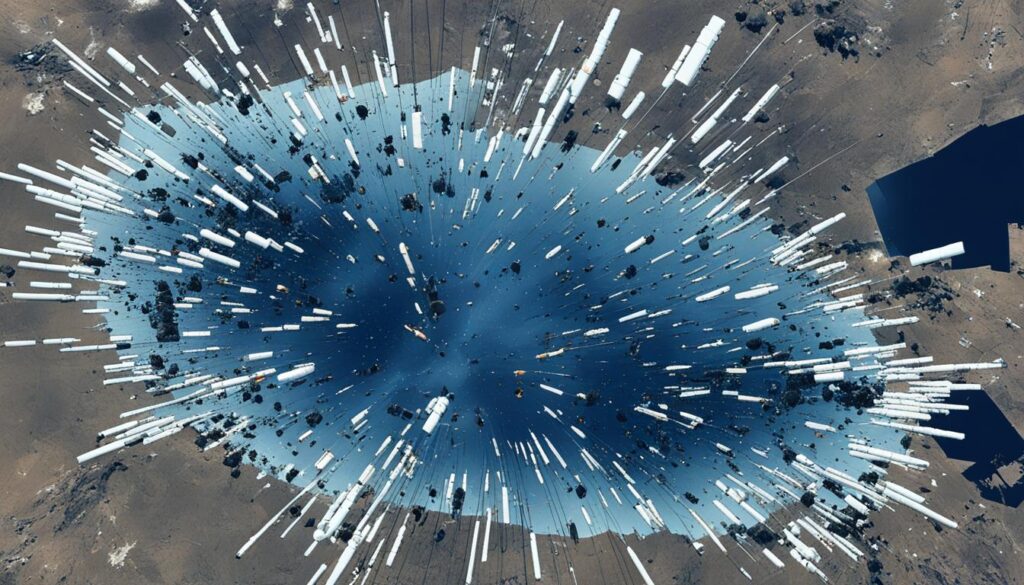
Monitoring Smaller Debris Using Space-Based Sensors
Ground tools can only spot big debris, like objects 10 cm or bigger. Smaller pieces, from 1 mm to 1 cm, are a big risk for spacecraft and satellites. They’re too small to see and avoid. But, space sensors, like the one on the International Space Station, can spot these small pieces.
Now, over 50 radars around the world help track space objects and debris. But, these radars can only work in low orbit because signals fade away quickly with distance. Optical detection can see big debris in higher orbits, but signals get weaker with distance too.
To fix these issues, space sensors have been made to better track small space debris. In 2010, the U.S. Air Force launched a satellite that could find objects as small as 1 m³ in high orbit. The ESA has also funded research on using space for better awareness and surveillance in space.
It’s important to watch the small debris because it can cause big problems. Right now, we know of about 28,210 objects in space, but there are likely many more. These small pieces can destroy a satellite, making it harder and using more fuel for missions in crowded space.
Researchers are looking into new ways to spot small debris. They’re using satellites with star trackers to find objects in space. This method can see targets by looking at the stars and finding where objects are. It helps increase the chances of spotting space objects.
Challenges in Debris Mitigation and Remediation
Getting rid of orbital debris needs work from countries around the world. But, only about 20 to 30% of spacecraft are removed from orbit after use, as agreed. This makes it hard to stop debris from growing in space.
We need to follow international rules, like the United Nations Space Debris Mitigation Guidelines. But, we don’t have strong global rules or ways to enforce them. This makes it tough to keep space clean for the future.
International Cooperation and Compliance
Fixing the orbital debris problem needs teamwork from countries and private companies. Some big hurdles include:
- Getting countries to agree on rules to follow international guidelines.
- Creating ways to watch and punish those who create more debris.
- Sharing technology and knowledge so all countries can fight debris.
- Finding enough money and resources for research and technology to clean up space.
We must work together worldwide to keep space safe for everyone. This is important for countries and the growing space industry.
« Achieving the necessary level of compliance to significantly slow the growth of debris in low-Earth orbit remains a significant challenge. »
Future of Space Situational Awareness and Debris Tracking
The global space sector is growing fast, with more commercial operators launching satellites. This makes tracking and removing space debris more important than ever. New tracking tech, like ground and space sensors, is key to keeping an eye on space and managing debris.
Advancements in Tracking Technologies
New radar tech, better modeling, and combining data from various sources improve how we track and understand space debris. These advances are vital for dealing with the growing debris problem. They help make space safe and sustainable for everyone.
Role of Commercial Operators
Companies like SpaceX, OneWeb, and Amazon are launching many satellites, making debris tracking and removal more critical. They want to keep space clean to protect their investments and keep their services running. Working together, government and companies can tackle the challenges of more satellites in space.
Julien Cantegreil, CEO of SpaceAble, says only 4% of objects in low Earth orbit are tracked by current systems. LeoLabs, a California-based company, tracks more objects than the U.S. government and helps protect many satellites.
The market for space situational awareness is set to grow from $82 million in 2022 to about $1.4 billion in 10 years, Euroconsult predicts. Companies like NorthStar Earth & Space and Scout are investing in new tracking tech to handle the increasing number of satellites and debris.
« Collaboration between government agencies and commercial entities in the development and implementation of debris tracking and mitigation technologies will be crucial for addressing the challenges posed by the increasing number of satellites in orbit. »
Conclusion
Satellite telemetry data is key in tracking and managing orbital debris. It uses ground-based tracking, radar, and space sensors. This helps improve our understanding of space and find ways to clean up debris. It’s crucial to work together and keep improving technology to prevent the Kessler Syndrome, which could limit our access to space.
Managing space is vital for the future of space exploration and its benefits to us. The US and other countries are working together to tackle the debris problem. They’re using advanced systems and international partnerships to keep space safe and open for everyone.
As more companies enter the space industry, the need for good space tracking and debris management grows. By using the latest tracking methods, working together, and finding new solutions, we can make space safe and sustainable. This will let us fully enjoy the benefits of exploring and using space.