
The global investment in space is growing fast, aiming for $1 trillion by 2040. This growth means more satellites in space, connecting our world in many ways. They help with communication, defense, GPS, weather, finance, and flying planes. But, they also face threats like cyber attacks, space debris, and space weather.
To keep satellites safe, we need strong risk management plans. New strategies are being tested to protect against cyber threats, improve supply chain safety, and use smart defense systems. By using data and smart planning, we can better protect our space assets.
Key Takeaways
- Comprehensive satellite risk management strategies are essential to protect space-based assets in the face of growing threats.
- Effective mitigation measures include enhanced cybersecurity, supply chain risk management, and autonomous protection systems.
- Data-driven insights, predictive analytics, and sustainable space operations can help anticipate and address diverse risks.
- Collaboration and information sharing among space stakeholders are crucial for developing robust satellite protection solutions.
- Regulatory frameworks must evolve to keep pace with the rapid advancements in space-based technologies and initiatives.
Space Security Environment: Emerging Threats
The space security scene is changing fast, with big worries about the counterspace skills of countries like China and Russia. These countries are getting better at electronic warfare, directed energy, and anti-satellite (ASAT) weapons. This makes them a big threat to the space stuff the United States and its friends use.
China’s Counterspace Capabilities
China is really pushing its counterspace program, using many technologies to go after U.S. and ally satellites. Now, China has about half of the world’s space-based spy satellites. This big network lets China watch over the globe and get important intel.
Russia’s Anti-Satellite Weapons
Russia has set up a special space force and made anti-satellite weapons. In 2021, they tested a missile that could knock out satellites, creating a lot of space junk. This includes over 1,500 pieces we can track, and many more we can’t.
These moves show how important space security threats, counterspace capabilities, and anti-satellite weapons are. We need to keep a close eye on space and have strong plans for space warfare to protect our space stuff.
| Space Security Threat | Description | Potential Impact |
|---|---|---|
| China’s Counterspace Capabilities | China has developed electronic warfare, directed energy, and direct-ascent anti-satellite (DA-ASAT) systems to target U.S. and allied satellites. | China’s extensive satellite network gives it a significant advantage in monitoring global activities and gathering critical intelligence, posing a threat to the security and resilience of U.S. and allied space assets. |
| Russia’s Anti-Satellite Weapons | Russia has reorganized its military to create a dedicated space force and has developed a suite of reversible and irreversible counterspace systems, including the successful test of a DA-ASAT missile in 2021. | Russia’s development of anti-satellite weapons, including the creation of space debris, threatens the safety and operability of critical space-based assets, undermining global space security. |
« The space security environment is rapidly evolving, with major powers like China and Russia investing heavily in counterspace capabilities that pose a significant threat to the United States and its allies. Maintaining space domain awareness and implementing robust space warfare strategies will be crucial in the years to come. »
National Security Objectives in Space
The U.S. Department of Defense is focusing on national security goals in space, thanks to the 2022 National Security Strategy. This plan highlights how vital space is for America’s safety, wealth, and lifestyle. The main goals include investing in American power and forming alliances to shape the world.
Leveraging Commercial Space Solutions
The United States Space Force (USSF) is blending organic, allied, and commercial space solutions for its goals. This mix is backed by policies like the DoD Commercial Space Integration Strategy (2024) and the National Security Strategy (2022).
The USSF is looking into new ways to meet its needs. This includes using proliferated commercial low Earth orbit capabilities and on-orbit servicing. U.S. launch services have gotten cheaper, cutting the cost to send a kilogram to Low Earth Orbit (LEO) by 90% in ten years.
The USSF works with commercial firms, allies, and partners through the Joint Commercial Operations cell (JCO) on tasks like Surveillance, Reconnaissance, and Tracking (SRT). This strategy aims to boost the U.S. edge by using commercial space tech.
« The USSF must act with forethought on how best to integrate commercial space solutions during different phases like peace, competition, crisis, conflict, and post-conflict. »
The USSF has created the Commercial Augmentation Space Reserve (CASR) framework. It allows for deals with the commercial sector that can be used in crises or conflicts.
The commercial space industry is growing fast, with investments in startups hitting $7.6 billion in 2020. Experts believe the space industry could grow to $2.7 trillion by 2050. The USSF aims to use these advancements for its space security goals.
Satellite Risk Management Strategies
In today’s changing space world, it’s key to have good satellite risk management plans. These plans need accurate, up-to-the-minute data and constant checks and risk checks.
Accuracy and Availability of Near Real-Time Data
Having the right satellite data quickly is vital for making fast decisions and handling risks well. With the latest in satellite tech, groups can get near real-time info on their space systems. This info helps them act fast against threats, reducing damage and keeping important work safe.
Continuous Monitoring and Risk Assessment
Keeping a close watch on satellite health and the changing space scene is key for being proactive. Always checking and doing full risk checks helps groups spot weak spots, guess threats, and take strong steps against them. This way, they can handle the space world’s challenges with confidence and speed.
« Satellite data is the backbone of modern risk management strategies, empowering organizations to make informed decisions and respond swiftly to emerging threats. »
The space field is always changing, making it more important to find new ways to manage risks with satellites. Using the latest in data and monitoring, groups can stay ahead. This ensures their space assets are reliable and strong.
Weather and Terrain Independent Monitoring
Satellite technology is a key tool for utilities during natural disasters. It offers weather-independent data and terrain-independent monitoring. Satellites use sensors like Synthetic Aperture Radar (SAR) to give detailed satellite imagery and remote sensing data. This is true even when the weather is bad or it’s dark.
This satellite monitoring is very useful for utilities in places that are hard to reach. It helps them see the effects of disasters like floods, earthquakes, or wildfires. They can then make quick decisions about how to respond and recover.

Satellites can also give weather-independent data and terrain-independent data. This lets utilities keep an eye on their infrastructure all the time. They can spot risks early and plan for the future. This helps keep important utility assets safe.
« Satellite technology provides utilities with a comprehensive, real-time view of their infrastructure, empowering them to anticipate, respond, and recover from natural disasters more effectively. »
Using satellite monitoring, utilities can manage disasters better. This ensures they can keep delivering essential services, even when the environment is tough.
Leveraging Artificial Intelligence for Predictive Insights
The use of artificial intelligence (AI) and machine learning (ML) is changing how we handle satellite risk management. AI helps satellite operators and risk teams get valuable insights from satellite data. This lets them predict and prevent threats.
AI-driven models give real-time insights on risks, helping teams focus on the most severe and likely threats. By analyzing past data, AI can spot patterns and risks. This makes incident response faster and more effective.
AI also keeps a close watch on IRM processes, checking how well controls work and finding compliance issues. It can change how we manage supply chains by understanding complex data. This leads to better demand prediction, logistics optimization, and quicker responses to changes in demand or supply.
AI helps plan for business continuity by simulating different scenarios. It can spot high-risk areas using satellite and other data, helping relief teams quickly find where they’re needed most. AI-based systems look at security alerts, figure out how severe incidents are, and suggest what to do next.
Using AI in IRM automation improves automated risk monitoring and reporting. This boosts risk assessment and management for companies. As AI use in risk management grows, companies could see a 25% drop in risk-related losses and a 35% boost in operational efficiency.
The future of satellite risk management is all about combining AI and satellite data smoothly. With predictive analytics and automation, companies can stay ahead of threats. They can make better decisions and keep their critical satellite systems safe.
Disaster Response Planning and Damage Estimation
After natural disasters or big events, satellite data is key in planning how to respond and figure out the damage. High-resolution satellite images help teams quickly see where it’s most dangerous, find safe paths, and help utility companies fix things fast.
Rapid Damage Assessment
Teams use before and after satellite pictures to see how much damage there is. This lets them quickly find where to send help and fix things first. It makes sure they use resources well to meet the biggest needs.
Recovery and Restoration Planning
Satellite data is also key for planning how to get things back to normal. It shows where buildings and roads are damaged, helps plan fixing essential services, and makes sure resources are used right. This way, fixing things happens faster and less people are affected.
Groups like the British Geological Survey, CEOS, UNDP, Copernicus Emergency Management Service, and the World Bank Group are leading the way in using satellite data for disaster response. They work together to improve disaster management and make communities stronger against future disasters.
« Satellite data gives emergency teams a powerful tool for quick damage checks and planning for recovery. By using this info, we can better manage resources, coordinate help, and prepare for future disasters. »
Identifying Natural Regional Risks
Today, we live in a world where natural risks are a big concern. Thanks to satellite technology and remote sensing, we can now spot and tackle these risks better. Satellites help us understand the risks in different areas by giving us lots of data.
Satellites let us see weather patterns, geological activity, and environmental changes. When we mix this data with advanced tech, we can predict where natural disasters might hit. This info helps people in charge plan ahead to lessen the damage from these events.
Satellite Data: The Foundation of Predictive Modeling
Satellite data is key to predicting disasters and understanding regional risks. By looking at past satellite images and data, scientists can spot patterns. This helps them make models for disasters like floods, wildfires, and earthquakes.
This means we can get ready for these disasters before they happen. It makes communities and important buildings stronger against nature’s challenges.
| Satellite Data Application | Potential Benefits |
|---|---|
| Flood Monitoring and Prediction | Improved early warning systems, more effective evacuation planning, and better allocation of emergency resources |
| Wildfire Detection and Mapping | Faster response times, enhanced firefighting strategies, and more accurate assessment of damage |
| Earthquake and Geological Monitoring | Better understanding of tectonic plate movements, improved seismic risk models, and enhanced infrastructure resilience |
Using satellite data and remote sensing helps us spot and reduce natural risks. This knowledge is key to making our communities stronger and more ready for the unpredictable natural world.
Space Debris: A Growing Threat
The space environment is facing a big challenge – more space debris. There are about 1 million pieces of debris 1 cm and larger orbiting Earth. This problem will get worse as more satellites are launched, making 6,300 tonnes of debris expected by 2030.
Space debris collisions with active satellites are a big worry for the space industry and everyone. The number of alerts about these potential collisions is rising fast. This puts spacecraft and their missions in danger.
The space industry is coming together to solve this problem. 27 industry actors from across the space sector have signed the Space Industry Debris Mitigation Recommendations, aiming for better post-mission disposal and limiting debris time in orbit. The World Economic Forum and the European Space Agency also support these efforts for sustainable space use.
A company leading in space sustainability is Astroscale, started 10 years ago to tackle space debris. With launch rates now 10 times higher than a decade ago, finding new solutions is crucial.
| Statistic | Value |
|---|---|
| Pieces of debris 1 cm and larger in orbit | Approximately 1 million |
| Satellites in near-Earth orbit by 2030 | 60,000 |
| Debris in near-Earth orbit (tonnes) | 6,300 |
| Industry actors signed Space Industry Debris Mitigation Recommendations | 27 |
To fight the threat of space debris, the space industry and global groups are acting. They’re creating new technologies for removing debris and improving tracking. By working together, we can make space safe for the future.
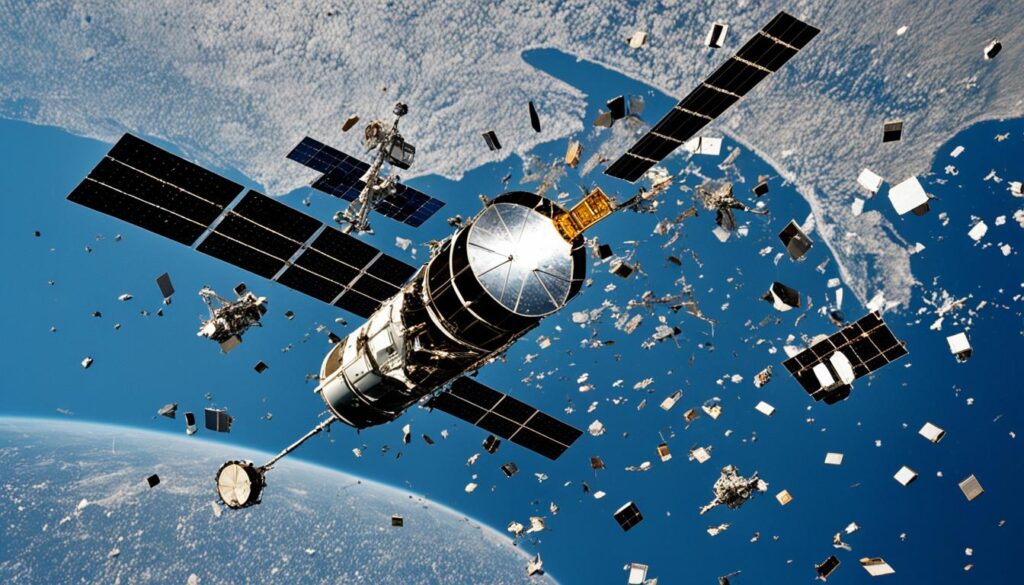
« The number of collision alerts received every week due to the rise in space activity and debris in orbit is growing, putting valuable spacecraft and their missions at risk. »
Space Weather Hazards and Mitigation
The Earth’s space environment faces severe disturbances, known as space weather. These disturbances can harm critical infrastructure like satellites and ground systems. Solar storms, including coronal mass ejections and solar flares, can mess with communication networks, navigation systems, and power grids. This leads to big disruptions and could cause economic losses.
Space weather has been a challenge for human activities for a long time. In the mid-1800s, solar flares messed up telegraph service. In the early 1900s, radio signals were affected by these events. A big solar storm in 1859, called the Carrington Event, caused telegraph service disruptions for days.
Impact on Critical Infrastructure
Space weather can have huge effects. In 1989, a geomagnetic storm caused a nine-hour blackout affecting over 6 million people in the Hydro-Québec power network. In the 1960s, space weather problems included outages and data loss for weather satellites.
Today, space weather still affects us. Airlines flying over 7,500 polar routes a year use high-frequency (HF) radio. This can be disrupted by solar radiation, causing communication blackouts. Also, there’s a risk of big solar energetic particle events during manned space missions, which could be dangerous for astronauts.
Magnetic storms from space weather can cause many problems. These include beautiful auroras, communication issues, radiation risks for astronauts, current surges in power lines, satellite damage, and oil pipeline corrosion.
Mitigating Space Weather Hazards
- NASA’s heliophysics observatory watches space weather with solar, heliospheric, and geospace spacecraft. It gives real-time science data through space weather « beacons » for forecasting.
- The National Space Weather Program is a group that helps agencies work together. It aims to make the country more resilient to space weather effects.
- The National Space Weather Strategy and Action Plan was made by the SWORM Working Group. It lists strategic goals and actions to make the country ready for space weather.
- Many federal agencies, like the Department of Homeland Security, Department of Defense, and Department of Energy, are working on the Strategy and Action Plan.
By understanding space weather’s effects and building strong monitoring, forecasting, and mitigation systems, we can protect critical infrastructure. This ensures the resilience of our space and ground systems against these natural hazards.
Sustainable Space Operations
The space world is changing fast, making sustainable space operations more important than ever. With more objects in space, and new countries joining the space race, we need good plans to deal with space debris. This ensures space stays safe for the future.
One big goal is to follow zero-debris rules. This means making fewer pieces of space junk by being careful during launches and when satellites reach the end of their life. Groups like the Inter-Agency Space Debris Coordination Committee and the United Nations are pushing for better ways to use space.
There’s also a push for companies to help keep satellites running longer. They can fix, refuel, and move satellites around, cutting down on the need for new launches. This helps reduce space junk.
Getting satellites to safely end their life in space is also key. Companies and leaders in space are setting up rules to make sure satellites don’t become space junk. They want to make sure satellites are taken out of orbit safely.
As space technology grows, keeping space safe for the future is a top goal. By following zero-debris rules, using services to keep satellites going, and ending satellites’ lives safely, we can protect space. This way, future generations can also enjoy the benefits of space.
Commercial Satellite Servicing Capabilities
The need for in-orbit servicing (OOS) is growing in the commercial, civil, and military satellite sectors. This technology can help keep satellites running longer and avoid early retirement. It’s key to making space use sustainable over time.
Experts say routine spacecraft refueling might start in 5 to 10 years. This could let commercial satellite operators in geosynchronous Earth orbit keep their satellites longer. Both government agencies and the private sector aim to show they can do robotic OOS in the next five years.
Tools and systems for robotic servicing are getting better fast. They can do many tasks in space, like supporting satellites, changing orbits, refueling, and fixing things. This makes satellites last longer and work better.
NASA’s Satellite Servicing Projects Division is leading the way in OOS tech. They’ve developed the SpaceCube for better computing in space and the Cooperative Service Valve (CSV) for refueling satellites. Engineers at Goddard Space Flight Center have also made robotic grippers for grabbing and fixing satellites.
| Capability | Description |
|---|---|
| Non-contact support | Providing assistance without direct physical interaction with the satellite |
| Orbit modification and maintenance | Adjusting the satellite’s orbit and maintaining its optimal position |
| Refueling and commodities replenishment | Replenishing the satellite’s fuel and other essential resources |
| Upgrade, repair, and assembly | Upgrading, repairing, and assembling components of the satellite |
| Debris mitigation | Removing or deorbiting defunct or obsolete satellites and space debris |
These new commercial satellite servicing capabilities are key to a sustainable space future. They help satellites last longer and remove old or broken ones, making space safer.
Europe’s Role in Space Sustainability
Europe is stepping up to tackle the big challenges of space sustainability. The European Space Agency (ESA) leads the way with efforts to reduce space debris, improve space weather services, and grow the satellite servicing industry.
ESA’s PROTECT Accelerator
The ESA’s PROTECT Accelerator is a key part of Europe’s plan. It aims to solve problems like space debris, servicing satellites in orbit, and making space use sustainable. ESA is working on systems to spot and avoid space dangers, meet zero-debris goals, and help a commercial satellite servicing industry grow.
This program shows Europe’s dedication to keeping space safe and sustainable for the future. ESA is using new tech to create solutions that make space safer and more sustainable. This helps the whole space community.
| Key Initiatives of the PROTECT Accelerator | Focus Areas |
|---|---|
| Space Debris Mitigation |
|
| Space Weather Services |
|
| In-Orbit Servicing |
|
Europe is leading the way in making space exploration and use sustainable. The PROTECT Accelerator shows Europe’s commitment to a sustainable future in space. This benefits the whole space community.
Conclusion
The space industry is always changing, making it vital to have good satellite risk management plans. Today, threats like cyber attacks, space debris, and weather in space are big risks for important space assets. We need a strong, forward-thinking approach to keep space safe for the future.
This article talked about ways to deal with these risks. We looked at using artificial intelligence for better predictions, planning for disasters, and figuring out damage. By always watching, keeping an eye on risks, and working together with other countries, the space industry can protect its important role in our lives.
Looking ahead, we need new ideas and a focus on keeping space safe for the long term. By focusing on managing risks, the space industry can face new challenges and open doors for more exploration, discovery, and tech growth.