
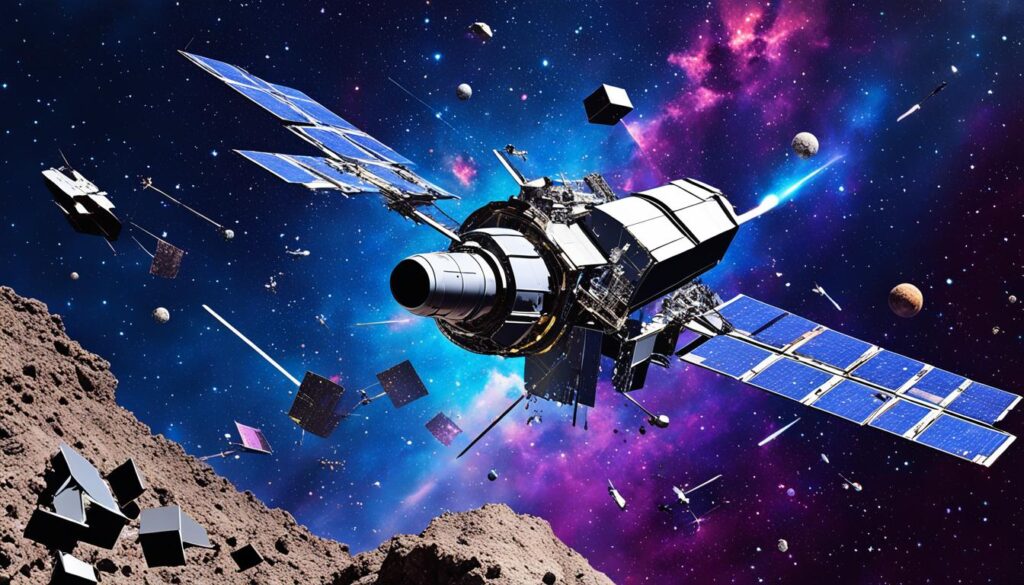
Space debris, or « space junk, » includes non-working human-made objects in orbit around Earth. These can be old satellites, rocket parts, or pieces from explosions or collisions. This junk is a big problem because it can crash into working satellites or spacecraft, causing damage.
Creating solutions for satellite defragmentation is key to keeping space safe for future use. It’s important to clean up the space to protect satellites and ensure safe space travel.
This article will look at new ways to remove space debris. We’ll talk about how to manage traffic in space and avoid collisions. By solving these problems, we can keep satellites working well and protect the space around Earth for a long time.
Key Takeaways
- Space debris is a big threat to satellites and space travel because it can cause collisions and damage.
- We need good solutions for satellite defragmentation to keep space safe for the future.
- This article will cover new technologies, how much they cost, and how working together can help solve the debris problem.
- Removing debris and cleaning up space is key to keeping it safe for the next generations.
- We need to work together on strategies and actions to deal with the growing problem of space debris.
Introduction to Space Debris and its Impact
Space debris is any non-functional human-made object in Earth’s orbit. It includes defunct satellites, rocket stages, and pieces from collisions or explosions. These objects can be as small as a few centimeters or as big as several meters. They move at speeds up to 28,000 kilometers per hour, making them a big threat to satellites and space travel.
Definition of Space Debris
Space debris includes things like old satellites, rocket parts, and pieces from explosions. These objects fill Earth’s orbit, making it dangerous for spacecraft and people in space. They can cause serious damage or even destroy important equipment.
Sources of Space Debris
There are several reasons why space debris exists. Launching objects into space, using space for exploration, and collisions between debris are the main causes. Every year, thousands of satellites and spacecraft are launched, but many don’t work anymore and add to the debris. Collisions and explosions also create more debris.
Hazards Posed by Space Debris
Space debris is a big problem for satellites and space travel. Even small pieces can hit spacecraft hard, causing damage or destruction. This can lead to losing important communication and navigation tools. It also makes spacewalks dangerous and can harm the International Space Station.
| Orbit Type | Probability of Collisions (Next 100 Years) | Catastrophic/Non-catastrophic |
|---|---|---|
| LEO-LEO | 21.9 | 12.6/9.3 |
| LEO-GTO | 0.6 | 0.3/0.3 |
| GEO-GEO | 1.2 | 0.4/0.8 |
| Total | 23.7 | 13.3/10.4 |
The table shows the high risk of collisions in low-Earth orbit. The chance of both major and minor collisions is much higher here than in other orbits. This highlights the need for solutions to reduce space debris and keep space safe for future use.
Growth Trends of Space Debris
Scientists have looked into the size and spread of space debris in orbits like low-Earth orbit (LEO) and geostationary orbit (GEO). They found that small pieces, from a few centimeters to several meters, are most common. Larger items, like old satellites and rocket parts, are fewer in number. It’s important to study how space debris grows and changes to keep space safe for the future.
Analysis of Debris Size and Distribution
Researchers have studied the size and spread of space debris. They found that small pieces make up most of the debris. Larger items, like old satellites and rocket parts, are fewer. Knowing about the size of space debris helps us find ways to protect spacecraft.
Modeling the Development of Low-Earth Orbit Debris
Scientists have made models to understand how space debris grows in low-Earth orbit. This orbit is very crowded. The models look at how many objects are launched, how often they break apart, and how air resistance affects them. These models show that debris in LEO will keep growing unless we do something to stop it.
The study of space debris growth gives us important information. It helps us understand how to keep space safe for the future. By knowing how debris forms and spreads, we can make better plans to reduce its risks. This helps keep satellites and other space equipment safe.
Satellite Defragmentation Solutions
Ground-based laser systems are a promising way to deal with space debris. These systems use high-energy lasers to change the path of space debris. This can make the debris fall out of orbit or move away from where satellites are.
Ground-based laser systems are a cost-effective way to clean up space debris in crowded orbits like low-Earth orbit.
Ground-Based Laser Systems
Ground-based laser systems use strong lasers to change the orbits of space debris. The laser heats the debris, making it lose material and create a small thrust. This thrust can change the debris’s path or make it fall back to Earth.
This method is great for removing small to medium-sized debris from busy orbits. It helps protect satellites from being hit by other objects.
Orbital Debris Removal Vehicles
Another way to clean up space debris is with special spacecraft called orbital debris removal vehicles. These spacecraft grab and remove big pieces of debris, like old satellites and rocket parts, from orbit. They use arms, nets, and tethers to catch and safely move the debris out of orbit.
| Metric | Value |
|---|---|
| Bandwidth provided by a T1 line | approximately 1.544 Megabits/second (Mbps) |
| Bandwidth provided by a T3 line | approximately 45 Megabits/second (Mbps) |
| Typical bandwidth of LANs | between 10 Mbps to Gigabit/second (Gbps) |
| Maximum packet size for ethernet (LAN) | 1500 octets |
| Maximum packet size for token ring and FDDI | 4096 octets |
| Maximum length of an IP datagram | 64K |
Ground-based lasers and debris removal vehicles are key to solving the space debris problem. They help remove or change the paths of dangerous objects. This keeps the orbit safe for satellites and helps protect our space technology.
« The use of defragmentation software on a regular basis can create larger blocks on the hard drive, allowing for smoother modifications and preventing fragmentation-related slowdowns in file processing. »
Earth-Based Repetitively Pulsed Laser Technology
The Earth-based repetitively pulsed laser system is key in removing space junk. It has a moderate-power laser, an advanced beam director, and a high-resolution tracking system. Together, they can hit and break up small space debris up to 500 kilometers away.
Overview of the Laser System
This laser system uses a 530 nanometer wavelength for the best balance of atmosphere and cost. It has a 20 kilojoule pulse energy and 20 kilowatt power. These settings help remove space junk safely and efficiently.
Laser Specifications and Parameters
The laser’s settings are vital for breaking up space debris. The energy and power levels are chosen to safely remove debris from orbit. The wavelength is picked for good atmosphere transmission and cost savings.
Detection and Tracking Devices
The system uses a telescope for detecting and tracking small debris in low-Earth orbit. It gives the laser the exact spot to hit, making the removal process more effective. This ensures the laser hits the right targets precisely.
| Laser Parameter | Value |
|---|---|
| Wavelength | 530 nanometers |
| Pulse Energy | 20 kilojoules |
| Average Power | 20 kilowatts |
| Range | Up to 500 kilometers |

Cost and Efficiency Analysis
Researchers have looked into how well and how much ground-based laser systems work for cleaning up space debris. They found that one 20-kilowatt laser, with advanced tracking, can clear out hundreds of thousands of big pieces of debris in four years. This whole setup costs about $220 billion.
Performance Evaluation of Laser Systems
Researchers have checked how well ground-based lasers work for cleaning up space debris. They saw that a strong 20-kilowatt laser, with top-notch tracking, can take out a lot of big debris from space in four years.
Cost Breakdown and Optimization
People are working to make the system better and cheaper. This will help space agencies and companies use it more. The cost to start this system is about $220 billion. But, researchers are trying to make it cheaper and easier to use.
« The total cost of implementing a ground-based laser system for satellite defragmentation, including the laser, detection and tracking devices, and operational expenses, is estimated to be around $220 billion. »
The cost to start might be high, but it’s key to deal with space debris. Making the system cheaper and better is important. This will help more space agencies and companies use it.
The document titled « Assessing RailFreight Solutions to Roadway Congestion: Final Report » looks into how rail freight can help ease road traffic.
Orbital Debris Removal Vehicles
Orbital debris removal vehicles are special spacecraft made to remove big pieces of space junk from orbit. They use methods like robotic arms, nets, and tethers to grab and safely bring down the junk. These vehicles need to be able to move well, attach to debris, and handle different sizes and shapes of junk.
Concept and Design Considerations
Creating these vehicles is a big task. They need smart systems to guide them and attach to the junk without causing more problems. They also have to be able to deal with all kinds of junk, big or small.
Operational Strategies and Challenges
Using these vehicles is hard. Planning many missions at once is tough, and avoiding collisions is a big worry. The goal is to clean up space without causing more harm.
Scientists are looking at new ways to make this work better. Using many vehicles together could help clean up space more effectively. This way, we can make space safer for the future.
| Technique | Description | Advantages | Disadvantages |
|---|---|---|---|
| Robotic Arms | Robotic arms that can grab and hold onto debris | They can control debris well and handle different sizes | They are complex and might collide with debris |
| Nets | Nets that wrap around debris to catch it | They are simple and can catch big objects | It’s hard to move and hold onto debris with nets |
| Tethers | Tethers are long strings that help control debris | They are useful with other methods too | They might get tangled and controlling big debris is hard |
Creating and using these vehicles is key to solving the space junk problem. By removing debris, we can make space safer for future use. This is important for science, business, and exploring space.
International Collaboration and Regulations
Dealing with space debris needs countries working together and making strong rules. Groups like the United Nations Committee on the Peaceful Uses of Outer Space (COPUOS) and the Inter-Agency Space Debris Coordination Committee (IADC) have made rules. These rules help reduce new debris and manage what’s already there. They aim to make space use responsible and support fixing satellites.
Existing and Proposed Policies
Space agencies are sharing data and working together to track debris. Programs like the Space Surveillance and Tracking (SST) in Europe and the Space Surveillance Network (SSN) in the U.S. show how countries are helping each other. These efforts improve how we know what’s in space and help manage space debris.
Coordination Among Space Agencies
These efforts help share information and plan how to deal with debris. By working together, agencies can better understand the problem and find solutions. This is important for tackling the global issue of space debris.
| Organization | Key Initiatives | Focus Areas |
|---|---|---|
| United Nations Committee on the Peaceful Uses of Outer Space (COPUOS) | – Established guidelines and best practices for debris mitigation – Promotes responsible space operations | – Mitigating the generation of new debris – Managing the existing debris population |
| Inter-Agency Space Debris Coordination Committee (IADC) | – Coordinates international efforts for debris monitoring and removal – Develops joint strategies for debris mitigation | – Improving space situational awareness – Facilitating coordination among stakeholders |
| Space Surveillance and Tracking (SST) program | – Enhances Europe’s ability to monitor and track space objects – Facilitates the coordination of debris-related activities | – Monitoring and tracking space debris – Improving space situational awareness in Europe |
| Space Surveillance Network (SSN) | – Tracks and catalogs objects in Earth’s orbit – Shares data with international partners | – Monitoring and tracking space debris – Facilitating international coordination on debris mitigation |
« Addressing the space debris crisis requires a concerted global effort to develop and implement comprehensive policies and regulations that promote responsible space operations and encourage the adoption of effective satellite defragmentation solutions. »
Future Developments and Challenges
Researchers are looking into new ways to deal with satellite debris and prevent more from happening. They’re looking at advanced materials and coatings to make satellites less likely to create debris. They’re also exploring new tracking and avoidance systems and ways to capture and remove debris from orbit.
Emerging Technologies for Debris Mitigation
One idea is to use new materials that are very light but strong. These materials could help satellites survive in space without breaking into pieces. Researchers are also looking at coatings that can fix themselves and surfaces that push debris away.
Another idea is to use robots to track and avoid space debris. These robots would use sensors and algorithms to watch the sky and move satellites out of the way of potential collisions. This could make space safer by reducing the chance of human mistakes.
Long-term Sustainability of Orbital Environment
Keeping space clean is a big challenge. Experts say we need to do more than just remove debris. We need to follow better rules and use new technologies. Working together across the world, making new discoveries, and being careful with space will help.
« Achieving a sustainable space environment will require ongoing international cooperation, technological advancements, and a commitment to responsible space exploration and utilization. »
As more satellites go up, we need new ways to deal with space debris fast. By using new tech, working together, and thinking about the future, we can make space safer for everyone.
Satellite Defragmentation Solutions
The issue of space debris is growing in the world of satellite technology. A key solution is satellite defragmentation. This method aims to reduce orbital clutter, ensuring our space stays sustainable.
Satellite defragmentation uses ground-based lasers and vehicles to remove debris. These technologies help find, track, and safely take out satellites and debris. This prevents more damage and collisions.
More satellites are being used for communication, navigation, Earth observation, and research. This means more chances for collisions and new debris. It’s a big risk for current and future space missions.
This problem is why we need satellite defragmentation. It helps keep space safe and organized. With international work and rules, we can use space better and keep it safe for the future.
The future of satellite defragmentation looks bright. New technologies like advanced lasers and debris removal vehicles will make cleanup better. As we keep innovating, keeping space clean and safe becomes more possible.
Role of Satellite Operators and Industry
Satellite operators and the space industry are key to solving the space debris issue. They do this by following responsible practices. This means designing satellites to be disposed of safely, reducing debris during launch and use, and working together to track and manage debris.
Responsible Operational Practices
Satellite operators are leading the way in tackling space debris. They’re doing this by:
- Creating satellites that can be safely removed from orbit at the end of their life.
- Reducing debris by securing parts and limiting the release of materials during launch and operation.
- Sharing data and working with others to track and manage space debris.
Data Sharing and Coordination Efforts
Sharing information and working together is vital for tracking space debris and finding ways to reduce it. The Space Data Association (SDA) helps by sharing data and setting standards for safe space use.
By working together and following responsible practices, the satellite industry is crucial in solving the space debris problem. This ensures the space around Earth stays safe for future use.
Environmental Impact and Sustainability
When we talk about satellite defragmentation, we must think about how it affects the environment and its future. Researchers are looking into how these methods might change the space around Earth. They want to know if they could make more space junk or affect how space debris comes back to Earth.
Keeping space safe for the future is key when we work on fixing up satellites. Experts say we need a plan that removes debris, follows rules, and sets up strong laws. This way, we can keep using space safely for a long time.
Assessment of Debris Mitigation Techniques
We need to check how methods like lasers and space vehicles will affect our planet. Researchers are looking at the risks, like making more space junk or how it might come back to Earth.
Long-term Preservation of Orbital Environment
Keeping space safe for the future is very important. We need a plan that removes debris, follows rules, and sets up strong laws. This will help us use space safely for many years to come.
| Metric | Value |
|---|---|
| Sustainability journals | 6.8% |
| Special issues related to landscape fragmentation and sustainable environmental assessment | 3.3% |
| Deadline for manuscript submissions | March 31, 2021 |
| Published papers in the special issue | 5 |
| Articles cited by at least 1 source and viewed by 2092 readers | 1 |
| Manuscripts viewed | 37176 |
The table shows we’re focusing more on making things sustainable. There are many papers on topics like space junk and how to fix it. This shows we’re serious about looking at the effects of our actions in space.
« Preserving the long-term sustainability of the orbital environment is a crucial consideration in the development and deployment of satellite defragmentation solutions. »
Policy and Regulatory Frameworks
Effective policies and rules are key for managing space debris. They help guide the use of solutions to fix this problem. The United Nations and other groups have made guidelines to help countries work together on this issue.
National and International Guidelines
These guidelines give advice on how to reduce space debris. They suggest ways to limit debris, remove old spacecraft, and avoid collisions. By working together, countries can keep space safe for the future.
Legal Aspects and Liability Considerations
Using solutions to fix space debris brings up tricky legal issues. Questions about who owns debris and who is responsible need answers. It’s important to make clear rules to make sure debris removal is done safely.
Working together, lawyers, policymakers, and the space industry can solve these problems. This will lead to better ways to keep space clean for the next generations.
« Effective policy and regulatory frameworks are essential for guiding the implementation of satellite defragmentation solutions and promoting the responsible management of space debris. »
Conclusion
Space debris is a big problem for the future of space use. Solutions like ground-based lasers and vehicles to remove debris are being explored. But, making these work will need help from countries around the world, strong rules, and the space industry’s effort.
We need new tech, careful space use, and a focus on keeping space clean. This is key for a safe and lasting use of space. With more satellites and space missions, we must work together to solve the debris issue.
By using new ideas, working together, and aiming for responsible space use, we can keep space safe for the future. It’s up to all of us in the space world to act now for a clean orbit. The future of space exploration depends on it.