
The threat of space debris is growing fast. It’s a big worry for the aerospace industry and space agencies around the world. There could be up to 170 million pieces of debris orbiting Earth, most too small to track now.
This debris is a big risk to satellites, spacecraft, and even the International Space Station. For example, the ISS had to dodge collisions twice in just one month.
To fix this problem, space agencies and companies are looking at different ways to remove debris. They’re checking out techniques like tug vehicles, lasers, and recycling debris for new materials. NASA has done a detailed study on the costs and benefits of cleaning up space debris. This study is helping guide these efforts.
Key Takeaways
- Space debris poses a growing threat, with an estimated 170 million pieces of debris in orbit.
- Active debris removal techniques, including tug vehicles, lasers, and recycling, are being explored to address the issue.
- NASA’s cost-benefit analysis has provided valuable insights to guide space debris mitigation efforts.
- Effective space debris management is crucial for ensuring the sustainability of orbital space.
- International collaboration and regulatory frameworks are essential in tackling the space debris challenge.
Introduction to Space Debris
Space exploration has led to a buildup of man-made objects in Earth’s orbit. These objects, known as space debris, include old rocket stages, broken satellites, and pieces from explosions. They are a big risk to working spacecraft and satellites. Objects range from tiny pieces to several meters wide, making the danger real. Collisions can happen at speeds over 17,000 mph.
Definition and Types of Space Debris
Space debris means all the human-made objects in Earth’s orbit that are no longer useful. There are different kinds, such as:
- Defunct satellites and spacecraft
- Spent rocket stages and other launch vehicle parts
- Fragments from collisions, explosions, or when objects break apart
- Debris from on-orbit breakups, like solid rocket motor pieces and coolant flecks
Risks and Consequences of Space Debris
Space debris is a big risk to working satellites and spacecraft. Even small pieces can cause huge damage because they move so fast. The Kessler syndrome is a worry, where more collisions make more debris, leading to even more problems.
This could mean losing valuable satellites, disrupting communication and navigation, and threatening human space missions.
« Space debris is a growing threat to active satellites and human space exploration. The high-speed collisions can cause catastrophic damage, and the Kessler syndrome is a real concern as the amount of debris continues to increase. »
The Growing Threat of Space Debris
More objects are now in Earth’s orbit, thanks to more space exploration and the launch of many satellites. This has led to a lot of debris in space, reaching a critical level. This situation increases the risk of collisions, which can create even more debris, causing the Kessler syndrome.
Increasing Number of Satellites and Space Activities
There are now over 27,000 pieces of space junk bigger than a softball in orbit. Millions of smaller pieces also pose a big threat. SpaceX’s Starlink constellation, with over 20% of all trackable objects, has added to the problem.
From 2022 to 2023, the number of satellites launched went up by 23%. Over 2,800 satellites were launched in 2023, showing how busy the commercial space industry is.
Kessler Syndrome: The Cascading Effect of Debris
A 2009 collision between a Russian satellite and an Iridium satellite shows how dangerous space debris can be. The International Space Station has had to change course 32 times since 1999 to avoid debris. Experts say the Kessler syndrome, where debris levels get too high, could cause more collisions.
There are hundreds of thousands of particles between 1 and 10 cm in size, and over 100 million pieces bigger than 1 mm. With over 9,000 metric tons of material in orbit, finding ways to deal with space debris is urgent.
space debris removal techniques
The growing number of satellites and space activities is making the space debris crisis worse. We need effective space debris removal methods now more than ever. Researchers and space agencies are looking at different ways to remove debris from orbit.
One idea is using tethers and nets to catch big pieces of debris. Systems like DARPA’s Electrodynamic Debris Eliminator (EDDE) can grab onto objects and pull them down safely. Robots with arms and tentacles are also being made to pick up smaller pieces carefully.
Lasers are another way to deal with debris. They can push or break up debris, changing its path so it burns up in the atmosphere.
| Technique | Potential Benefits | Estimated Cost |
|---|---|---|
| Tethers and Nets | Ability to capture large debris objects | Varies, depending on scale and complexity |
| Robotic Arms and Tentacles | Precise control for removal of smaller fragments | Relatively lower, compared to large-scale systems |
| Lasers | Ground-based: Cost-effective; Space-based: Reach higher altitudes | Ground-based: ~$1 million per object; Space-based: Higher initial investment |
New technologies like ion beam shepherds and atmospheric drag enhancement are being looked at too. These new ideas aim to give us more ways to deal with space debris for good.
« Removing as few as five of the highest risk objects per year can stabilize the long-term low Earth orbit debris environment. »
The space industry is growing, making it more important to have good debris removal tech. Space agencies, research places, and companies need to work together. They must develop and use debris removal plans to keep space safe for future use.
Active Debris Removal Techniques
The European Space Agency (ESA) and others are looking into active debris removal (ADR) technologies to deal with space junk. They’re exploring tethers and nets to catch big pieces, and robotic arms to pick up smaller ones.
Tethers and Nets for Capturing Debris
Tethers and nets can safely pull down or move big space junk like old satellites and rocket parts. They catch the object and either make it burn up in the atmosphere or move it out of the way. This helps tackle the biggest dangers from large space objects.
Robotic Arms and Tentacles for Debris Capture
Robotic arms and tentacles can grab and move small pieces of space junk. They work with great precision, making it possible to remove individual pieces of debris. This is especially useful for dealing with the many small pieces that can still harm working spacecraft.
These methods are key to cleaning up space. With more satellites and space activities, we need to keep our orbit clean more than ever.
| Active Debris Removal Method | Advantages | Challenges |
|---|---|---|
| Tethers and Nets |
|
|
| Robotic Arms and Tentacles |
|
|
As space technology grows, using tethers and nets for debris capture, robotic arms for debris removal, and other active debris removal technologies will be key. They help keep space safe for future missions.
Ground-Based Debris Removal
Ground-based debris removal techniques using laser technology are now a key solution to the growing space debris problem. These laser debris removal and laser debris nudging methods help clear the space of dangerous objects without touching them.
Ground-based lasers can push debris out of the way or make it fall back to Earth. This ground-based debris removal is seen as an affordable way to deal with debris, big or small. But, it needs a lot of energy and can be affected by the atmosphere.
A NASA study found that a space laser could remove up to 100,000 small pieces of debris in a few months. It focuses on the area between 450-850 km high where many small pieces are found. This could help prevent the Kessler syndrome, where debris hitting each other creates more debris.
The space industry is looking at ground-based laser debris removal and other new technologies to solve the space debris problem. Using different technologies together can help make space safer and protect important space equipment.
« The challenging aspect of the proposed space debris removal solutions includes substantial costs due to the scale of the problem, along with potential impacts on Earth’s atmosphere, emphasizing the multi-faceted concerns within the industry. »
| Debris Removal Technique | Potential Impact | Challenges |
|---|---|---|
| Ground-Based Laser Debris Removal | – Cost-effective approach to address large and small debris – Potential to alter debris trajectories or trigger re-entry | – Requires significant energy input – Atmospheric distortion can impact effectiveness |
| Space-Based Laser Debris Removal | – Potential to remove up to 100,000 pieces of small debris in a few months – Targeted approach to address critical altitude ranges | – High development and operational costs – Potential impacts on Earth’s atmosphere |
Space-Based Debris Removal
The threat of space debris is growing fast. New solutions are coming up to deal with this big problem. One idea is to remove debris from space itself, which might work better than taking it down to Earth. The ion beam shepherd method is getting a lot of attention as a way to remove debris from space.
Ion Beam Shepherding for Debris Removal
The ion beam shepherd uses a spacecraft with an ion beam to guide debris into a new orbit or towards burning up in the atmosphere. This method works right in space, avoiding energy loss that ground lasers face.
This technique can push the debris gently but precisely to where we want it to go. It’s safe and doesn’t break the debris apart, unlike some other methods.
Ion beam shepherding has big advantages over taking debris down from the ground. It can get closer to the debris, needing less energy to move it. And without air in space, the ion beam can work well over longer distances and be more accurate.
With more stuff in space, we really need new ways to clean up debris like the ion beam shepherd. This tech uses space to its advantage, offering hope for a cleaner space future.
Atmospheric Drag Enhancement
The space industry is growing fast, making the problem of orbital debris more urgent. Atmospheric drag enhancement is a new idea that could help. It uses the Earth’s atmosphere to break down space junk without needing expensive technology.
This method works by changing the shape of space debris. This makes it more likely to burn up when it enters the Earth’s atmosphere. It’s not as direct as removing debris on purpose, but it can help over time, especially with small pieces.
There are about 100,000,000 objects between 1 – 10 cm across in space. And over 36,500 pieces are bigger than 10 cm. These objects can stay in space for a very long time because the atmosphere doesn’t slow them down much above 250 km.
Small spacecraft designers are finding ways to make objects fall back to Earth safely. Most small satellites can fall apart in less than 5 years if they’re below 400 km. Rules also say satellites in LEO should be taken out of orbit or moved to a special orbit within 25 years after they’re no longer needed.
Passive deorbit methods are getting better and more popular. They’re simple and don’t cost a lot. But, active methods are also being used to help objects fall out of orbit faster.
How well atmospheric drag enhancement works depends on things like where the object starts, its shape, and the weather. By changing how debris objects are made and positioned, we can help keep space clean. This is important for keeping our space safe for future use.
Debris Recycling and In-Space Manufacturing
The space industry is looking for new ways to deal with the growing problem of space debris. They’re exploring debris recycling and in-space manufacturing. These ideas could help make space more sustainable.
These methods aim to turn old space debris into useful materials or fuel. This way, the space industry can cut down on waste in orbit. It also helps build new space infrastructure and services. This could make launching things into space cheaper and better for the environment.
Right now, over 8,000 metric tons of space junk orbits Earth, including more than 13,000 old satellites. About 30% of these working satellites are from the United States. They’ve launched over 4,100 satellites so far.
To tackle this issue, the National Space Policy wants to remove five to ten big pieces of debris each year. This has sparked a new industry focused on space debris removal and recycling. There are projects underway to create recycling systems in space.
| Key Debris Recycling and In-Space Manufacturing Initiatives | Highlights |
|---|---|
| ESA’s Circular Economy in Space | Aims to become space debris-neutral by 2030 and implement a circular economy in space by 2050 to ensure long-term orbital sustainability. |
| Orbit Recycling’s Space Tug Mission | Presented various concepts for a recycling space tug mission, including designs that could be launched by vehicles like Vega-C or Ariane 64. |
| Ground Observation of Debris Orbits | Preliminary ground observation validated the orbits and tumbling rates of selected space debris items, aiming to reduce risks associated with debris removal for recycling. |
Starting debris recycling facilities might cost a lot at first. But, the benefits over time could be huge. By making « waste into value, » the space industry can create a sustainable and cost-effective circular space economy. This supports space-based resource utilization and in-space manufacturing.
« The political will to ‘turn waste into value’ is identified as a missing component for advancing space recycling initiatives. »
As the space industry grows, having strong debris recycling and in-space manufacturing will be key. It will help make space activities sustainable for the long term. And it will help create a more circular space economy.

International Collaboration and Regulations
As space debris becomes a bigger problem, working together across borders is key. It’s important to have strong rules to tackle this issue. But, using technology to clean up space raises worries about it being used for harmful purposes. This affects trust and relations between countries.
Dealing with space debris is a big task that needs a worldwide plan. Now, we’re launching more satellites than ever before, but we’re not following the rules well. Big pieces of debris break apart often, making more trash in space.
Challenges and Concerns with Debris Removal
Removing space debris is hard for many reasons. We need a solid plan and the right technology to do it. Also, some worry that these technologies could be used for bad things, making it harder to work together.
Even though it’s tough, we’re moving slowly towards a solution to prevent space crashes. The market for space services is growing, but so is the problem. We need better ways to track space objects, avoid collisions, and remove debris. Strong teamwork and rules are essential for keeping space safe for the future.
| Year | Event |
|---|---|
| 2002 | The Inter-Agency Debris Coordination Committee (IADC) published the IADC Space Debris Mitigation Guidelines, which served as a baseline for the UN Space Debris Mitigation Guidelines. |
| 1994 | The Subcommittee at the thirty-first session considered matters associated with space debris on a priority basis. |
| 1999 | The Technical Report on Space Debris was adopted by the Subcommittee at its thirty-sixth session. |
| 2003 | IADC presented its proposals on debris mitigation during the fortieth session of the Subcommittee. |
| 2007 | The General Assembly, in resolution 62/217 of 22 December 2007, endorsed the Space Debris Mitigation Guidelines. |
We need a careful plan to tackle debris removal and deal with international issues. A global effort is needed to keep space safe for the future. This will help us handle the growing space debris problem.
NASA’s Orbital Debris Program Office (ODPO)
The NASA Orbital Debris Program Office (ODPO) is key in fighting the danger of space debris. This team keeps a detailed list of trackable debris. They also focus on removing the biggest and most harmful objects.
Prioritizing and Cataloging Debris for Removal
The ODPO starts by tackling the biggest debris first. This way, they make debris removal more effective and lower the risks from space debris. Since 1979, they’ve gathered data from radar, optical, and in situ measurements. This helps them understand the debris in space.
Some big wins for the ODPO include:
- Analyzing 677 impact features on the Hubble Space Telescope’s Wide Field and Planetary Camera 2 (WFPC2) in 2009, with a limiting feature size of approximately 300 μm.
- Working with Japan’s Kyushu University on tests to see how different materials like carbon fiber and glass fiber handle impacts.
- Since 1979, they’ve studied how debris impacts and how to prevent it. They recommend a 90% post-mission disposal rate and removing at least 5 old spacecraft each year to protect space.
The ODPO’s efforts in picking and listing debris are vital. They help create plans to lessen the threat of space debris. This ensures space operations can continue safely for a long time.
Emerging Technologies and Future Solutions
Researchers and innovators are working hard to tackle the growing problem of space debris. They’re looking into new technologies like laser-based removal and robotic systems. These could be the key to keeping space clean for the future.
Lasers might soon help remove small to medium-sized space junk. This method uses high-powered lasers to change the path of debris. It makes the debris fall back to Earth where it burns up. This method is already being tested and could get even better.
Robotic systems are also being improved for capturing space debris. They use tech like computer vision and AI to find and remove debris. Companies like OrbitGuardians and ClearSpace One are leading this effort, showing how we can clean up space effectively.
Another idea is to make new things from old space junk. Companies like Obruta want to recycle debris into materials for new satellites. This approach helps reduce space junk and makes better use of space resources.
The space industry needs new and shared solutions to deal with space debris. By using new tech and working together, we can make space safer for the future. This will help keep space exploration going strong.
| Emerging Technologies | Key Advancements | Potential Impact |
|---|---|---|
| Laser-based Debris Removal | Utilizing high-powered lasers to alter the trajectory of small-to-medium-sized debris | Increased efficiency and scalability in deorbiting and removing space junk |
| Robotic Capture Systems | Advanced technologies like computer vision, IoT, and AI-powered tethered-net removal | Precise identification, capture, and removal of space debris of various sizes |
| In-Space Manufacturing | Repurposing and recycling existing space debris into useful materials for new satellites and spacecraft | Promoting a circular economy approach and reducing the overall amount of space debris |
The world is coming together to solve the space debris problem. New technologies and teamwork offer hope for a cleaner space future. By using these new methods, we can make space safe for everyone.
The Cost and Benefits of Debris Removal
Space debris is growing fast, making it vital to clean it up. NASA looked into how much it would cost to remove debris. They found that even though it’s expensive upfront, it’s worth it in the long run.
NASA’s Cost-Benefit Analysis
NASA says U.S. satellites face about $58 million in costs each year because of debris. Most of this is from military and civil satellites. They found that using lasers to remove debris could pay off in ten years.
They also looked at other methods like avoiding collisions just in time. These could start showing benefits right away or in a few decades. If big debris pieces fall back to Earth, it could pay off in 20 to 25 years.
Removing small debris with spacecraft could take decades to show a profit. Recycling debris for fuel also needs a lot of research and could take decades to break even.
Debris-removal lasers aren’t strong enough to harm satellites, but there are worries about using them as weapons.
| Debris Removal Technique | Breakeven Time |
|---|---|
| Ground- and space-based lasers | Within a decade |
| Just-in-time collision avoidance | Immediate to a few decades |
| Reentry of larger debris | 20 to 25 years |
| Sweeper spacecraft | A few decades |
| Recycling debris for propellant | A few decades |
NASA’s study shows it’s key to clean up big and small debris. Both are dangers in space. Knowing the costs and benefits helps leaders make good choices about cost of debris removal and benefits of debris removal.
Space Sustainability and Environmental Protection
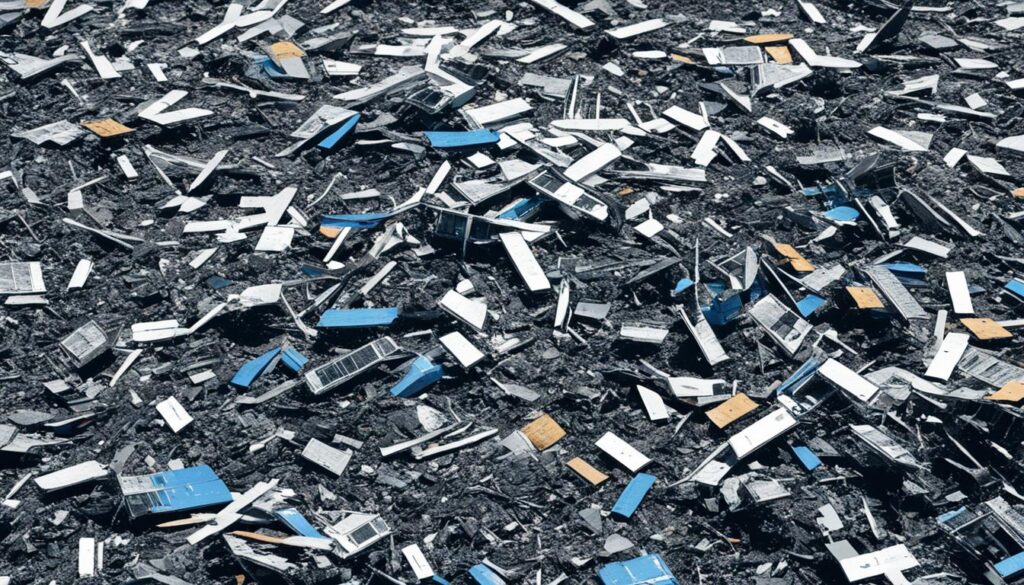
More satellites and space activities mean more debris in orbit. About 128 million pieces bigger than 1 millimeter are up there. This includes around 34,000 pieces bigger than 10 centimeters. This debris is a big risk to working satellites, spacecraft, and even our plans to explore space.
Now, we talk a lot about making space sustainable. We see space as a limited resource that needs careful handling. It’s up to leaders and the space industry to come up with ways to stop debris from growing. This will help keep space safe for the future.
To make space sustainable, we’re looking at tracking debris and how full the orbits are. By knowing where debris is, we can push for removing it. This will encourage better space use habits.
| Orbital Debris Mitigation Strategies | Objectives |
|---|---|
| Deorbiting Space Objects | Reduce the time left in protected regions to below 5 years to improve orbital clearance |
| Collision Avoidance | Develop automated decision criteria and optimize maneuvers to avoid in-orbit collisions |
| Preventing Break-ups | Implement measures to prevent the intentional release of space debris and internal explosions |
| Minimizing Astronomical Impact | Reduce the impact of space objects on optical and infrared astronomy, maintaining dark and quiet skies |
We need to see near-Earth space as a valuable resource. This way, the space industry can aim for a sustainable future. It helps us keep exploring space and protects it for the future.
« Reduction of debris in space is crucial for preserving near-Earth space for future generations, with the problem projected to become more significant in the future. »
Fixing the debris problem will cost a lot, but it’s worth it. By focusing on sustainability, we can keep exploring space. This also helps us move forward in science and technology.
Conclusion
The problem of space debris is a big challenge we must tackle to keep space safe for future use. With more satellites and space activities, the risk of collisions and the Kessler syndrome grows. But, there are many ways to remove debris that show promise.
Techniques like tethers, nets, robots, lasers, and enhancing atmospheric drag are being explored. Also, recycling debris and making things in space could help lessen the problem. Yet, we face hurdles like needing global cooperation and strong rules. Still, the report stresses how crucial it is to deal with space debris for the future of space.
By using new removal methods, working together globally, and making strong policies, we can make space cleaner and safer. This will make space missions safer and help us keep exploring and using space. The report’s conclusion highlights the need to tackle space debris together for a secure and bright future in space.