
Space exploration has given us a lot of knowledge, but it has also created a problem. Millions of tiny objects are now orbiting Earth, threatening current and future spacecraft. We need a better system to detect, track, and clean up small space.
There are about 25,000 big pieces of space junk we can track in Earth’s orbit. But there are millions more small pieces like lens covers and fragments from explosions. These events, like the 1961 rocket explosion and the 2007 Chinese test, have made the problem worse.
Key Takeaways
- There are now 25,000 trackable space junk objects, with millions of smaller pieces also posing risks.
- Events like collisions and intentional destruction have greatly increased the amount of space debris.
- We need good space junk monitoring systems to keep space safe for missions now and in the future.
- Good space awareness and traffic management help prevent collisions in crowded orbits.
- We need to work together and use new technologies to deal with the space debris problem for safe space use.
The Threat of Orbital Debris
More objects are now orbiting our planet, threatening space operations and the future of space. Over the years, we’ve left behind a lot of space junk. There are over 25,000 objects bigger than 10 cm in Earth’s orbit. Plus, there are hundreds of thousands of pieces between 1 and 10 cm, and more than 100 million smaller than 1 mm.
The orbital debris issue is a big worry, especially for small pieces. These debris can travel fast and hit satellites or spacecraft, causing big problems. For example, they can mess with communication, navigation, and weather forecasting. Right now, there’s more than 9,000 metric tons of stuff in orbit as of January 2022.
Some satellites were destroyed on purpose, like the Fengyun-1C weather satellite in 2007. Others collided accidentally, like the Iridium-33 and Cosmos-2251 in 2009. These events have added a lot of big debris fragments to orbit, making things worse.
It’s unlikely that two big objects will crash into each other, but there are so many space junk pieces out there. This could lead to a big problem called the Kessler syndrome. We need to deal with this to keep our space safe for the future.
The Need for Robust Space Situational Awareness
More satellites and space debris are going into Earth’s orbit, making it vital to have strong space situational awareness systems. Current systems use radar and telescopes but have limits in spotting small debris. This makes it hard to keep space safe and avoid collisions that could be very harmful.
Limitations of Current Tracking Systems
Existing space tracking systems are not perfect. They can track big objects like satellites but miss smaller debris. This is a big problem because small pieces can also cause damage. We need better ways to find and track these small pieces of space debris.
The Importance of Detecting and Characterizing Small Debris
- The market for space situational awareness is growing from $1.41 billion in 2023 to $2.08 billion by 2028. This shows we need better tracking and monitoring.
- New satellite constellations like SpaceX’s Starlink and OneWeb increase the risk of collisions in space. So, we need strong debris characterization solutions.
- New technologies like Maris’ video systems, Jupiter AI’s tracking, and Pearl’s edge computing are helping improve space situational awareness.
We must develop better space tracking systems to keep space safe. We need to find, track, and understand small debris. Using new tech like artificial intelligence will help us better understand space and avoid collisions.
ESA’s Zero Debris Approach
The European Space Agency (ESA) is taking action against the growing space junk problem. They aim to reduce debris in Earth and lunar orbits by 2030 for all new missions. This plan is to prevent more space junk from being created.
ESA wants to lower the risk of collisions with fast-moving debris. These collisions can be very dangerous for satellites and spacecraft.
Stricter Requirements for Future Missions
ESA is setting new rules for space missions. These rules cover how missions are made, flown, and cleaned up after use. The goal is to make sure objects in space are safely removed.
ESA also wants to improve how we avoid collisions in space. This is important because there are already 130 million pieces of space debris larger than a millimeter around Earth.
Improving Orbital Clearance and Collision Avoidance
ESA plans to make satellites and rocket bodies leave orbit faster, ideally in less than five years. This is a change from the current 25 years. By 2030, ESA hopes to have services ready to remove space debris on purpose.
They are also testing lasers to track space debris. This will help us know where the debris is and how to avoid it.
The « Zero Debris approach » focuses on preventing satellites from breaking apart and not releasing objects on purpose. ESA is creating a guide for the space community to help make space safer for the future.
« More satellites have been launched in the last two years than in the entire six decades of space exploration, underscoring the urgent need for robust space debris mitigation strategies. »
ESA is taking big steps to tackle the space debris problem. They want to make space safer for everyone and for future generations.
NASA’s Detect, Track, and Remediate Challenge
NASA launched the « Detect, Track, and Remediate: The Challenge of Small Space Debris » competition. This challenge aimed to find new ways to deal with small space debris. It invited people from all over the world to share their ideas.
The competition offered a $120,000 prize for the best ideas. Winners came up with many new technologies. These included optical imaging satellites and interferometric radar techniques for detecting debris. They also proposed solar-pumped lasers and a deployable rotating tethered sweeper for cleaning up debris.
There were also ideas for a swarm of small satellites and a crossbow-inspired mechanism called Skimmer. Another idea was a fleet of satellites with a powerful laser for capturing debris and causing chemical reactions.
This challenge focused on small debris, from 1mm to 10cm in size. With over 2,800 satellites launched in 2023, the problem of space debris is getting worse. NASA wants to find ways to deal with it effectively.
NASA’s challenge encourages new ideas and cutting-edge technologies. It aims to make space safer and more sustainable. This will protect our space infrastructure and help us continue exploring space.
« The winners of this challenge have shown they’re serious about solving the space debris problem, » said a NASA spokesperson.
space junk monitoring systems
Effective space junk monitoring systems are key to protecting satellites and spacecraft from orbital debris. They use advanced tech like radar systems, optical telescopes, and data fusion. These tools help detect, understand, and track small debris pieces.
Detecting and Characterizing Small Debris
Finding and understanding small debris pieces is a big challenge in space junk monitoring. Researchers have come up with new ways to do this. They use electrical bursts from debris collisions in space to learn about the debris’s size, shape, and makeup. This helps with better monitoring and managing the debris.
Tracking Debris Trajectories and Orbits
It’s important to know where space debris is going and where it is. Sophisticated algorithms combine data from radar, telescopes, and satellite tracking. This gives real-time info on debris locations and movements. This helps satellite and spacecraft operators make smart decisions to protect their assets.
| Key Capabilities | Significance |
|---|---|
| Debris detection and characterization | Identifying the size, shape, and composition of small debris fragments to enhance monitoring and mitigation efforts |
| Debris trajectory and orbit tracking | Providing real-time, accurate data on the location and movement of debris objects for effective space traffic management and collision avoidance |
| Data fusion and analysis | Combining information from multiple sources to deliver comprehensive, actionable insights on the space debris environment |
By using these advanced systems, satellite and spacecraft operators can better protect their assets. This ensures the long-term sustainability of space operations.
Remediation Strategies for Space Debris
The number of satellites and space missions is growing, making small space debris a big concern. To fix this, we’re looking at designing satellites to break apart safely when they’re done and launching missions to clean up debris. But, getting rid of small pieces of debris is hard because it’s expensive and takes a lot of time. We need new, affordable ways to reduce debris and keep space safe for future missions.
One idea is to create better space debris removal technologies. The European Space Agency (ESA) is leading the way with its Clean Space program. They’re testing ways to stop making more debris and removing big pieces that are already out there.
Working together and making rules are also key to managing space debris. Groups like the Inter-Agency Debris Coordination Committee (IADC) and the Zero Debris Charter are bringing countries together. They aim to find ways to clean up debris and make space use sustainable.
The space industry is growing, and we need strong plans to deal with debris. By supporting new tech and working together, we can make space cleaner and safer for the future.
The Role of International Collaboration
Space is a shared resource for everyone. We can’t solve the space debris problem alone. That’s why space agencies and governments are working together. They aim to keep space safe for the future through teamwork.
The Inter-Agency Debris Coordination Committee (IADC)
The Inter-Agency Debris Coordination Committee (IADC) leads this global effort. It has 13 major space agencies as members. They’ve set guidelines for dealing with space debris. These rules help everyone act responsibly in space.
They suggest reducing new debris, removing old satellites, and keeping space safe for the future.
The Zero Debris Charter
The European Space Agency (ESA) helped create the Zero Debris Charter. It’s a call for a world without space debris. By signing it, groups promise to work together to clean up space.
| Key Statistics | Highlights |
|---|---|
| NASA has cataloged over 250 satellite fragmentation events | Caused by factors such as battery explosions and propulsion issues |
| One confirmed collision instance in 2021 | Marking the fifth confirmed collision between cataloged objects |
| China maneuvered its space station twice in 2021 | To avoid collisions with Starlink satellites |
These efforts show how important it is to work together. They help tackle the space debris problem and keep space safe for the future.
Emerging Technologies for Debris Mitigation
The threat of space debris is growing fast. New technologies are being made to tackle this issue. Passivation and active debris removal are key areas getting attention.
Passivation Technologies
Passivation tech aims to remove all energy from a spacecraft at the end of its life. This stops more debris from being released. It includes discharging batteries, venting propellant, and safely bringing the spacecraft back to Earth.
For instance, Spinnaker3 from Purdue University engineers can make a vehicle deorbit in 15 days instead of 25. This helps keep the time in orbit shorter.
Active Debris Removal Techniques
Active debris removal (ADR) tech finds, catches, and takes out big pieces of space junk before they break into smaller, harmful parts. Obruta uses a net to grab debris less than 20 cm. The ClearSpace One project has a giant claw to pick up debris and send it to a lower orbit for safe disposal.
These new techs, working together with international efforts and policies, are key to solving the space debris problem. They help keep our space safe for the future.
| Technology | Description | Key Features |
|---|---|---|
| Spinnaker3 | Developed by Purdue University engineers, Spinnaker3 reduces a vehicle’s deorbit process from 25 days to 15 days. | Faster deorbit process, minimizing time spent in orbit and reducing debris generation. |
| Tethered-net removal | Obruta employs a net capture system to eliminate debris smaller than 20 cm. | Effective at removing small-sized debris, helping to mitigate the proliferation of hazardous fragments. |
| ClearSpace One | A startup spin-off from the Swiss EPFL Space Centre, ClearSpace One uses a giant four-armed claw to grab debris and send it to a lower orbit for safe disposal. | Capable of capturing and removing larger pieces of space junk, preventing them from breaking up into smaller, more dangerous debris. |
These new techs, along with working together and making policies, are vital for dealing with space debris. They help keep our space safe for the future.
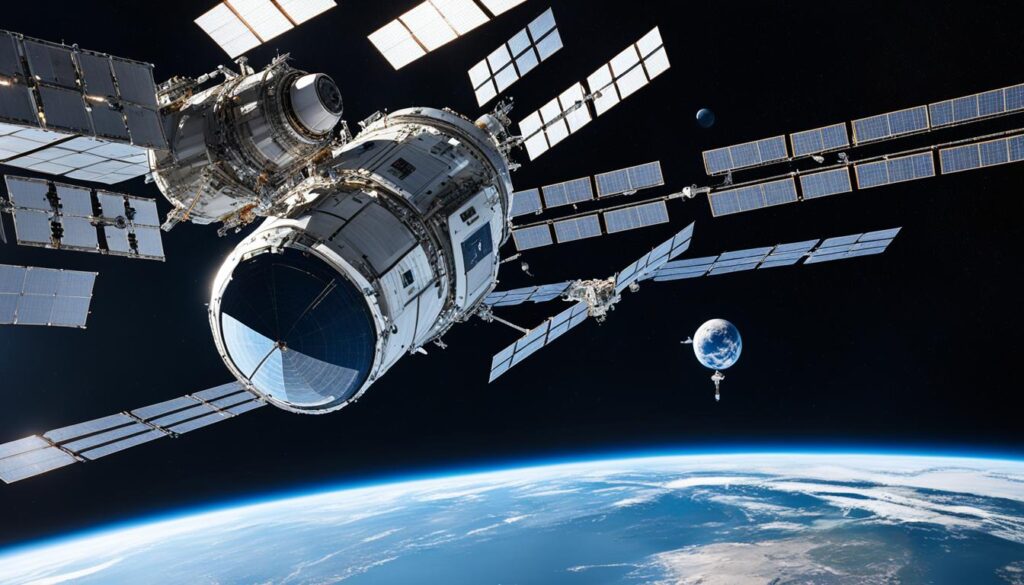
« In 1978, NASA scientist Donald J. Kessler theorized the Kessler Syndrome, predicting an increase in collisions between objects in orbit, resulting in more space debris. »
The U.S. Space Force’s Space Fence
The United States Space Force (USSF) has made a big step forward. They’ve accepted the Space Fence radar system on the Kwajalein Atoll in the Republic of the Marshall Islands. This technology will change how we watch and understand space, giving us better space situational awareness (SSA).
The Space Fence is a top-notch ground radar. It can spot, track, and identify objects as small as a marble in low Earth orbit (LEO). This is a big leap from the old Space Surveillance Network (SSN), which could only see objects bigger than a softball.
This system is already making a difference. It tracked debris from an anti-satellite test by India. By predicting where objects will cross paths, the Space Fence boosts the USSF’s space domain awareness (SDA). It helps protect important space assets.
Lockheed Martin worked on the Space Fence in the Marshall Islands. They showed off their engineering skills and radar tech. With a budget of $1.594 billion (FY15), it’s set to track about 200,000 objects and make 1.5 million observations daily.
The Space Fence helps not just the U.S., but also other countries. It shares data with partners like Australia, Japan, Italy, Canada, France, South Korea, and the UK. It also works with the European Space Agency and Eumetsat.
When the USSF accepted the Space Fence on March 28, 2020, it was a big deal. It’s a step towards better global space awareness and protecting our space-based infrastructure.
The Importance of Space Domain Awareness
With more satellites and space debris, keeping an eye on space domain awareness (SDA) is key. It ensures space operations are safe, secure, and sustainable. SDA means understanding space activities, including what objects in space can do and what they’re up to.
Space Situational Awareness (SSA) is a big part of SDA. It collects data on where and what space objects are. Together with SDA, they help us watch and manage space better. This helps us make smart choices about space traffic, how to use resources, and plan missions.
The U.S. Space Force’s Space Fence is a big help in keeping an eye on space. It gives Space Force leaders the info they need to protect assets. With space being crowded and contested, keeping space superiority and security is key for defense and the economy.
Working with other countries is important for better SDA. Groups like the U.S. Department of Defense, U.S. Air Force Space Command, NASA, and the National Space Defense Center (NSDC) watch over space. They make sure space operations are safe and secure.
As space gets busier, with thousands of new satellites coming, space domain awareness is more important than ever. Knowing what’s in space helps us make smart choices, avoid dangers, and keep space safe for the future.
| Key Aspects of Space Domain Awareness | Importance |
|---|---|
| Monitoring and Cataloging Space Objects | Enables effective management of space traffic and collision avoidance |
| Detecting and Characterizing Space Threats | Crucial for safeguarding critical space infrastructure and national security |
| Predicting and Attributing Space Activities | Supports decision-making and strategic planning for space operations |
| International Collaboration and Information Sharing | Enhances global space security and promotes responsible space stewardship |
By keeping a close eye on space domain awareness, we can keep space safe, secure, and sustainable. This lets us keep exploring space, making new discoveries, and staying connected worldwide.
Protecting Critical Space Infrastructure
The commercial space industry is growing fast, and more satellites are going into orbit. This means we need to protect our space-based infrastructure more than ever. Even a small piece of space junk can harm the important technologies we use for things like satellite communications, GPS, and weather forecasting.
These technologies are key to our daily lives and the smooth running of many industries. They help keep us safe, secure, and connected. That’s why it’s crucial to have good systems to monitor and deal with space junk.
Safeguarding Communications, Navigation, and Weather Forecasting
Space tech gives us many services we can’t live without. It helps with global communication, GPS navigation, and even weather forecasting. These services are a big part of our modern world.
- Satellite communications let us make calls and send data all over the world.
- GPS is key for things like getting around, managing money, and helping in emergencies.
- Weather satellites give us the info we need to prepare for and deal with natural disasters.
Keeping these space services running smoothly is key to our safety and security. That’s why we need good ways to watch out for and stop space junk.
The more satellites we have in space, the bigger the danger from space junk. We need to be proactive in finding and dealing with debris to protect our important space tech.
Sustainable Space Operations
Creating a sustainable future in space means managing space debris well. This needs international work, strict rules, new tech, and a strong space situational awareness system. By tackling orbital debris, we can keep space travel and tech safe for the future.
The ClearSpace-1 mission is a big step towards sustainable space operations. Led by the European Space Agency (ESA), it aims to remove debris from Earth’s orbit on its own. With 90 experts on board, it’s leading the way in cleaning up space and making room for new tech.
Removing debris is just part of the plan. The space world is also working on keeping space clean with better tracking systems. With more satellites going up, managing space debris is more important than ever. NASA and ESA are leading the charge with advanced systems to watch and predict space objects.
For space to stay sustainable, we need to work together and follow the same rules. The 25-year rule is a good start, asking satellites to burn up in the atmosphere after 25 years. But, current rules are not laws and are up to countries to follow.
As more satellites join the sky, making space safe for the future is more urgent. By using new tech, working together, and having strong space debris management plans, we can keep space safe for the next generations.
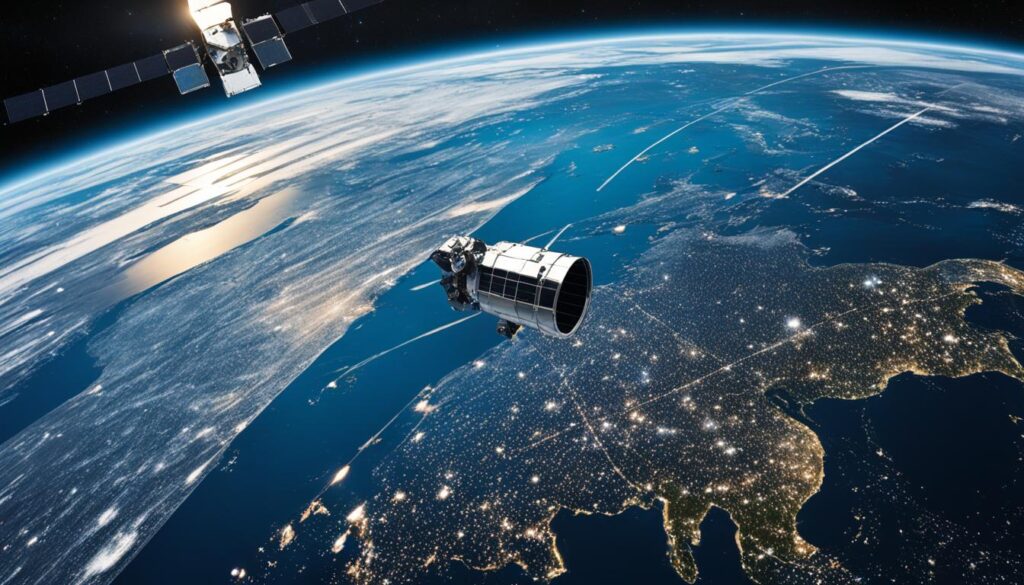
« The ClearSpace-1 mission is a critical step towards a sustainable future in space, demonstrating our commitment to preserving the space environment for generations to come. »
Working towards sustainable space operations is key for our planet and our future. By dealing with space debris now, we protect our space assets, keep vital services running, and open doors for more space discoveries and innovations.
Conclusion
Space junk in Earth’s orbit is a big problem for space activities now and in the future. We need a worldwide effort to tackle this issue. The market for tracking and removing space debris was worth $1.32 billion in 2022. It’s expected to grow by 6.94% each year until 2028, reaching $1.99 billion.
Technologies like the U.S. Space Force’s Space Fence help us track and remove space junk. The space community is working hard to keep our skies safe for the future. It’s important for space agencies, companies, and research groups to work together to find new solutions.
Dealing with space junk is hard because of the costs, the complexity of removing it, and the need for international cooperation. Overcoming these challenges is key to moving forward. If we succeed, we’ll protect important space systems and make space exploration sustainable for the future.
By using the latest technology, working together globally, and making good policies, we can keep the skies safe. This will ensure a secure space for generations to come.