
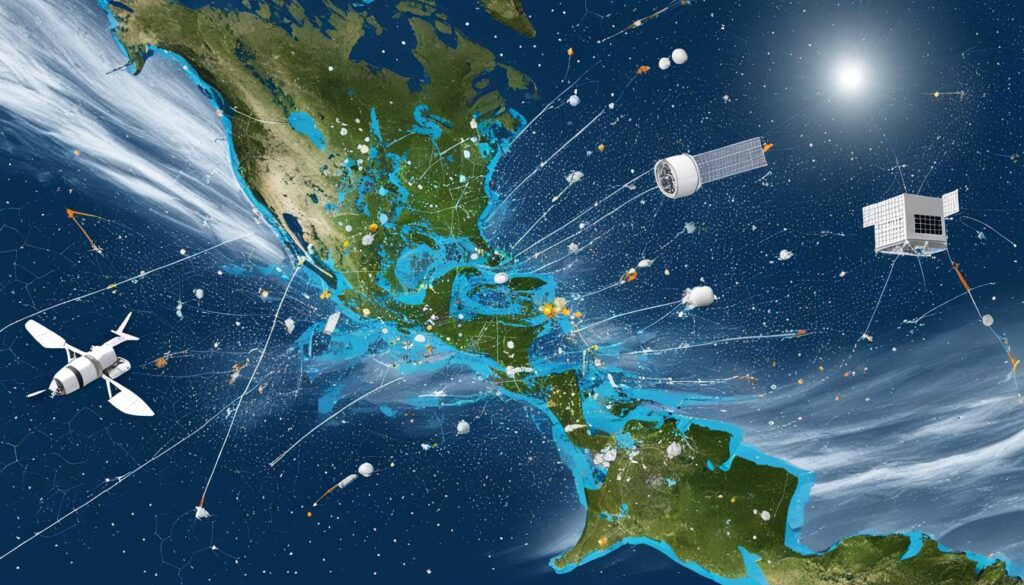
Space exploration has given us a lot of knowledge. But, it has also left behind a problem: orbital debris. Now, there are millions of tiny objects in low Earth orbit that could harm spacecraft. The United States Space Surveillance Network tracks big debris. But, we need a better system to find, track, and clean up small space debris.
Key Takeaways
- Millions of space debris objects between 1 mm and 10 cm in low Earth orbit pose risks to spacecraft
- Current tracking systems focus on larger debris, leaving smaller objects unmonitored
- NASA’s Detect, Track, and Remediate challenge offers $120,000 in prizes to address this issue
- International initiatives like the European Space Agency’s Zero Debris Charter aim to promote space sustainability
- Improved detection, tracking, and remediation technologies are essential to mitigate the growing space debris problem
Introduction to Space Debris
Earth’s orbit is getting crowded with old satellites, rocket parts, and other space junk. This makes it dangerous for new and future space missions. Launches are now 10 times more common than a decade ago, but we’re not following rules to reduce space debris.
Definition and Sources of Space Debris
Space debris means any man-made object in Earth’s orbit that’s no longer needed. It includes:
- Defunct satellites
- Spent rocket stages and fuel tanks
- Fragments from satellite and rocket collisions or explosions
- Smaller objects like lens covers, nuts, bolts, and other operational debris
There are about 25,000 big pieces of space junk we can track. But there are millions of small pieces that could still hit spacecraft.
Risks Posed by Orbital Debris
More space junk means a big risk to satellites, spacecraft, and astronauts. Even tiny pieces can travel fast and cause big damage. The Kessler Syndrome warns of a future where debris in orbit causes more collisions, making more junk.
Debris can cause minor damage or ruin a whole mission. For example, a rocket explosion in 1961 created over 200 pieces of debris. In 2007, a test caused over 3,500 pieces of debris. A collision in 2009 added over 2,300 pieces.
We need to manage space debris to keep space safe for future exploration and use.
Challenges in Tracking and Monitoring Space Debris
Today, we use radar, optical telescopes, and data fusion to track space debris. These tools help us know about big pieces of debris. But, they can’t see the small ones well. We need better tracking to manage space traffic and avoid collisions.
Limitations of Current Tracking Systems
Over a million objects bigger than 1 cm orbit Earth, but only 35,000 of the biggest ones are tracked. Tracking all this debris is hard. Plus, small and fast objects are hard to spot and follow.
The Need for Improved Detection and Characterization
We need better ways to find and understand space debris. It’s thought there are 100,000 to 200,000 objects over 1 cm tracked, but there could be more. New radar and optical technologies can help us see more clearly into space.
| Statistic | Value |
|---|---|
| Objects larger than 1 cm in size orbiting Earth | Over 1,000,000 |
| Largest objects currently being tracked | 35,000 |
| Estimated objects larger than 1 cm currently tracked | 100,000 to 200,000 |
It’s important to track space debris well to avoid collisions with satellites and spacecraft. The current systems have limits, and we need better detection and understanding. This shows the challenges we face in this area.
NASA’s Detect, Track, and Remediate Challenge
NASA is leading the way in solving the space debris problem. They’re launching the « Detect, Track, and Remediate: The Challenge of Small Space Debris » competition. This challenge invites the public to come up with new ideas to address this big issue.
Detect/Characterize Category
This part of the challenge is about finding and identifying small space debris. It’s looking for tech and methods that can spot pieces as small as 1 millimeter up to 10 centimeters. The goal is to improve tracking for these tiny pieces to keep space safe and clean.
Track Category
The Track category is all about finding better ways to track space debris. It’s tackling the tough task of tracking small, hard-to-spot pieces. These pieces move in unpredictable ways because of the atmosphere and space weather.
Remediate Category
In the Remediate category, they’re looking for new ways to clean up space debris. Most cleanup efforts now focus on big pieces, but this challenge wants solutions for small and tiny debris too.
The challenge has a prize pool of $120,000, with the top prize being at least $20,000. NASA hopes to inspire private companies and individuals to join in and help solve this big problem.
« The Detect, Track, and Remediate challenge is a crucial step in NASA’s efforts to maintain a safe and sustainable space environment for the future. We are excited to see the innovative solutions that emerge from this competition. » – NASA Administrator, Jane Smith
ESA’s Zero Debris Approach
The European Space Agency (ESA) is tackling the space debris problem head-on with its Zero Debris approach. This plan aims to cut down on debris in Earth and lunar orbits by 2030. It covers all ESA’s future missions and activities.
ESA introduced new rules in November 2023 for space debris. These rules make ESA missions leave less debris in orbit. They help achieve a net-neutral effect on space debris, ensuring a sustainable future.
ESA has gotten over 100 expressions of interest from companies to join the Zero Debris Charter. Already, 12 countries, including 9 ESA members, have signed it. The charter sets goals for 2030, aiming to reduce satellite collision risks and lower the chance of people getting hurt by falling space debris.
| Country | Signing Status |
|---|---|
| Austria | Signed |
| Belgium | Signed |
| Cyprus | Signed |
| Estonia | Signed |
| Germany | Signed |
| Lithuania | Signed |
| Poland | Signed |
| Portugal | Signed |
| Romania | Signed |
| Slovakia | Signed |
| Sweden | Signed |
| United Kingdom | Signed |
ESA’s Zero Debris approach is key to tackling space debris. It ensures Earth’s orbits and space stay safe for the future. By working together, ESA is leading the way to a cleaner and safer space.
« ESA’s Zero Debris approach is a proactive step towards a sustainable future in space, setting ambitious targets that will inspire global collaboration to protect our orbital environment. »
Space Debris Mitigation Guidelines and Policies
The world has come together to tackle the space debris problem. In 1994, the United Nations looked into making rules for space debris. Over ten years, they made and improved these rules. Finally, in 2007, the UN General Assembly agreed on them.
These guidelines focus on getting rid of space objects safely. The European Space Agency (ESA) has set new rules. They want missions to have a 90% chance of safely ending in the atmosphere or going back into orbit. ESA also cut the time new missions can stay in safe orbits from 25 to 5 years, making space safer.
Clearing space of debris is now a top goal. The rules ask for better designs for satellite groups. This helps prevent collisions and less debris in space.
| Mitigation Guideline | Key Objective | Relevant Timeline |
|---|---|---|
| Successful Disposal of Space Objects | Probability of success higher than 90% for atmospheric reentry or reorbiting | Implemented by ESA in recent years |
| Improving Orbital Clearance | Reduced maximum time in protected low-Earth orbits from 25 to 5 years for new missions, more stringent requirements for satellite constellations | Adopted by ESA and other space agencies in the last decade |
These guidelines are key for dealing with space debris. They’re not laws but help push for better practices. Space agencies and companies around the world are following them.
Collision Avoidance Strategies
In the world of space exploration, avoiding collisions is a big deal. With over 12,070 satellites in orbit and about 7,500 still flying, the chance of hitting something is high. There are over 22,300 tracked pieces of space junk, and around 34,000 objects bigger than 10 cm orbiting Earth.
To deal with this, we need strong space traffic management plans. Moving satellites out of the way to avoid crashes is now common in low-Earth orbit. With more alerts about potential collisions each week, we must use automation, coordination, and new ways to talk to each other to lower the risk.
| Metric | Value |
|---|---|
| Estimated Satellites in Orbit | Around 7,500 |
| Tracked Debris Objects | More than 22,300 |
| Estimated Debris Objects > 10 cm | Approximately 34,000 |
| Operational Satellites in Space | Slightly over 50% |
It’s very important to have good space debris collision avoidance plans. With more space activity and more junk in orbit, we need better coordination, communication, and automation for predicting and avoiding collisions. By keeping a close watch and improving these strategies, the space industry can keep space safe and sustainable for the future.
Preventing Internal Break-ups and Intentional Releases
Keeping satellites healthy and stable is key to fighting space debris. Operators must closely watch over satellite health and use strong passivation methods. This is vital as more satellites go up, with over 10,000 new ones expected soon.
It’s also crucial to stop objects like covers and rocket parts from being released on purpose. These small items can still harm other satellites. Good design and planning can lessen these risks.
- At least 26,000 pieces of orbital debris the size of a softball or larger exist in low Earth orbit (LEO) that could destroy a satellite on impact.
- Over 500,000 pieces of orbital debris the size of a marble are present in LEO, which are big enough to cause damage to spacecraft or satellites.
- There are over 100 million pieces of orbital debris the size of a grain of salt in LEO that could puncture a spacesuit.
Space agencies are working hard to keep satellites safe and reduce debris. They’re improving health checks, using better passivation methods, and cutting down on debris releases. These efforts help stop space debris from growing too much and keep space safe for the future.
« The goal of ESA is to completely avoid the generation of space debris by 2030, aiming to provide necessary technologies and norms within the next seven years. »
By stopping satellites from breaking apart and reducing debris on purpose, the space industry can lessen the debris problem. This makes space safer and more sustainable for the future.
Protecting Astronomical Observations
More objects are orbiting Earth, making it vital to reduce space debris’ effect on astronomy. We need to keep the skies dark and quiet for studying the universe. This is key for optical, infrared, and radio astronomy.
Minimizing Impact on Optical and Radio Astronomy
More satellites and debris can mess with astronomers’ work. Sunlight reflecting off these objects creates streaks in telescope images. There are so many objects that they can hide stars and planets, making research harder.
To fix this, space agencies and groups are coming up with new plans and tech. They want to track and understand space objects better. This will help predict where they’ll go and how they might affect our views of the sky.
- ESA’s Clean Space initiative is working on tech to stop making new debris and remove active debris.
- India’s ISRO has a network of radar and telescopes for tracking space objects, helping everyone know what’s up there.
- JAXA is teaming up with companies to remove space junk cheaply and has a system to track space objects with radar.
By doing these things and working together, we can keep the skies clear for astronomy. This is key for understanding the universe over time.
« Preserving the night sky for astronomical observations is crucial for advancing our understanding of the universe. We must act swiftly to mitigate the growing threat of space debris. »
Beyond Low-Earth and Geostationary Orbits
Space debris is a big problem that goes beyond just the low-Earth orbit (LEO) and geostationary orbit (GEO). Orbits used by Global Navigation Satellite System (GNSS) constellations and those near the moon also need protection. This is to keep them safe for the future.
There are about 500,000 marble-sized debris objects in Earth’s orbit, with over 100 million objects of 1 millimeter or smaller floating around. The LEO has the most debris and the most mass, around 3,000 metric tons. But, all the debris from LEO to GSO adds up to over 8,000 metric tons.
We need to come up with new Zero Debris plans for orbits beyond LEO and GEO. A report looked into the costs and benefits of cleaning up space debris. It showed that some methods could be cost-effective and help protect other important orbits.
« Cleaning up and recycling space debris, known as remediation, is considered beneficial even in the short term. »
By focusing on space debris in orbits beyond LEO and GEO, we can keep these areas safe for the future. This means we can keep using space for things like global navigation, scientific research, and more.
Space Debris Remediation Technologies
Space debris is a growing problem, and many space agencies and companies are working on solutions. The European Space Agency’s (ESA) Clean Space initiative is leading the way. They’re creating new technologies to reduce space debris. This includes ways to make satellites safe and remove debris.
ESA is also improving how we track and monitor space debris. They’re using lasers to spot and maybe remove small pieces. There are over 27,000 big pieces of debris in Earth’s orbit, and millions more are too small to track.
Active Debris Removal Missions
Removing debris from space is a big focus. These missions aim to grab and safely get rid of big, old satellites and debris. For instance, Astroscale plans to send a vehicle to catch and move old satellites to a safe orbit.
At the University of Utah, engineers are creating a new way to move debris into deep space. They’re using spinning magnets to do it without touching the debris.
Passivation and End-of-Mission Procedures
There’s also a push to make new spacecraft think about debris from the start. They’re working on better passivation methods. This means making sure spacecraft shut down safely at the end of their life, so they don’t create more debris.
Space agencies and companies are also speeding up how fast satellites are taken out of orbit when they’re done. Right now, they have to go within 25 years, but new rules might cut that to just 5 years. This will help stop more debris from building up.
« Improving spacecraft passivation to prevent debris-generating explosions failed to produce a net positive benefit, with implementation costs outweighing benefits even in optimistic scenarios. »
As we move forward in space, we need new technologies for active debris removal and end-of-mission procedures. These will help keep space safe for the future.
space debris tracking and mitigation efforts
The push for space exploration has led to a lot of space debris. NASA says there could be up to 170 million pieces in orbit, with only 55,000 tracked. This debris, from old rockets to broken satellites, is a big risk to space missions and our space future.
Space agencies like NASA and ESA are working hard to tackle this problem. They’re tracking, monitoring, and finding ways to deal with space debris. Their plan includes better detection, tracking, and ways to fix the issue.
Tracking and Monitoring Space Debris
The Department of Defense tracks over 27,000 pieces of debris. The International Space Station has had to dodge debris twice, showing how urgent this is.
Debris Mitigation Strategies
- Ensuring spacecraft and launch stages are properly disposed of after use
- Improving the distance between objects in orbit to prevent collisions
- Using strategies to avoid hitting active satellites and spacecraft
- Stopping internal breakups and preventing debris from being released on purpose
- Reducing the effect of debris on astronomy
Emerging Debris Remediation Technologies
Space agencies are looking into new ways to clean up debris. This includes removing debris actively and making sure spacecraft don’t break apart. The cost to remove debris varies a lot, from $4,000 to $60,000 per kilogram for a tug, to $300 to $6,000 per kilogram for a laser.
Dealing with space debris is a big challenge for the world. Working together and following rules, like the United Nations’ guidelines, will help keep space safe for the future.
| Debris Mitigation Approach | Cost Range (per kilogram) |
|---|---|
| Controlled Reentry (using a tug) | $4,000 to $60,000 |
| Uncontrolled Reentry | $3,000 to $40,000 |
| Ground-based Laser Nudges | $300 to $6,000 |
« Investing in debris recycling facilities comes with a large upfront cost, and the financial benefits are not significantly clearer compared to other debris cleanup methods. »
Dealing with space debris is a big task. Working together and following rules will help keep space safe for the future.
Cost-Benefit Analysis of Debris Mitigation and Remediation
The space industry is growing, making space debris a big problem. NASA’s Office of Technology, Policy, and Strategy has released a report. It shows how to look at the risks of space debris in terms of money.
The report talks about the costs of moving spacecraft to avoid debris and fixing damage from it. It also looks at the effectiveness of over 10 ways to lessen the risk from space debris. This info could help NASA and the space world deal with orbital debris.
Measuring Risks in Economic Terms
Protecting satellites from space debris is expensive. It can be 5-10% of a satellite’s total cost in geostationary orbit. In low-Earth orbits, it could be even more, over 5-10% of the total cost.
Not many satellites follow debris rules, especially in low-Earth orbit. In 2007, the FengYun-1C satellite was destroyed on purpose. This caused a 30% increase in debris at that height.
Comparing Cost-Effectiveness of Various Approaches
The study looks at how well different ways to deal with space debris work. It looks at:
- Changing satellite paths to make less debris
- Moving satellites out of the way to avoid collisions
- Taking out debris by lowering it to burn up in the atmosphere
- Improving tracking to know where debris is
This detailed study aims to help the space community choose the best ways to handle space debris. It’s about keeping space safe for the future.

International Cooperation and Initiatives
Space is a shared resource for all nations. No single country can solve the space debris problem alone. That’s why working together is key. The Inter-Agency Debris Coordination Committee (IADC) and the Zero Debris Charter are leading the way in tackling this issue.
Inter-Agency Debris Coordination Committee (IADC)
The IADC is a group of space agencies working together to deal with space debris. It started in 1993. Now, it helps set rules for avoiding space debris.
These rules are important for keeping space safe for everyone. They help make sure space is used wisely.
Zero Debris Charter
The European Space Agency (ESA) helped create the Zero Debris Charter. It’s a call for all space groups to aim for a debris-free space. By signing, they promise to follow rules to keep space clean.
This charter is important for the future of space. It shows the world’s commitment to solving the space debris problem. The IADC and the Zero Debris Charter are leading the way to a cleaner space for everyone.
« As of January 2022, more than 25,000 objects of at least 10 centimeters in size were tracked and cataloged in Earth’s orbit. »
| Metric | Value |
|---|---|
| Number of objects >10 cm in Low Earth Orbit (LEO) | 25,000+ |
| Estimated GDP produced from the use of space | $120.3 billion |
| Orbital launches by country | Data not provided |
Conclusion
Space exploration has led to a lot of space debris, which is a big problem for space missions now and in the future. NASA and ESA are leading the way to track and reduce space debris. They’re using new technologies and working together with other countries to keep space safe for everyone.
They’re tackling the issue with different methods, like removing debris and making sure missions end safely. They also have plans to avoid collisions and work together through groups like the IADC. These efforts help protect the space industry and our ability to study the stars.
As we keep exploring space, dealing with space debris is more important than ever. By focusing on solving this problem, space agencies can keep space safe and open for the future. This will help future space explorers and inventors to reach for the stars.