
Spacecraft collision avoidance is about making sure satellites don’t crash into each other in space. It includes stopping space debris from building up, predicting where collisions might happen, and moving satellites to safety. If satellites collide, it can be very dangerous because they move so fast.
To keep satellites safe, operators and agencies use many techniques. They watch the space around them, figure out the risks, and act to prevent crashes. This means they use advanced tools to track satellites and space junk. By doing this, they can avoid dangerous situations.
Key Takeaways
- Satellite collision avoidance is key to keeping space safe and open for everyone.
- It involves watching the space around us, checking for risks, and moving satellites to avoid crashes.
- Using advanced tools to understand orbits and the space environment helps predict and prevent collisions.
- There are ways to remove debris and dispose of old satellites safely to keep space clean.
- Working together to manage space junk is important for the future of space travel and exploration.
Introduction to Spacecraft Collision Avoidance
Spacecraft collision avoidance is key in modern space work. With more satellites and debris in orbit, the chance of big crashes is rising. The growing debris is a big threat to working spacecraft. It could lead to the Kessler syndrome, where many satellites crash, making space hard to use.
The Necessity of Collision Avoidance Measures
Only about 4,700 of over 12,000 satellites launched are still working. The rest could become debris. Small things like micrometeoroids and paint can also hurt spacecraft. We need good space debris mitigation and ways to avoid collisions to deal with these risks.
Risks Posed by Orbital Debris and Collisions
The 2009 crash of the Iridium-33 and Kosmos-2251 satellites made over 823 pieces of debris and two clouds in Low Earth Orbit (LEO). This showed we need strong spacecraft collision avoidance to stop such big problems. We must keep space safe for future use.
| Statistic | Value |
|---|---|
| Number of countries owning and operating spacecraft | Over 86, a twofold increase from 2010 |
| False alarm rate for collision avoidance screening services | High, impacting trust in alerts by satellite operators |
| Likelihood of collision avoidance responses | Affected by factors like mission type, propulsion, maneuverability, and collision avoidance support |
« Miscommunications between operators have led to numerous near-misses between satellites in orbit. »
We need good space situational awareness and ways to avoid collisions. This keeps space safe and usable for the future.
Understanding Orbital Mechanics and Debris
Orbital mechanics is key to understanding space debris and its dangers. Spacecraft move at speeds over 7.8 km/s in low Earth orbit. This speed makes collisions very dangerous, causing objects to break into many small pieces.
Orbital Velocities and Kinetic Energy Involved
When objects collide in low Earth orbit, they can hit each other at up to 12.2 km/s. This speed means a huge amount of kinetic energy, leading to severe damage. There are over 25,000 objects bigger than 10 centimeters in low-Earth orbit, showing the big problem of space debris.
| Metric | Value |
|---|---|
| Tracked Objects in LEO | More than 25,000 (>10 cm) |
| Relative Collision Velocity in LEO | Up to 12.2 km/s |
| Collision Avoidance Maneuvers per Year (ESA) | 12 on average |
| Reentry of Larger Objects | About once a week |
| Reentry of Small Tracked Debris | About two per day |
We need strong strategies to avoid collisions with space debris. Research, like a $600,000 NASA project, is looking into new ways to protect spacecraft. These include using dust clouds to dodge debris.
Prevalence of Space Debris and Collision Events
Space is getting more crowded with space debris, which is a big threat to working spacecraft. There are over 22,300 pieces of debris bigger than 10 cm in Earth’s orbit, says the United States Space Surveillance Network. This number gets even scarier when looking at smaller pieces, with hundreds of thousands between 1-10 cm and millions between 1 mm and 1 cm.
Estimated Quantity of Space Debris in Earth’s Orbit
Small, fast-moving objects can cause big problems if they hit active satellites. A major collision happened in 2009, between a Russian satellite and an Iridium communications satellite. This created over 1,000 new pieces of trackable debris. It showed how dangerous space debris can be and why we need to avoid collisions.
In the next ten years, we might see many more satellites in space, with thousands of new ones planned. Most of the space debris comes from explosions and collisions. Losing a spacecraft can cause big problems on Earth, like losing important satellite services. And hitting untrackable debris can even lead to losing human lives.
Even though we know about this problem, not many follow the rules to reduce space debris. We could improve by tracking better with new tools and working together more. Also, using insurance and fees could encourage people to be more careful in space.
« Collision with an untrackable piece of debris can result in the loss of human lives. »
Mitigating Risks: Best Practices and Methods
Satellite operators around the world are taking steps to reduce space debris. They make sure satellites don’t stay in orbit longer than needed. This includes using suborbital trajectory disposal, deorbiting in low Earth orbit, and putting satellites in graveyard orbits when they’re done working.
There’s a big problem with space debris because more satellites are being launched now than before. Many aren’t following rules to reduce space debris. This means more alerts about space debris, which is dangerous for satellites and people in space.
Big space agencies and groups are doing something about it. The European Space Agency’s (ESA) Clean Space initiative is working on technologies to reduce space debris. ESA also helped create the Zero Debris Charter with over 40 space experts to help everyone work together on this issue.
It’s important to avoid collisions in space to keep space safe and sustainable. The Space Safety Institute (SSI) and Aerospace are key in making rules and tools for dealing with space debris.
« Debris tracking and mitigation are critical for ensuring the safety and sustainability of space operations. Lack of space traffic coordination can result in a rapid increase in space debris, leading to potential losses in space missions. »
As more companies join the space industry, dealing with space debris is more important than ever. By working together and following best practices, we can keep space safe and sustainable for everyone.
Suborbital Trajectory Debris Disposal
Objects launched on suborbital trajectories, like sounding rockets and rocket stages, quickly fall back to Earth. They burn up in the atmosphere before they can reach orbit. The Space Shuttle’s tank, for example, breaks off and burns up during atmospheric reentry.
Reentry and Disintegration of Suborbital Objects
Unlike objects in orbit, suborbital objects don’t have enough speed to stay in space. They follow a curved path, enter the atmosphere, and break apart. This happens because of the heat and pressure during debris disposal.
This process is key to managing space debris. By making launch vehicles and parts break apart safely, we can reduce the impact on space.
| Metric | Value |
|---|---|
| Moving to a 15-year post-mission disposal timeframe | Could potentially produce up to $6 billion in net benefits over 30 years. |
| Immediate deorbiting of spacecraft after their missions | Could yield up to $9 billion in net benefits, although with lower cost-benefit ratios. |
| Cost-benefit ratios for debris remediation techniques | Are comparable to the most promising debris mitigation approaches. |
| Techniques like spacecraft passivation | Did not demonstrate a net positive benefit over 30 years, with implementation costs outweighing the benefits. |
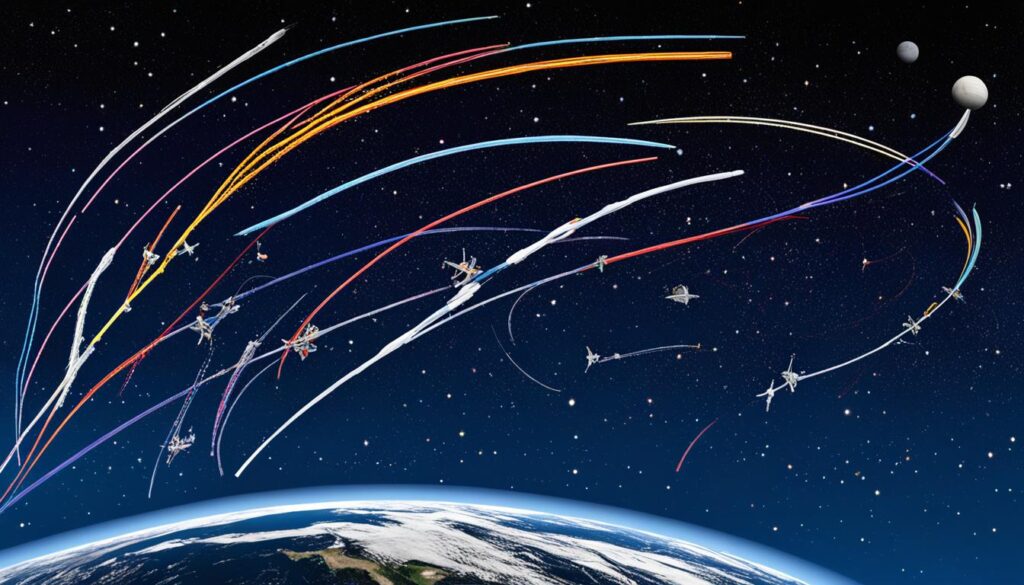
By designing launch vehicles and spacecraft to break apart safely, we can manage debris disposal better. This reduces the long-term effect on space.
Low Earth Orbit (LEO) Satellite Deorbiting
Most artificial satellites are in the low Earth orbit (LEO), where they can safely reenter the atmosphere. They use up their fuel to fall back to Earth at the end of their life, reducing space debris. This helps keep the space around us clean.
Satellites above 700 km stay in orbit for decades, and those over 800 km can last centuries. But satellites below 400 km fall back to Earth within a year because of the atmosphere. The altitude and deorbiting times in LEO are as follows:
- Lower Low Earth Orbit or L-LEO: Altitude of 400 km and lower, deorbiting time less than a year.
- Middle Low Earth Orbit or M-LEO: Altitude between 400 and 600 km, deorbiting time less than 25 years.
- Upper Low Earth Orbit or U-LEO: Altitude of 600 km and higher, deorbiting times spanning from 25 years to millennia.
The current rule says satellites should be deorbited within 25 years. But, using thrusters at higher altitudes is suggested. Also, adding devices for removing debris is a good idea, especially in higher orbits.
| Altitude Range | Deorbiting Time |
|---|---|
| Below 400 km (L-LEO) | Less than 1 year |
| 400 – 600 km (M-LEO) | Less than 25 years |
| Above 600 km (U-LEO) | 25 years to millennia |
There are over 4,800 satellites in orbit now, most being commercial ones in LEO. It’s important to deorbit them on time to keep space clean for future use.
Medium Earth Orbit and Higher Altitude Disposal
Satellites moving beyond low Earth orbit face big challenges. They go into medium Earth orbit (MEO) and geostationary orbit (GEO). These orbits are too high for onboard propulsion to slow down the spacecraft for a controlled reentry.
The « 25-Year Rule » for Deceleration and Reentry
The world has set the « 25-year rule » for satellites in lower MEO. It means satellites should naturally slow down and fall out of orbit within 25 years after they stop working. This lets them slowly drop in altitude and reenter the atmosphere safely, usually in the remote South Pacific « spacecraft cemetery ».
This rule is key to dealing with debris in medium Earth orbit and geostationary orbit. It helps prevent objects from staying in space for centuries. By deorbiting satellites on time, we can reduce the risk of collisions and protect working spacecraft.
« The program will estimate and limit the probability of collision with objects 10 cm and larger to less than 0.001 (1 in 1,000) during orbital lifetime. »
The world has also set rules and best practices for making spacecraft. These include:
- Keeping debris bigger than 5 mm to a minimum
- Showing a low chance of explosions that could create debris
- Reducing the risk of hitting other objects in space
- Designing spacecraft to avoid collisions with small space debris
Following these rules and the 25-year rule helps make space safe for future space missions.
Graveyard Orbits for Geostationary Satellites
The geostationary orbit (GEO) is a key spot in space, with only a few spots available. To keep it clean, satellites are moved to higher « graveyard orbits » when they retire. This keeps the area clear for new satellites.
These orbits are about 300 kilometers above the GEO belt. They are far from active satellites. Moving satellites here at the end of their life is key to keeping space clean.
The graveyard orbit has many benefits. It clears out old satellites, making room for new ones. It also lowers the chance of collisions, which could create harmful space debris.
Keeping a satellite in a geostationary orbit means constantly adjusting its position. When it’s no longer needed, it’s moved to a higher orbit. This keeps the orbit clear for others.
Moving a GEO satellite to a graveyard orbit is a detailed process. First, it’s raised 300 kilometers to get out of the way. Then, any fuel left is vented to prevent explosions. Finally, the satellite is shut down to avoid causing trouble.
By planning how satellites end their lives, we can keep the GEO orbit useful for the future. This careful planning is key for a sustainable use of space technology.
« Coordination with neighboring satellites operators is essential to anticipate emergencies. »
Dealing with Spent Rocket Stages in Orbit
The issue of orbital debris is a big problem for space. Spent rocket stages are a major part of this problem. They are left in orbit and can stay for years, adding to the debris.
Modern Rocket Design for Debris Mitigation
Now, new rocket designs aim to reduce the impact of their upper stages on debris. SpaceX’s Falcon 9 is a great example. The first stage comes back to Earth quickly, and the second stage either goes into a safe orbit or breaks down on its own. This helps lessen the debris problem.
It’s thought there could be up to 170 million pieces of debris in space, most too small to see. Of the pieces we can track, over 27,000 include rocket boosters, working satellites, and dead satellites. The Department of Defense tracks these with their Space Surveillance Network.
Dealing with rocket stages in orbit is key to keeping space safe for future use. New rocket designs that focus on reducing debris are vital. Along with tracking and removing debris, this is how we keep space safe for everyone.
« The fear of the Kessler syndrome, where space collisions lead to an unstoppable cascade of debris, poses a significant risk to the usability of low Earth orbit for future space missions, including Earth observation. »
Collision Prediction and Tracking Methods
Keeping satellites safe from collisions is key in the fast-growing space industry. Predicting collision risks uses detailed databases from the United States Department of Defense Space Surveillance Network. This network tracks the location and speed of objects in space. By knowing these details, we can predict where objects might meet and avoid collisions.
Space Surveillance Network and Orbital Projections
The Space Surveillance Network uses ground and space sensors to find, track, and list objects in Earth’s orbit. This info helps make predictions about where objects might go, helping satellites avoid each other. But, predicting orbits far ahead is tricky because many things can change their path, like gravity.
To solve this, teams use smart algorithms and models to plan how satellites can move to avoid each other. These plans aim to save fuel and keep satellites working well. Sometimes, satellites have systems that can move on their own to dodge other objects.
Working together, satellite teams and space agencies set rules for avoiding collisions and managing space debris. This helps keep space safe for everyone. As more people use space, making sure we can predict where things will be and avoid collisions is more important than ever.
« The lack of progress in preventing collisions remains stagnant, despite the growing market for space-enabled data and services. »
satellite collision avoidance strategies
Collision Avoidance Maneuvers for LEO and GEO Satellites
Researchers have come up with strategies to help satellites avoid collisions in low Earth orbit (LEO) and geostationary orbit (GEO). These strategies use the satellite’s propulsion to change its orbit slightly. This helps the satellite avoid a collision. It’s important to use less fuel and keep the satellite in the right place after moving.
NASA’s $250 million HelioSwarm mission is set to launch in 2028. It will study solar wind turbulence. The Starling mission was moved 10 kilometers higher because of SpaceX Starlink satellites in that orbit.
Ground-based software will alert satellites about possible collisions and help plan how to avoid them. The Starling mission will test these strategies in a six-month experiment. It aims to show how satellites can communicate, navigate, and work together.
Moriba Jah, an expert at the University of Texas at Austin, says automatic collision-avoidance is crucial. With more satellites in space, the current systems are struggling with data flow. There’s not enough time to send and receive information for making quick decisions.
- NASA’s $250 million HelioSwarm mission is planned to launch in 2028 to study solar wind turbulence.
- Starling mission was initially intended for an orbital altitude of 555 kilometers but was adjusted by 10 kilometers higher due to SpaceX Starlink broadband satellites operating in that orbit.
- Conjunction-analysis software on the ground will automatically alert satellites of possible collisions and prompt maneuver planning.
- Starling mission focuses on demonstrating swarm communications, navigation, and autonomy through a six-month series of experiments.
- Moriba Jah, an associate professor of aerospace engineering at the University of Texas at Austin, emphasizes the importance of automatic collision-avoidance strategies due to the anticipated increase in spacecraft in low Earth orbit.
By using these strategies, satellites in both LEO and GEO can move safely in a crowded space. This makes space safer for everyone.
Geostationary Orbit Collision Avoidance Constraints
Satellites in the geostationary orbit (GEO) face unique challenges when it comes to avoiding collisions. They must stay in their assigned spots to avoid problems with other satellites. This makes avoiding collisions a tricky task.
Station-Keeping Requirements and Fuel Optimization
Geostationary satellites need to stay in a specific area to not mess with other satellites. After avoiding a collision, they must quickly get back to their spot. This fast move uses up their limited fuel, which is key for staying operational.
To save fuel, satellite operators plan and execute collision avoidance carefully. They use complex math and work with other satellites to make sure avoiding collisions is smooth and efficient.
| Statistic | Value |
|---|---|
| Geostationary region objects (end of 2012) | 1,369 |
| Operational geostationary satellites with object encounters | Variable by satellite location |
| Projected increase in operational satellites (next 5 years) | Double or triple |
More satellites and space junk in the geostationary region make it crucial to have good collision avoidance plans. By being smart with fuel and position, satellite operators can keep the GEO area safe for the future.
Chemical Propulsion for Collision Avoidance
Many satellites use chemical propulsion to quickly change their orbit. This is key to avoiding collisions in crowded space. Geostationary satellites do regular maneuvers to stay on track and avoid collisions. These maneuvers help save fuel.
Chemical propulsion is great for avoiding collisions. It can make quick changes to the orbit. This is super useful in the Low Earth Orbit (LEO) where there’s a lot of space junk.
But, chemical propulsion has its downsides. Doing too many maneuvers eats up a lot of fuel. This shortens the satellite’s life. So, planning carefully is key to staying safe without using too much fuel.
« Incorporating collision avoidance into regular orbital control procedures is an important consideration for minimizing fuel consumption. »
Using chemical propulsion with other technologies can help save fuel. By combining different propulsion methods, satellites can avoid collisions better. This makes space operations more sustainable.
Electric Propulsion for Collision Avoidance
More satellites are going into orbit, making the risk of collisions higher. Traditional chemical propulsion has been used for moving satellites and avoiding collisions. But, electric propulsion is now a strong contender.
Electric propulsion (EP) systems have big advantages over chemical ones. They use higher fuel efficiency, so satellites need less propellant and can be designed better. But, EP thrusters have lower thrust than chemical engines. This means they might not be quick enough for avoiding collisions.
Advantages and Limitations of Electric Thrusters
Over 200 geostationary satellites now use electric propulsion systems. They benefit from improved fuel efficiency. This efficiency comes from using electrical energy to speed up the propellant, usually xenon gas. Chemical propulsion, on the other hand, uses chemical energy from burning propellant. This leads to lower efficiency and shorter fuel life.
Electric thrusters save a lot of fuel, but they can’t accelerate as fast as chemical systems. This makes it hard for EP satellites to quickly change direction for avoiding collisions. It’s important to plan carefully with EP’s limits in mind to keep satellites safe.
| Metric | Chemical Propulsion | Electric Propulsion |
|---|---|---|
| Specific Impulse (Isp) | 230-280 seconds | 1,800 seconds |
| Thrust | High (Newtons) | Low (Millinewtons) |
| Fuel Efficiency | Lower | Higher |
| Collision Avoidance Maneuverability | Rapid | Slower |
The use of electric propulsion for satellite collision avoidance will grow in importance. Knowing the advantages and limitations of this tech helps satellite operators keep their spacecraft safe and working well in crowded orbits.
Novel Approaches: Targeted Dust Cloud Deployments
Researchers are looking into new ways to deal with space debris. They want to stop satellites from crashing into each other. They plan to use dust clouds from space to change the path of debris.
This method is better than old ways because it works fast and can be changed for each problem. Computers help figure out how to make the dust clouds work best.
Computational Modeling and Analysis of Dust Remediation
Scientists use computers to test how dust clouds can move debris. They study how the dust, debris, and space around it interact. This helps them make the best plans to avoid collisions.
Computers analyze how the dust cloud can change the debris’ path. They look at speed, energy, and when to release the dust. This makes the dust cloud work better at avoiding collisions.
| Key Statistic | Value |
|---|---|
| Collisions among large cataloged objects | Statistically occur every 5 to 10 years |
| Collisions among cataloged objects that cannot be avoided due to non-maneuverability | 86% |
| Potential collisions involving one very large non-maneuverable object | More than half |
| Collisions involving objects lighter than 100 kg | 80% |
| Collisions involving objects lighter than 1 ton | 95% |
Creating dust cloud strategies is a big step in cleaning up space. By using computers and new ideas, scientists aim to make space safer. This will help us use space for a long time.
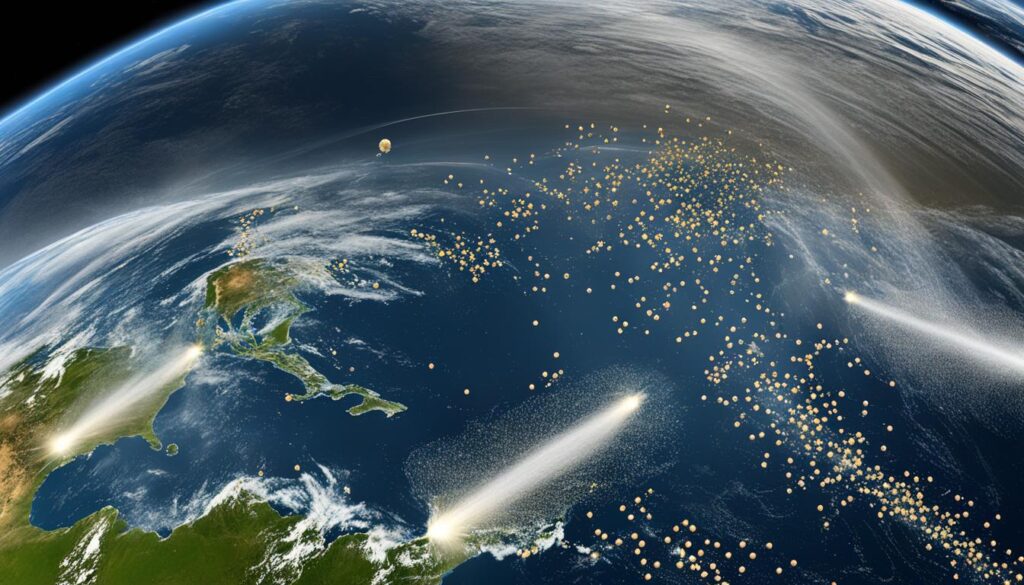
Research and working together are key to improving dust cloud methods. The DANA partnership is an example of this. As space technology grows, these new ways could really help reduce space debris risks.
Conclusion
Effective satellite avoidance strategies are key to protecting space assets and ensuring safe space access. With the growing space debris problem, spacecraft operators use many best practices. These include disposing of suborbital trajectories, deorbiting in low Earth orbit, and using graveyard orbits for geostationary satellites.
Methods for predicting and tracking collisions, and strategies for avoiding them, are getting better. This helps lower the risk of big impacts. Collision prediction and tracking are important for keeping space safe.
New ideas, like deploying targeted dust clouds, show promise for better collision avoidance. Space debris mitigation efforts are vital for a sustainable space future. By tackling the orbital debris management issue, satellite operators can protect space technology and open new space exploration and commerce paths.
The space industry is growing, making strong and flexible satellite collision avoidance strategies more important. By leading in this area, space agencies, commercial operators, and scientists can keep the space environment safe for the future.