
Outer space around Earth is getting crowded with satellites, dead satellites, and space junk. This is a big risk to safe space activities. « Space junk » includes objects made by humans that are no longer useful, like old satellites and spacecraft parts. Over the last 60 years, the amount of space junk has grown a lot.
This is because more satellites and objects are being sent into space. Also, some explosions and collisions happen on purpose or by accident.
Key Takeaways
- Orbital debris monitoring is crucial for maintaining the safety and sustainability of space operations.
- Launch rates have increased 10-fold in the past 10 years, escalating the risk of collisions and debris generation.
- Stricter debris mitigation guidelines, such as reduced end-of-life orbital lifetimes, aim to curb the growth of orbital debris.
- Improved collision avoidance strategies are necessary to address the rising number of collision alerts and the escalating risk.
- Space agencies and private entities are collaborating to develop advanced technologies and policies for effective debris monitoring and mitigation.
Introduction to Orbital Debris Monitoring
Orbital debris, also known as « space junk, » is a big problem in space. It includes old satellites and pieces from broken spacecraft. As more satellites and space missions happen, the debris in space has grown. This is a big risk to working satellites and the future of space use.
Definition and Overview of Orbital Debris
Orbital debris means any man-made object in space that is no longer needed. This includes old satellites, rocket parts, and pieces from crashes or explosions. There are millions of these pieces in low Earth orbit, where many satellites and the International Space Station are.
Importance of Monitoring and Mitigating Orbital Debris
- More debris means a risk to important space services like weather forecasts, phone calls in space, and finding your way around the globe.
- Running into debris can hurt or break satellites, which could affect our daily lives on Earth.
- The Kessler syndrome, where too many objects in space cause more collisions, is a big worry. We need to watch and fix this.
- Just trying to stop more debris isn’t enough. We need to work together worldwide to fix the problem.
We must keep an eye on the debris and come up with smart ways to deal with it. This will help protect our space stuff and keep space safe for the future.
Growth of Orbital Debris: A Global Concern
Space activity is growing fast, causing more orbital debris. This debris threatens space operations and the future of space. Launches are now 10 times more common than a decade ago, but debris rules are not being followed well. Even if we stopped launching new missions, debris would still increase because big pieces break into smaller ones.
Increasing Launch Rates and Debris Generation
The space industry is booming, with up to 60,000 satellites expected in near-Earth orbit by 2030. This growth means more debris. Now, there are about 1 million pieces of debris that are 1 cm and larger. The total mass of debris in near-Earth orbit is around 6,300 tonnes.
Potential Consequences of Unchecked Orbital Debris Growth
More debris means we could lose critical space-based services like weather forecasting, telecommunications, and GPS. Airbus wants everyone in the space industry to follow the same sustainability rules. The ESA warns that if we keep making debris at this rate, some orbits will be too crowded to use, threatening our future in space.
Dealing with orbital debris is a global problem that needs teamwork from space agencies, companies, and international groups. Voyager Space Holdings believes we need clear rules for safe behavior in space to prevent debris and collisions. Groups like the IADC and the U.S. Government’s ODMSP are working to reduce debris and ensure space operations can continue safely.
Managing orbital debris is a big challenge that needs everyone in the space industry to work together. By controlling the growth of space activity and debris, we can make space safer and more sustainable for all.
orbital debris monitoring: Tracking and Cataloging Space Objects
In Earth’s orbit, millions of pieces of debris threaten satellites and space missions. These include over 26,000 pieces as big as a softball, which could destroy a satellite. There are also over 500,000 pieces as big as a marble that could cause damage, and over 100 million pieces as small as a grain of salt that could harm a spacesuit.
These objects need careful space object tracking and detection.
Radar Systems and Optical Telescopes for Debris Detection
To track these objects, radar systems and optical telescopes are used. These tools work hard to find, track, and keep a detailed list of debris in space.
Challenges in Detecting and Tracking Small Debris Particles
Even with these systems, finding and tracking small debris is hard. The NASA Orbital Debris Program Office (ODPO) has limited data on objects over 3 mm. They face challenges like decreasing radar time, broken equipment, and many users competing for resources.
They also struggle to get data on debris smaller than 3 mm in certain orbits. This is a big worry because small debris can cause a lot of damage to missions in low Earth orbit (LEO).
| Debris Size | Estimated Number in Earth’s Orbit | Potential Damage |
|---|---|---|
| Softball or larger (>10 cm) | 26,000 | Can destroy a satellite on impact |
| Marble-sized (>0.5 cm) | 500,000 | Can cause damage |
| Grain of salt (>0.1 mm) | 100 million | Can puncture a spacesuit |
It’s important to overcome these challenges to improve tracking small debris. This will help keep space safe and sustainable for future missions.
Space Situational Awareness and Collision Avoidance
In the crowded space, keeping track of satellites and debris is key. Aerospace has made big strides in this area. They focus on space situational awareness and collision avoidance.
Monitoring Satellite Orbits and Predicting Collision Risks
Aerospace’s CORDS has created the ADEPT tool. It predicts debris and collision risks in the future. This helps satellites and space agencies avoid crashes.
Aerospace has also improved how they track satellites. They changed the SGP4 model to make it more accurate. This is a big deal for knowing what’s in space.
Strategies for Satellite Maneuvering and Debris Avoidance
More and more satellites are getting close calls, so Aerospace is working on new ways to avoid them. They use many sensors and work with other countries to manage space traffic better.
Aerospace has made tools for tracking space and predicting close calls. These help satellites move safely and avoid debris.

Knowing what’s in space is important for more than just avoiding crashes. It helps keep national security assets safe. Working together with other countries also depends on this knowledge.
As we use space more, keeping track of what’s up there is even more important. Aerospace’s work is crucial for a safe and secure space future.
International Collaboration and Regulations
The challenge of orbital debris needs a global team effort. The Inter-Agency Debris Coordination Committee (IADC) leads this effort. It was set up in 1993 to share research and rules for dealing with space debris.
IADC: Spearheading Debris Mitigation Efforts
The IADC has been key in making debris mitigation guidelines that everyone agrees on. In 2002, they came out with the IADC Space Debris Mitigation Guidelines. These rules help make sure everyone plays fair and space stays safe for the future. The European Space Agency (ESA) helps keep these guidelines up to date.
UN Space Debris Mitigation Guidelines
In 2007, the United Nations suggested debris mitigation guidelines that match the IADC’s work. These guidelines were accepted by the UN General Assembly. They set up rules for international space policy and space regulations to tackle orbital debris. But, getting rid of the debris already out there is still a big challenge.
« Ensuring at least 90% of all spacecraft are removed from orbit within 25 years of the end of their mission could help slow the growth of debris in LEO. »
Debris Mitigation Strategies
The space industry is growing fast, making it crucial to manage debris reduction. Space agencies and companies are working hard to deal with end-of-life disposal and satellite passivation. They aim for sustainable space operations for the future.
Ensuring Safe Disposal and Satellite Passivation
The European Space Agency (ESA) has new rules for managing space debris. They want missions to safely dispose of objects by burning up in the atmosphere or moving them to a safe orbit. If a mission can’t dispose of itself, it should be easy to remove later.
They’re also focusing on keeping satellites healthy and using strong passivation techniques. This helps satellites not break apart in space.
Designing Satellites for Reduced Debris Generation
ESA’s Clean Space program is working on new tech to reduce space debris. They’re testing ways to passivate satellites and remove debris. By designing satellites to create less debris, ESA hopes to greatly reduce debris in space by 2030.
| Debris Mitigation Strategy | Key Objectives | Potential Benefits |
|---|---|---|
| End-of-Life Disposal |
|
|
| Satellite Passivation |
|
|
| Satellite Design for Debris Reduction |
|
|
By using these debris mitigation strategies, space agencies and companies are protecting the space environment. They’re making sure space operations can continue safely into the future.
Active Debris Removal: Emerging Technologies
The world is facing a big challenge with orbital debris. New technologies for removing space junk are key to solving this problem. Space agencies and companies are working on systems to safely take out big pieces of space trash. This will help make space safe for the future.
ESA’s CleanSpace program is leading the way with new tech like advanced image processing and robotics. The eDeorbit mission is a big step forward. It aims to show how to capture and safely get rid of a large piece of space debris.
NASA’s Active Debris Removal Vehicle (ADRV) is also making progress. It’s at a technology readiness level of 6, meaning it’s been tested and works well. The ADRV is designed to remove big pieces of debris from low-Earth orbit. It uses a special propulsion system and a Capture and Release System (CARS) to grab different types of debris.
Another important development is NASA’s Multi-Stage Filtration System. It helps HEPA filters last longer, which is key for removing debris. This system is vital for the long-term success of debris removal efforts.
As more satellites are launched and space activity grows, the need for active debris removal, debris remediation, and space cleanup technologies is urgent. These new technologies could make space cleaner and safer for the future. They promise to protect our access to space for years to come.
| Technology | Key Features | Development Status |
|---|---|---|
| ESA’s CleanSpace Program | Advanced image processing, complex guidance, navigation, and control, innovative robotics for active debris removal | Developing technologies for the potential eDeorbit mission, ESA’s first ADR mission |
| NASA’s Active Debris Removal Vehicle (ADRV) | Bi-propellant hypergolic propulsion system, Capture and Release System (CARS) for adaptively capturing uncooperative targets | Reached Technology Readiness Level 6, demonstrated system/sub-system model or prototype in an operational environment |
| NASA’s Multi-Stage Filtration System | Novel solution that extends the working life of HEPA filter elements, reducing the frequency of filter replacement | Developed to support long-term viability of active debris removal operations |
« The removal of as few as five of the highest risk objects per year could stabilize the long-term low Earth orbit debris environment. »
Role of Space Agencies and Private Entities
Government agencies and private companies are working together to tackle the growing problem of space debris. This threat is a big concern for space operations. They are focusing on monitoring, reducing, and possibly removing debris from space.
NASA’s Orbital Debris Program Office (ODPO)
NASA’s Orbital Debris Program Office (ODPO) is leading the way in this effort. They are measuring the debris in space and helping set rules to reduce it. The ODPO uses funds from the Office of Safety and Mission Assurance to keep spacecraft safe from debris.
Commercial Efforts in Debris Monitoring and Mitigation
Private companies are also playing a big part in solving the debris problem. Companies like Astroscale and Privateer Space, founded by Apple’s Steve Wozniak, are working on removing debris. The European Space Agency (ESA) is helping create a guide for the space community on how to deal with debris.
The way we handle space debris is changing, showing how space exploration is evolving. More countries and companies are now active in space. Working together, public and private groups are finding new ways to remove debris from space.
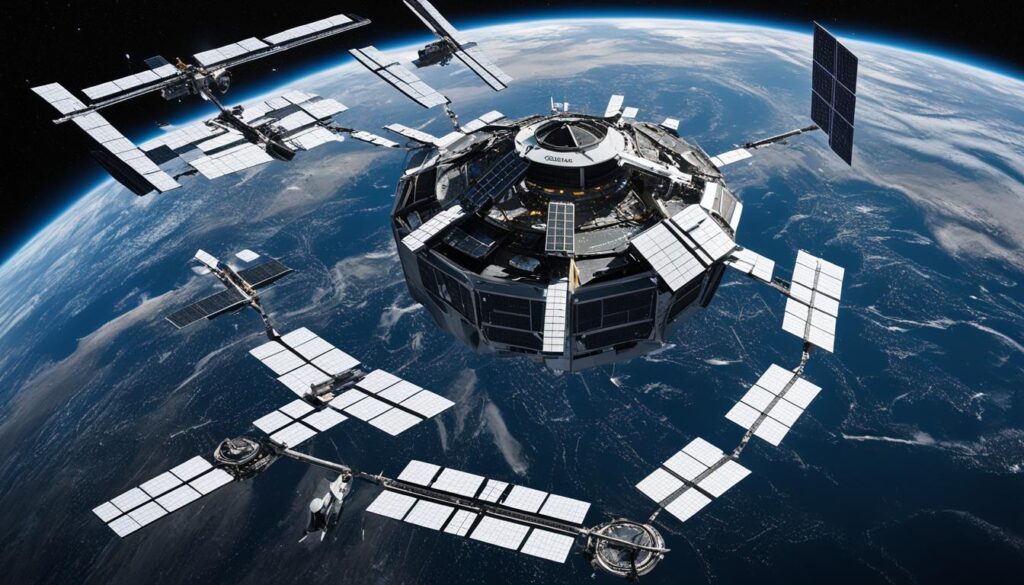
Space agencies and private companies are key to solving the debris crisis. They use their knowledge, data, and resources to find solutions. NASA leads in measuring and reducing debris, while companies bring new technologies to the table. Together, they aim to keep space safe for future generations.
Impact on Space-Based Services and Applications
The growing amount of orbital debris threatens the stability of important space-based services we use every day. These services include weather forecasting, telecommunications, and global navigation systems. They all need a safe space environment to work well.
When debris hits satellites, it can damage or destroy them. This leads to service disruptions that affect us a lot. For instance, the 2009 collision between two satellites created a lot of debris. This debris will stay in orbit for years, threatening other satellites and the space-based applications they support.
Threats to Satellite Operations and Space Infrastructure
In geostationary orbit, protecting satellites from space debris costs about 5–10% of the total mission budget. This can be hundreds of millions of dollars. In low Earth orbits, the costs might be even higher. Also, less than 60% of satellite operators in low-Earth orbit follow debris mitigation rules. Only 20% do in orbits above 650 km.
The Kessler syndrome, where collisions create more debris, is a big worry. It could make some orbits unusable for humans. This shows we need strong space infrastructure protection and debris mitigation strategies.
Implications for Weather Forecasting, Communications, and Navigation
Keeping space clean is key for services like weather forecasting, telecommunications, and global navigation systems. If these services get disrupted, it can affect our daily lives and the economy.
Automation helps avoid collisions in space, like the European Space Agency’s Space Safety Programme. But, we need more efforts to deal with the risks of satellite operations and communication service disruptions.
« The ClearSpace-1 mission, aimed at removing a Vespa upper stage from orbit, is a vital step towards proving debris removal in space and establishing a commercial service for reducing orbital debris. »
Future Challenges and Opportunities
The problem of space debris is getting worse. We need to tackle the challenges and grab the chances to keep space safe. Improving how we collect data and model debris, and making better technology to remove debris, are key steps forward.
Improving Data Collection and Modeling Capabilities
NASA’s Orbital Debris Program Office (ODPO) uses models that don’t have enough data. This puts spacecraft at risk of not being protected enough from debris. The radars used to track debris are getting less time, and some missions failed, leaving us without data on small debris. We need to get better at collecting and modeling debris data.
Developing Advanced Debris Removal Technologies
Studies show that slowing down debris growth in low-Earth orbit can be done by removing most spacecraft within 25 years and taking out five old ones each year. But, NASA hasn’t made much progress on this. We have big chances to improve with active debris removal technology and space cleanup innovations.
| Metric | Current Status | Future Outlook |
|---|---|---|
| Tracked Objects in Orbit | 36,500 objects greater than 10 cm | Continued growth, with over 500,000 pieces of debris the size of marbles and 20,000 pieces bigger than a softball |
| Fragmentation Events | Over 550 confirmed, 9% from collisions, 24% from deliberate breakups | Increased risk of collisions in overpopulated orbits, especially at 550 km altitude |
| Space Traffic Management | Lacking a global system, but efforts underway to enhance collaboration | Crucial need for a comprehensive Space Traffic Management (STM) system |
| Active Debris Removal | Little to no progress on developing technologies | Anticipated market value of $273.5 million by 2030, but hindered by technology and funding scarcity |
By facing these challenges and taking new chances, the space industry can aim for a safer and more sustainable future. This will protect important space services and applications.
Policy and Regulatory Frameworks for Sustainable Space Operations
The space industry is growing fast, with more countries and companies joining in. This means we need strong rules to keep space safe and sustainable. International guidelines help, but making sure everyone follows them is hard.
In 2019, the Committee on the Peaceful Uses of Outer Space (COPUOS) created the Guidelines for the Long-term Sustainability of Outer Space Activities. These guidelines cover important topics like safety, cooperation, and research. They aim to make space operations safer and more sustainable.
But, not many countries follow the rules about cleaning up after space missions. Only 20 to 30 percent do it within 25 years, which is not enough. We need tougher space policy and space regulations to encourage responsible space use.
Groups like the Inter-Agency Space Debris Coordination Committee (IADC) and the International Organization for Standardization (ISO) have made rules to deal with space debris. These rules help everyone in the space industry follow the same safety standards. This makes space safer for everyone.
The commercial space industry is getting bigger, with more small satellites and big constellations. We might need to update our space policy and space regulations to handle these new projects. Working together, governments, space agencies, and companies can make rules that support innovation and protect the environment.
« Sustainable space operations are critical to ensuring the continued benefits of space-based services and the long-term viability of the space environment for future generations. »
By working together on space policy, space regulations, and sustainable space governance, we can make space exploration responsible and sustainable. This way, we protect the space around us for the future.
Public Awareness and Education Initiatives
The 2009 collision between the Iridium-33 and Cosmos 2251 satellites was a wake-up call. It showed us the danger of space debris and the need for more public engagement and space education.
Now, 95% of objects in Earth’s orbit are orbital debris, not working satellites. There are over 22,000 big pieces of space junk and millions of small ones. The space community has made rules to reduce new debris, but finding a full solution is hard.
« There is no system or program in place to remove or clean up near-Earth orbit. The cost of continuous damage to satellites may approach and exceed the cost of cleaning up space in the future. »
Many space agencies and private entities are working on public awareness and education initiatives. Groups like the Zero Debris community, Astroscale, ClearSpace, and the European Space Agency are leading the way. They’re making people aware and pushing for safe space use.
These efforts aim to get people involved and inspire action against space debris. With everyone’s help, we can keep space safe for the future and protect our space-based services and applications.
| Organization | Focus |
|---|---|
| Airbus Defence and Space | Conducts collision avoidance maneuver every 8 minutes due to space debris |
| ASTAREON | Enhances LEO space situational awareness and tracks space objects |
| Astroscale Ltd | Offers scalable solutions for on-orbit servicing and active debris removal |
| FFG (Austria) | Promotes Austrian space research with a focus on addressing space debris |
| Avanti Communications | Emphasizes safeguarding space for future generations through sustainable operations |
| CIRA (Italy) | Develops innovative technologies to reduce space debris and supports the Zero Debris Charter |
| ClearSpace | Contributes to a « Zero Debris Future » by offering responsible satellite end-of-life management |
| DLR (Germany) | Supports the Zero Debris Charter initiative for sustainable and safe space use |
| Dawn Aerospace | Aims to prevent space debris proliferation by enhancing collision avoidance capabilities |
| CS Group (France) | Participates in the Zero Debris charter to align with sustainable and responsible space operations |
Conclusion
Orbital debris is a big threat to space safety and sustainability. As we use space more, we need to keep an eye on and clean up debris. Even though we’ve made some progress, not enough countries are following the rules, and removing debris is still a new field.
To tackle this issue, we need to work together, make strong rules, and improve how we track and remove debris. NASA’s study showed us different ways to remove debris, like using lasers from the ground or space, avoiding collisions just in time, and bringing back big pieces of debris.
Keeping space safe is key for us to keep exploring and using space. By focusing on orbital debris monitoring, making space sustainable, and protecting the space environment, we can keep space open for future generations.